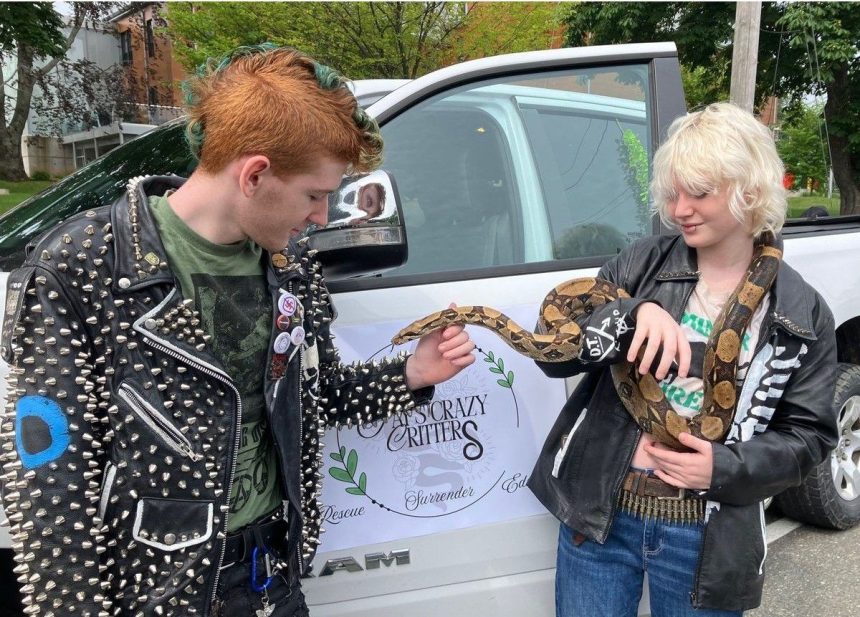
Article contentThe 29-year-old said the more public events they do, the more people find out about Jay’s Crazy Critters. And more surrenders are coming their way. Article contentRight now, there are about 50 animals at the house and over half of them are rescued reptiles and snakes. Article content“People don’t expect that reptiles need to be rescued,” Hardy said. Article contentBasically, it’s essential to keep them in clean enclosures and they need to be fed. Article content“A lot of times, people will get one for their kid and they don’t realize that snakes can live for 25 years. And they grow,” Hardy said. “It’s a lifelong pet.’ Article content“They don’t make a mess. They’re clean animals. They poop once a month and they’re very quiet.” Article content Two volunteers with Jay’s Crazy Critters walked in the Cape Breton Pride Parade recently along with special friend: Aries the boa constrictor. Dalys Tonary of New Waterford, left, and Ashton Gallant found Aries to be a very gentle companion for the walk. Aries lives at a reptile sanctuary near Donkin. Photo by ROSEMARY GODIN /CAPE BRETON POSTArticle content‘WE CAN LEARN FROM THEM’Article contentHardy said most of the surrenders were purchased initially as gifts for children who grew uninterested in them, causing the parents to have to care for them. Article contentOther surrenders come from people who are moving and can’t take their pets with them.Article content“Yes, they are cute. Yes, they are relatively low maintenance. But some of these are forever pets that live a very long life,” Hardy said. “If you’re afraid of that 20-year commitment, maybe a reptile is not the right pet for your household.” Article contentArticle contentHardy is just glad that they can provide a home for them when they can no longer be kept by others. Article contentHardy only lets them go to other homes after they know people have suitable enclosures for them and are responsible pet owners. Article content‘GOOD LIFE, GOOD ENDING’Article contentAnd they have a rule about not giving animals away to be used as Christmas gifts. Hardy won’t rehome before Christmas. Article contentThey aren’t in business to make money. Rather, this vegetarian just wants to make sure that living creatures have a good life and a good ending when it comes naturally. Article content“I always say love the unloved. This goes for all kinds of different critters. Some people are afraid of them; some people think they’re disgusting,” they say. “I think that they’re all beautiful sources of life and we can learn a lot from them.” Article content Nothing like some sunning and looking out at the world going by. Smash the bearded dragon is seen above doing just that on top of his enclosure at Jay’s Crazy Critters reptile sanctuary. Smash’s average life expectancy is 8-12 years. Contrary to popular belief, snakes and reptiles as pets is not a short-term commitment. CONTRIBUTEDArticle contentEDUCATING THE PUBLICArticle contentHardy has a dream of becoming a non-profit rescue some day with a facility where animals can be housed and the public can come and be educated. Article contentJay’s Crazy Critters has a donation jar when they travel to events and all the funds go into feeding the animals. Article contentArticle contentSnakes eat a lot and it can be expensive when you have so many. Hardy buys frozen rats from local pet stores to feed the larger ones. Article contentThey don’t feed anything live to the animals. The lizards eat crickets and meal worms. Article contentThey had two domesticated pet rats in the past. Article content“Rats are brilliant, but only live two years. They’re like little puppy dogs,” Hardy said. Article contentKept clean and healthy, they are no problem hygienically. And well-kept reptiles, Hardy said, are not a hygiene problem either. Article content“There’s not too much you can catch from them; it’s the same as touching a goat or a donkey,” they said.Article contentHowever, handwashing after touching any animal is always good practice.Article contentMINISTERIAL PERMITSArticle contentProvincial regulations under the Wildlife Act say no one is allowed to capture, take, possess, buy, sell or trade any native wildlife species or their eggs from the wild without specific ministerial permits — which are generally restricted to scientific or rehabilitation purposes rather than the pet trade.
‘Love the unloved’: Reptiles, snakes need rescuing too, says Cape Breton resident