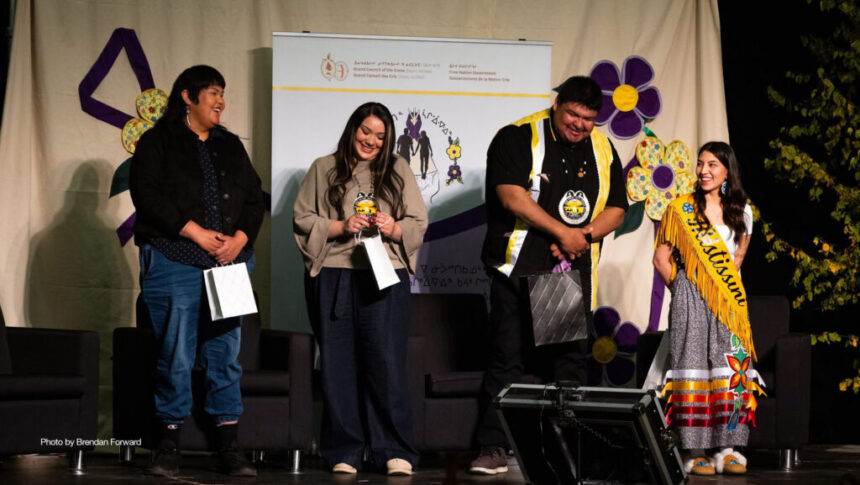
The difficult subject of domestic and sexual violence in Eeyou Istchee was discussed in Mistissini September 14-17 at the Yaayitinh Saachihiiwaawin (Holding Love Safely) Regional Gathering. Described as “a long time coming,” the event allowed over 300 frontline workers, survivors and advocates to have meaningful conversations about the realities in Cree communities. “Every person in Eeyou Istchee has the right to feel safe in their home, in their relationships and in their community,” stated Grand Chief Paul John Murdoch. “Domestic and sexual violence cannot be met with silence, and the responsibility for change cannot rest only with survivors or frontline workers – it requires all of us to stand together.” Organized by the CNG Department of Social and Cultural Development, the gathering’s name and logo was created by Raven Happyjack. The name Yaayitinh Saachihiiwewin represents the initiative’s vision: “a community where love is safe, healing is possible, and respect is the foundation of every relationship.” A 2023 Cree Health Board report documented the troubling scale of sexual violence in the region. The gathering was an opportunity to turn its recommendations into action. Kayla Moore, CNG coordinator of domestic violence awareness initiatives, collaborated with several entities to develop the event. “We’ve been discussing what pathways look like for community members reporting incidents and what safe spaces in communities look like,” said Moore. “Ultimately, we’re looking to gather recommendations about developing a domestic violence resource centre.” Eeyou Eenou Police Force (EEPF) members in the working group emphasized the issue’s prevalence, sharing that incidents of domestic and sexual violence are the highest reported crimes in Eeyou Istchee with numbers that continue to increase. CNG Justice Director Donald Nicholls highlighted his department’s programs on healthy relationships, anger management, domestic violence and substance use. He noted that Cree CAVAC officers can confidentially guide individuals through the court process while providing referrals to post-trauma counselling or other specialists. Featuring guest speakers, discussion panels and testimonials, the event’s presentations were organized according to each day’s theme: children, youth, adults and Elders. Considering the sensitive subject matter, participants were invited to seek support from traditional healers, pastoral care or psycho-social workers. “It takes a lot of courage to even show up to an event like this and share,” asserted Moore. “Despite the heaviness of the conversations, it felt like people are ready to stand together and find solutions. There’s a long road ahead of us but I’m feeling optimistic.” Moore said that Dr. James Makokis’ keynote address was a highlight, discussing gender-based violence as a two-spirit physician from Saddle Lake Cree Nation. Jo-Marie Einish expanded upon this theme the following day, speaking about two-spirit realities in Eeyou Istchee in both the historical and modern context. The health board’s Nishiiyuu department coordinated self-care activities in the evenings and made traditional healing and medicine a central component. Elders provided a calming presence throughout the gathering, sometimes giving warm hugs to speakers who had shared personal stories. Sacred fires, cedar baths and a sweat lodge were available on-site. “We came together so nobody feels alone,” explained traditional healer Harry Snowboy. “It’s encouraging when the leadership isn’t scared to talk about it. It is such a complex issue that needs to be addressed.” Snowboy spoke about the respect for women at the root of ancestral teachings and the colonizing forces that created intergenerational trauma and a more misogynistic society. In Cree communities where “everybody knows everybody,” he said that perpetrators are often protected while survivors face a backlash for speaking out. “There’s a lot of grooming involved before the actual assault happens,” Snowboy said. “Not only the victim but the people around the victim, so people have a tendency not to believe because the persona out there is almost covering his tracks.” On the final day, Snowboy participated in a knowledge transfer panel with Deputy Youth Grand Chief Darius Neacappo-Pelchat. Earlier, Youth Grand Chief Jade Mukash shared her personal journey as a survivor to address toxic masculinity and advocate for youth resources. The gathering’s participants included women’s organizations such as “Les Elles du Nord” and various support resources. Kerrie Coon from local addictions program Kapataakan emphasized the importance of “meeting people where they’re at in their recovery journey” and demonstrated single-use breathalyzers that can test drinks for date-rape drugs. Moore was pleased that high school groups were in attendance and underscored challenges faced by youth, such as digital violence and revenge porn. Kristin Quinn, who holds the title of Miss Mistissini, said that social media plays a significant role in silencing victims. “Somebody could post something about you and everyone can see it,” said Quinn. “Maybe it’s somebody in their family and they will shame the person into silence on social media. It has a big effect on why youth don’t talk about it these days.” As a police technology graduate, Quinn staffed the EEPF booth during the gathering and participated in a youth panel, sharing the story of her own sexual assault. This was her first time speaking so publicly about the incident, which occurred two years ago while at police school in Montreal. “I did it for people who don’t have a voice,” Quinn said. “I found it healing to be with a lot of survivors. You go through this and it’s not talked about. It’s very taboo but it has to be talked about for change to be made.” Quinn found solidarity in a similar experience shared by Isabelle Natawapineskum and was comforted by the compassion of Elders. She believed the event drew attention to the deficiencies in supporting survivors who come forward and would like to see a youth conference that talks about sexual consent and what healthy relationships look like. “I feel there’s a lack of resources,” asserted Quinn. “Sometimes survivors don’t go to the police because they don’t want to talk to a male. The trauma doesn’t stop right after police officers respond to the call. What else are we going to give them? Change begins when we are willing to speak about the things that are often left unspoken.”
Loving Safely Gathering addresses intimate violence issues