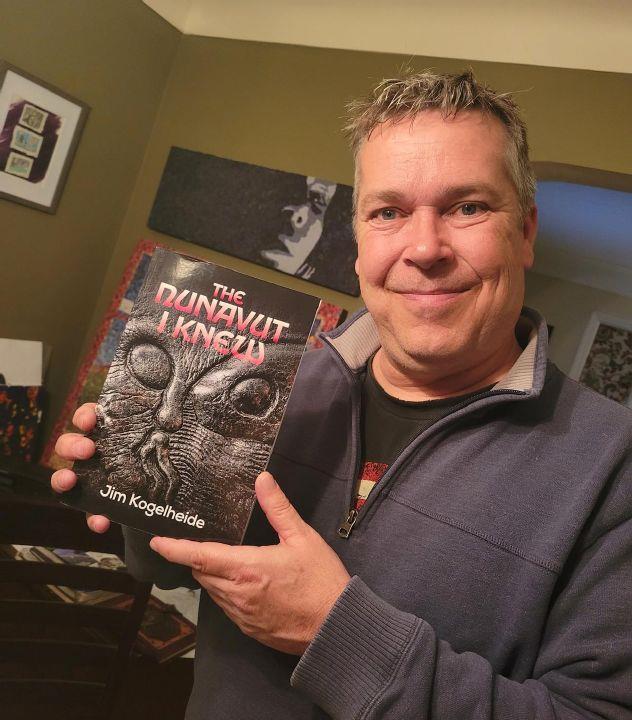
Twenty years after Jim Kogelheide travelled to Rankin Inlet to share his art and environmental message with young people, the experience continues to shape his life and work. The London, Ont., artist has turned his memories of the Kivalliq community into a book, ‘The Nunavut I Knew,’ drawing on the detailed journal and photographs he kept during his 2006 visit. What began as one stop in Kogelheide’s long-running, cross-Canada art project became a life-changing encounter with Rankin Inlet’s young people, artists, land and history. “The entire experience, from beginning to end, for all the days of these art workshops, was just a continuous celebration of life and the students’ energy,” he said. Kogelheide travelled to Rankin Inlet as part of ‘Canada: Glorious to Be,’ an art project he conceived in 1998. His goal is to create 13 original works — one representing each Canadian province and territory — while learning about the country and encouraging people to work together toward a more prosperous future. He and his wife initially spent five years travelling and living in different parts of Canada. Kogelheide created the project’s first work in London before the couple moved to Manitoba, British Columbia and then Nova Scotia. Along the way, schools and community organizations invited him to speak about his work and lead art and poetry projects focused on environmental issues and possible solutions. Northward bound Rankin Inlet presented a different challenge because of the distance and cost involved, he said. Rather than relocating there for a year or more, Kogelheide used his vacation time to visit the community. With assistance from local organizers and the school, he led an after-school environmental art workshop for students at the friendship centre. The sessions combined painting, poetry and discussions about peace, the environment and the future. One of Kogelheide’s fondest memories involved a student asking him to paint a peace symbol on her cheek. Soon, other students were lined up to have their faces painted. When he finished, Kogelheide noticed the room had gone quiet and the girls had disappeared. He eventually heard laughter coming from the washroom. “The door opens up a little crack, and these two eyes shine out at me, and they’re surrounded with blue and green paint,” he recalled. The students emerged meowing and crawling around the classroom. They had used the paint to give themselves whiskers and cat noses. “One of the parents showed up to pick up her daughter, and she came in and saw what was going on,” Kogelheide said. “She’s like, ‘This is crazy. This is so much fun.’” Another lively moment came while the students were composing acrostic poems using the words “peace on Earth.” One student initially announced that she hated poetry, but the mood changed when the class discovered the poems did not have to rhyme. Kogelheide encouraged the students to include animals in their writing. One girl named Chloe produced a line suggesting orangutans must enjoy smelly food because they eat with their feet. “The whole class burst out laughing,” he recalled. Other students immediately began writing their own humorous lines. Kogelheide then guided the class back toward more serious ideas about peace, but he remembers the laughter and creativity as an essential part of the experience. The artwork he created for Nunavut was later donated to Rankin Inlet’s Maani Ulujuk Ilinniarvik. The participating students were about to enter high school, and he wanted the work to remind them of what they had explored together. History revealed His visit to Rankin Inlet also took him beyond the classroom. After an article about his program appeared in Kivalliq News in 2006, a Rankin Inlet artist he knew as “Jack” visited Kogelheide’s temporary gallery at the Siniktarvik Hotel. The meeting led to an all-terrain vehicle trip onto the tundra. Jack showed the visitor an area where Inuit had lived before the present-day community developed and explained how access to shallow water made it easier to obtain water and fish. Kogelheide also visited a hunting cabin, where an Elder was watching for caribou after a herd had recently passed through the area. “For me to be witness to the earliest stages of an Inuit hunt was thrilling,” he said. He was also shown the remains of a traditional dwelling built with thick moss walls, animal bones, hides and a floor dug below ground to create more interior height. Those experiences helped Kogelheide decide his eventual book should do more than chronicle his travels. He wanted it to introduce readers to aspects of Inuit history, land use and life in Rankin Inlet. He told his wife after returning from Rankin Inlet that he would write a book about the experience one day. Fourteen years later, its first three paragraphs came to him as he had originally imagined them. The full process took about five-and-a-half years. The book’s cover features a soapstone carving Kogelheide received through an art exchange with the artist who guided him on the tundra. Released earlier this year, ‘The Nunavut I Knew’ is available through Amazon and IngramSpark. More information about Kogelheide’s art and the book is available at bitsandpeaces.com. His broader ‘Canada: Glorious to Be’ project remains unfinished, with more provinces and territories still to be represented. Kogelheide now hopes the memoir will complete its own journey north to Rankin Inlet and find a place in the community that inspired it. “Being able to use my book not only to talk about my adventures, but to talk about the history and present-day lifestyles of Inuit, is something I hope I did very well,” he said. “I took great honour in using my book for that purpose.”
Rankin Inlet experience inspires artists new memoir