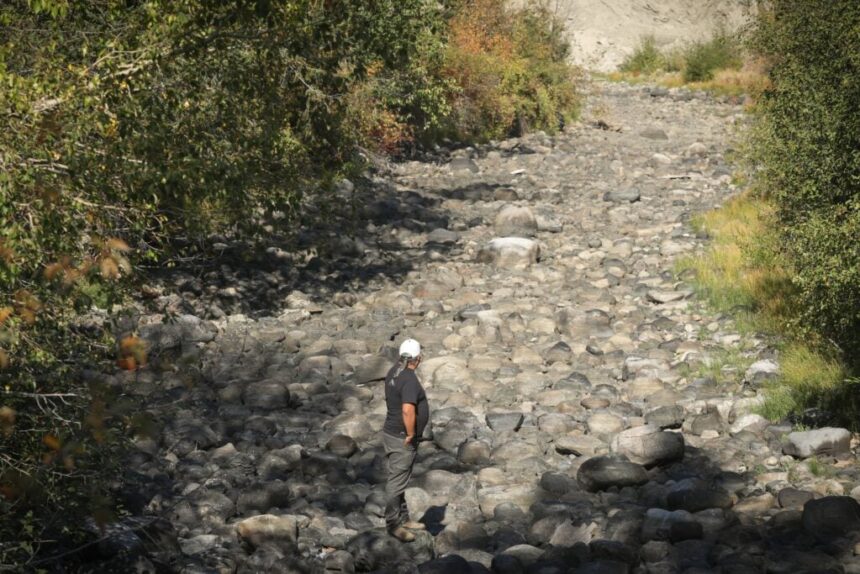
A UNB councillor is raising alarms that drought is leaving portions of the watershed without surface water — threatening fish, ceremony and his family’s connection to the water Brian Holmes, a councillor for the Upper Nicola Band, walks through a dry stretch of the Nicola River on Sept. 18, 2026, a few minutes downstream from his community of spaxmn (Douglas Lake) in the Nicola Valley, in B.C.’s southern interior. Photo by Aaron Hemens On this stretch of the Nicola River, Brian Holmes misses the sound of water. “This is heartbreaking,” he quietly says to himself as he prepares to park above a kilometre-long stretch where no surface water remains. In the absence of the river’s flow, birds can be heard in the thick vegetation, their calls occasionally joined by a horse neighing in the distance or a car passing along Douglas Lake Road above. The 44-year-old Upper Nicola Band (UNB) member and father of two leaves his vehicle and disappears into the bush separating the river from a small ranch below the road, a few minutes downstream from his community of spaxmn (Douglas Lake) in the Nicola Valley, in “B.C.’s” southern interior. He re-emerges from the bush and makes his way down a steep slope into the exposed riverbed, where large boulders rise from a channel that should be running with water on this warm mid-September morning. The Nicola River winds roughly 210 kilometres through syilx and Nlakaʼpamux homelands. It flows from its headwaters on the Thompson-Okanagan Plateau, down through Douglas and Nicola lakes before passing through Merritt, and eventually joining the Thompson River northeast of Lytton at Spences Bridge. But along this one-kilometre dry stretch between Douglas and Nicola Lakes, just around the corner from the community’s drinking water, the waterway resembles more of a meandering valley of rocks. “I’ve been looking at it enough that it’s numb to me now. This didn’t happen yesterday. It’s been like this for the last month,” said Holmes. He said that it’s tough to see dried-up sections of the river, especially “when you know there should be water.” “It’s supposed to be the major river system in this watershed, but it doesn’t have any water flowing through it over the surface,” Holmes said. “We’ve seen a little bit of a flow coming out of Douglas Lake, but it’s going to get sucked in by the groundwater now. There is a little trickle, but then it just disappears partway down. Any water that pops up anywhere is all groundwater.” Just upstream, on a bend in the river, there’s a deep hole in the waterway that Holmes and his friends used as a makeshift natural swimming pool every summer when they were children. Brian Holmes, a councillor for the Upper Nicola Band, stands near a deep hole in the Nicola River that he and his friends swam in as children, in his community of spaxmn (Douglas Lake) on Sept. 18, 2026. Photo by Aaron Hemens “I don’t know if you would swim in it now,” he said, citing health concerns from a buildup of harmful algae blooms in the water. “I’m hoping by the time (my sons) get to my age, they can enjoy it. If we’re in these (drought) cycles — hopefully we can survive long enough.” He walks across the dry riverbed, using the boulders as stepping stones, then stops for a moment and looks downstream to where water should be flowing. Brian Holmes, a councillor for the Upper Nicola Band, walks through a dry stretch of the Nicola River on Sept. 18, 2026, a few minutes downstream from his community of spaxmn (Douglas Lake) in the Nicola Valley, in B.C.’s southern interior. Photo by Aaron Hemens “It’s like another world, man. It’s — I don’t know. It just makes me think about missing that sound of water flowing,” Holmes said. “When you walk down a stream, and there’s no water, it’s like losing a relative, losing a part of you. It’s just hard to explain.” A few dozen kilometres up the river from this spot, where the stream converges with Chapperon Creek before flowing into Douglas Lake, IndigiNews observed smaller dry patches along the waterway’s surface as well. A dry patch of the Nicola River, at its confluence with Chapperon Creek northeast of Douglas Lake, on Sept. 18, 2026. Photo by Aaron Hemens The watershed entered the growing season with little room to spare. In March, “B.C.’s” River Forecast Centre forecast seasonal inflows to the Nicola River and Nicola Lake at just 40 to 60 per cent of normal, citing low snowpack, dry weather and already-low flows. By mid-June, the Nicola basin was a Level 4 on the province’s drought scale, the second-highest rating. It remained at that level in mid-July and had reached Level 5, the highest rating, by early August. It dropped to a Level 2 as of October, but the concern now extends into another winter. In its fall seasonal outlook, the BC Wildfire Service warned that an intensifying El Niño could bring warm, dry conditions and reduced snowpack to the Interior, limiting the prospect of drought recovery before next summer. Holmes described a year in which insufficient snow and precipitation, combined with warm temperatures, left less cold water flowing from the highlands into the watershed’s rivers and creeks. As flows diminished, some waterways dried up. Elsewhere, he said, nutrients and sediment accumulated in the remaining water, with algae spreading across rivers, creeks and lakes. An algae bloom on spaxmn (Douglas Lake) in Upper Nicola Band territory on Sept. 18, 2026. Photo by Aaron Hemens “It’s pretty tough,” Holmes said of the conditions. “Usually, I go out on (Douglas Lake) and get the calm. But now, when I go on the lake, I see the algae, I see the low flow. It just makes it worse. It makes me wonder, ‘What are we doing?’” For much of September, Holmes, who has served on his community’s council for over a decade, has been “taking some action” by documenting the watershed’s ailing health and posting videos to his YouTube page. “I can not sit here and watch it happen, and have my kids not being able to enjoy what we had, what we did when we were kids.” Bringing awareness to the issue through his videos “is the hope,” he said. Brian Holmes, a councillor for the Upper Nicola Band, stands near an algae bloom on spaxmn (Douglas Lake) in Upper Nicola Band territory on Sept. 18, 2026. Photo by Aaron Hemens “The more people that are aware of the situation, the more they can express concern and advocate for more work to be done about it. Or, step in and help,” he said. “If the land isn’t healing and healthy, then our people aren’t healing and healthy.” Alongside those effects on the community, Holmes worries about what continued drought and poor water quality could mean for native fish populations, now and in the years ahead. “We could lose this ecosystem for a whole generation (of fish) — that’s the concern with the kokanee,” he said. “If we don’t do something, they’ll be like the salmon: they won’t be here anymore.” Spawning adult Kokanee in Quilchena Creek on Sept. 18, 2026, near where the creek flows into Nicola Lake. Photo by Aaron Hemens These cumulative impacts, he said, warrant treating the watershed crisis as an emergency. “If this continues into the winter and into next year, it’s going to be even worse than what we experienced this year,” he said. “If we don’t think this is an emergency, wait until next year. Everything [in the water] is going to be dead. The fish in the lake will be dead. That’s my worry.” A dead adult Kokanee near Quilchena Creek by Nicola Lake on Sept. 18, 2026. Photo by Aaron Hemens ‘In my lifetime, I haven’t seen water this low’ Snowmelt and precipitation help replenish the watershed’s rivers and creeks, while dams on lakes such as Chapperon regulate the release of stored water. But the region didn’t get the snow or precipitation levels that they “really needed” at the beginning of the year, Holmes said. He said warm temperatures also brought an earlier spring freshet, the seasonal rise in streamflow as snow melts. Clearcut logging in the highlands has affected the land’s ability to retain water, he added. “It’s melting earlier. But this year, we didn’t even really have a freshet. Flows came up, but nothing of concern. You could barely tell that they came up.” Surface waters dried up “pretty quick” by June, he said. “In my lifetime, I haven’t seen water this low.” A dry stretch of the Nicola River on Sept. 18, 2026, a few minutes downstream from the Upper Nicola Band community of spaxmn (Douglas Lake). Photo by Aaron Hemens Both UNB communities, spaxmn and n̓łq̓iłəml̓x (Quilchena), get their drinking water from wells supplied by groundwater reserves rather than creeks or other surface waters. Holmes worries that if drought and water scarcity continue into the following year, the lack of surface water flowing through the watershed could begin to affect groundwater availability. “Because the surface water is no longer there, it starts dewatering the groundwater — there’s less groundwater to take from, because the surface water isn’t replenishing,” he said. “It’s just a domino effect. If we don’t get more precipitation, more snow, to fill these, it’s going to start impacting our groundwater, which is very important as well.” Brian Holmes, a councillor for the Upper Nicola Band, looks towards algae and low-water-flows on the Nicola River in his community of spaxmn (Douglas Lake) on Sept. 18, 2026. Photo by Aaron Hemens A notice in Upper Nicola Band’s Sept. 2 newsletter said a water restriction for Douglas Lake residents was lifted on Aug. 25, though it continues to urge conservation. He raised a question about the community’s future. “If there isn’t water here, how much longer can we live here?” he asked. “That’s part of why our community is out here, because of water.” ‘Now, my kids can’t even go in here’ Holmes said low flows and warm temperatures, combined with nutrients from cattle manure and runoff from wildfire-affected land, have contributed to algal blooms across the watershed’s lakes, rivers and creeks — from Nicola River to Douglas Lake. An algae bloom on spaxmn (Douglas Lake) in Upper Nicola Band territory on Sept. 18, 2026. Photo by Aaron Hemens “There’s no flush of the water through the system,” he said. “You actually go into these streams, and there’s so much algae on the rocks and slime on the rocks in the stream, because it’s not flowing enough and the temperatures are too high.” Warm, slow-moving water and excess nutrients can encourage the growth of cyanobacteria, commonly called blue-green algae. Some produce toxins harmful to people and animals, according to Health Canada. At Nicola Lake, BC Parks advises visitors to avoid contact with suspected blue-green algae and discourages swimming near blooms. “We’ve had people that got splashed by some algae water and started rashing up from it,” he said. Water-quality concerns have also changed how community members practice ceremony. “Now, when we do ceremony, we don’t go in the water anymore – part of the ceremony is going in the water. But because of the quality and the issues that we’re seeing, it’s unsafe to put individuals in there.” Holmes said community members have been advised against eating kokanee harvested from the watershed because of the blooms, “because you just don’t know how much has accumulated in them.” “It’s questionable to eat the fish out of here.” Algae and low-water-flows on Quilchena Creek on Sept. 18, 2026, where the waterway flows into Nicola Lake. Photo by Aaron Hemens Recreational swimming and fishing “is just no longer,” he said. “I remember, as a kid coming up in these areas, and it was fine to swim in this in the summertime. There was no concern. Now, my kids can’t even go in here and swim in it.” A generation of kokanee at risk On Sept. 18, adult kokanee were spawning in the shallow flows of Quilchena Creek, a tributary of Nicola Lake. Among the fish, IndigiNews observed a dead adult that Holmes said appeared to have died before spawning. “When it’s super warm, it’s really tough for them to come up through here. It’s a lot of energy being exerted to get through,” he said. A dead adult Kokanee in Quilchena Creek on Sept. 18, 2026, where the creek flows into Nicola Lake. Photo by Aaron Hemens Kokanee are a freshwater form of sockeye salmon. While ocean-going sockeye migrate to sea before returning to freshwater to spawn, kokanee remain in freshwater throughout their lives. In this system, Holmes described kokanee living in Nicola Lake before moving into rivers, creeks and other tributaries to spawn. Adults die after spawning, leaving their eggs to develop in the gravel. “Their babies will go out in the springtime and then come back, two to three years from now. But if the water stops flowing in this creek, then that whole genetic generation of that fish is gone,” said Holmes. “If that keeps happening over the next couple of years, we will eventually lose all the kokanee in this lake — at least the ones that spawn in this system.” Brian Holmes, a councillor for the Upper Nicola Band, walks by a dead adult Kokanee in Quilchena Creek on Sept. 18, 2026, where the creek flows into Nicola Lake, downstream from his community of spaxmn (Douglas Lake). Photo by Aaron Hemens For ocean-going salmon returning to the upper watershed, the route passes through the outlet of Nicola Lake, where the Nicola Dam stands. The original structure was built in 1927 and replaced in 1985-86, according to provincial records. Holmes links the disappearance of those salmon from the upper watershed to the dam and changes in water flow. “The water stopped flowing. The government said the salmon will figure stuff out; the experts were saying they’ll figure stuff out, so no real action was taken. Here we are, 40 to 60 years later, there’s no salmon in this upper part of the watershed,” he said. “It’s a similar conversation with the kokanee, that they’ll figure things out. I’m not wanting to take that risk.” Beyond the spawning grounds, Holmes has been watching for other wildlife along creeks and rivers with little or no surface water. He said the shortage of cold-water flows has consequences throughout the watershed. “If there’s no water here, then these animals are no longer here, including bears, deer and moose. All the ungulates that rely on it,” he said. “Even the mice, the snakes. It’s a huge cumulative impact, when you really sit down and think about what needs access to water.” Brian Holmes, a councillor for the Upper Nicola Band, walks along a low-flowing Quilchena Creek on Sept. 18, 2026, where the waterway flows into Nicola Lake, downstream from his community of spaxmn (Douglas Lake). Photo by Aaron Hemens ‘We just can’t keep making it worse’ Holmes hopes a proposed fish hatchery at spaxmn could open in 2027. Eggs collected from breeding fish would be incubated and young fish raised at the site before being released into the watershed. “The genetics from the natural, native fish — you can grow them in a hatchery, because they obviously can’t — they’re not going to survive in these rocks,” he said. Through the Nicola Watershed Governance Partnership, Holmes said there have also been discussions about increasing water storage to address low flows and water scarcity during drought. The partnership brings together the provincial government and five First Nations governments: Coldwater, Lower Nicola, Nooaitch, Shackan and Upper Nicola. “We’re actually talking about putting a dam here on Douglas Lake. That will hold back water,” he said. spaxmn (Douglas Lake) in Upper Nicola Band territory on Sept. 18, 2026. Photo by Aaron Hemens The proposals also include upgrading the existing dam on Chapperon Lake and building one on Pennask Lake to increase storage in the headwaters. The aim is to retain water during wetter periods for release when downstream flows fall. “I’m not saying it’s going to cure it all. But it’ll help alleviate it, and hopefully get us through this cycle,” he said. “We’ve done a study through the Nicola Watershed Partnership to identify those sites. Now we just need to go source funding to implement it.” The partnership’s 2024 call for a storage investigation sought an inventory of existing reservoirs and potential new sites in the Nicola watershed above Merritt, excluding Nicola Lake and its dam, and in the Coldwater watershed. Researchers were asked to assess storage capacity, environmental impacts and downstream effects, then recommend sites for further feasibility studies. The province has acknowledged difficulties turning earlier research into action. In its June 2025 order establishing a water sustainability planning area for the Nicola watershed, it cited costs, coordination difficulties and limited capacity while responding to seasonal emergencies as reasons recommendations had not been fully implemented. Work on the water sustainability plan remains underway, according to “B.C.’s” 2025–26 progress report. To address algal blooms, Holmes called for greater efforts to limit cattle access to rivers and streams, protecting waterways from manure and other contaminants. He also wants changes to logging practices to help retain water at higher elevations for longer. A separate forest-planning process is underway in the region. From May to July, the Ministry of Forests sought public input on the tmíxʷ naqscn Forest Landscape Plan, which First Nations and the province are developing for an area that includes the Merritt Timber Supply Area. Water, watershed health and climate adaptation are among its priorities. The process remains in its second of five phases, identifying and assessing the values that will guide future forest management. “The water’s sick. We need to give it time to heal. So stay away from it, stay out of it. It’ll do its thing. We just can’t keep making it worse,” he said. “We have to be conscious of our own use and our own contamination to it.” Brian Holmes, a councillor for the Upper Nicola Band, walks near spaxmn (Douglas Lake) in his community on Sept. 18, 2026. Photo by Aaron Hemens Recovery could take longer than one winter. In a Sept. 21 bulletin, the province warned that precipitation may first replenish depleted soils and groundwater before reaching rivers, lakes and reservoirs. Restoring water levels could take several years. While plans and efforts are being made to help the water, Holmes said, “it’s tough to sit here and experience this.” His sons already send him photographs of the dry riverbed on their way to school. “I wonder for our children, ‘Is this going to be what they’re going to live with?’ When my kid is my age, he won’t have any kokanee here. And what is he going to eat? Rocks? It’s crazy, right?”
As parts of the Nicola River run dry, a father fears what his children will inherit