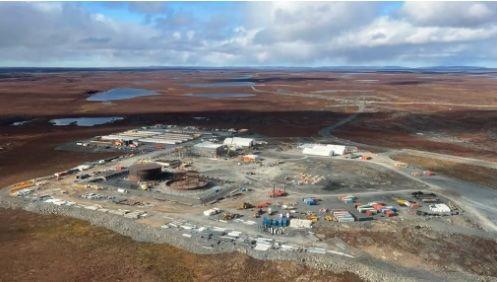
Published 1:21 pm Friday, October 30, 2026 By William Koblensky Varela Local Journalism Initaitive Northern News Service The Goose gold mine, 400 km south of Cambridge Bay, will not follow the rest of Nunavut in turning clocks back by one hour, but will instead follow Mountain Daylight Time (UTC-6) in the Northwest Territories and Alberta. B2Gold’s mine and its Allen Kapolak Marine Laydown Area on the western shore of Bathurst Inlet won’t change the time to remain in alignment with commercial partners, explained Cherry DeGeer, director of corporate communications for B2Gold. “This will provide operational consistency and support coordination with key transportation centres, suppliers and supply chain distribution points,” DeGeer said. Conversely, Agnico Eagle’s Hope Bay mine, 160 km south of Cambridge Bay, will continue to follow Kitikmeot time, changing its clocks to the Mountain Standard Time zone (UTC-7) on Nov. 1. Kitikmeot MLAs have peppered Government of Nunavut ministers with questions in the legislative assembly about ending Daylight Saving Time since neighbouring Northwest Territories decided to scrap the practice. The GN has consistently said it wants to study the issue further, as scrapping Daylight Saving Time in one region or all of Nunavut would put the territory out of alignment with other parts of the country. When the NWT stays on Mountain Daylight Time for the first time this November, the Kitikmeot region next door will be one hour ahead for the first time since 2001. Oddly, the Kitikmeot region will share the same time zone as Yukon and British Columbia during the winter. Cambridge Bay MLA Fred Pedersen was the first to publicly speak about the Goose mine not changing its clocks during question period in the legislative assembly on Oct. 29. “Just this morning, I was made aware that a mining operation in my region will not be following the seasonal time change at their operation,” he said. “They will remain in the same time zone as both the Northwest Territories and Alberta. Will other similar operators or communities follow? Time will tell as we approach Nov. 1.” Justice Minister George Hickes, who is responsible for time changes in Nunavut, said he still has concerns about ending the time change. Hickes said he empathizes with the Kitikmeot region being out of step with the Northwest Territories, but consultation with hamlets, airlines and internet providers still needs to take place. “I understand a private entity in a remote part of the of the territory could unilaterally decide, as a business model, that they’re not going to be changing the clocks,” the minister said. “However, from a government operational standpoint, and within our communities, even within the private sector, to be able to have that flexibility of just one-offs, I think, would just totally complicate so many different aspects of program delivery and scheduling.” Nunavut has three time zones, each one hour apart. The Qikiqtaaluk region is in the Eastern Time Zone, except for Resolute Bay, which is in the Central Time Zone. The Kivalliq region is in the Central Time Zone, except for Coral Harbour, which is permanently in the Eastern Daylight Time (UTC-5). Coral Harbour is the only community in Nunavut that doesn’t change its clocks. The Kitikmeot region is in the Mountain Time Zone.
Goose gold mine wont change time on Nov. 1