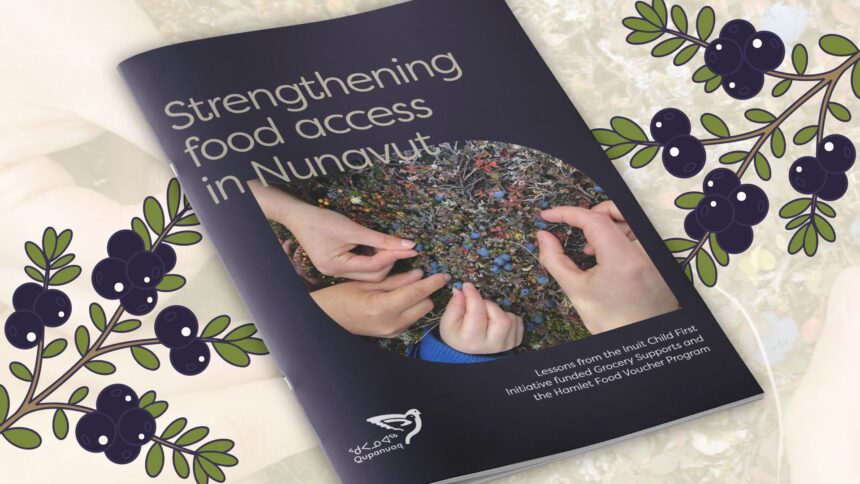
A new report on access to food in Nunavut says the territory continues to be in a “food security crisis” and children are most affected. “Existing survey data show that 7 in 10 Inuit children in the territory live in households that make sacrifices — skipping meals, eating less, and/or eating lower-quality food to make ends meet,” the report said. The 146-page report was written by more than two dozen researchers looking into grocery supports and the Hamlet Food Voucher Program for Nunavut Inuit. Researcher Vandna Sinha told APTN News that she hopes the new report will be the last word on the subject. “We brought together a really great team of researchers from across disciplines and across universities so that we could look at food insecurity, and the effect of these initiatives on food insecurity, in a really comprehensive way and put something out that would hopefully eliminate the need for people to say we need more research,” said Sinha, an associate research professor at the University of Colorado Boulder’s Faculty of Education. The report, Strengthening Food Access in Nunavut: Lessons from the Inuit Child First Initiative funded Grocery Supports and the Hamlet Food Voucher Program, is the product of work by four researchers from Qupanuaq, which advocates for Nunavut children and youth in partnership with 22 researchers from six universities along with the Institute for Circumpolar Research and BetterCart Analytics. Sinha, who began research on Jordan’s Principle while working at McGill University in Montreal, said Qupanuaq contacted her to discuss potential research about food supports in Nunavut. She said the research team and the number of local advisors has expanded over the years. Rankin Inlet, Nunavut. Photo: APTN Beginning with five pages of quotes from Nunavummiut about the strain and challenge of struggling to get enough food — and sacrifices that parents make to give their children better access to food — the report is unequivocal in its findings. “Food insecurity surveys usually ask about events during the year,” the report noted, “but families in Nunavut faced much more consistent challenges: 8 out of 10 families we interviewed faced daily, weekly or monthly struggles to make ends meet.” New report about an old problem Hunger, food access, food security and food sovereignty are all longstanding concerns in Nunavut, the report noted. In 2019, the federal government launched the Inuit Child First Initiative (ICFI) — an Inuit parallel to the Jordan’s Principle program designed to provide First Nations children with equal access to health, social and educational services. Initially, the ICFI offered “Grocery Supports” to individual Inuit families who requested them. By 2023, the report notes, individual-family requests for Grocery Supports were overwhelming bureaucrats and creating a large backlog, which led Nunavut hamlets to apply for funding for food-voucher programs that would feed all Inuit children and youth in the communities. This was known generally as the Hamlet Food Voucher program (HFV). Baker Lake, Nunavut. Photo: APTN “By the end of 2024, these programs reached Inuit children in 24 of 25 communities, for an estimated annual cost of just under $100 million,” the report said. “They operated without complex or time-consuming application processes and allowed families to use the funds in ways that complemented their other budget-stretching strategies.” The consequence was immediate; the report found the HFV seems to have reduced physical and psychological harms “by reducing hunger, increasing nutrition, improving physical health, improving quality of life and giving both families and communities greater resources to devote to needs that extended beyond nutrition.” In March 2025, Indigenous Services Canada ended the program, forcing families to make requests for Grocery Supports once again. However, the report notes, “After that, very few requests for individual Grocery Supports have been approved. The treatment of ICFI-funded Grocery Supports requests does not appear to meet the legal standards for responding to urgent cases that have been established for services to First Nations children through Jordan’s Principle, the southern parallel to ICFI.” The number of people seeking daily meals from Iqaluit soup kitchen Qajuqturvik Community Food Centre saw a steady decline after HFV — which reversed when the program ended. Likewise, since March 2025, Inuit children aged two to five have been found to have lower hemoglobin levels and are likelier to have anemia than during the period when HFV was operating. Resilience isn’t enough to beat hunger The research behind this report, Sinha noted, predated the emergence of the HFV program, but provides solid proof of arguments about the programs many advocates have made for years. “We’ve been working on it for a couple of years, and this is the culmination of all those different kinds of research,” she said. “We already know what we need to know. We know that hunger has been a long-term problem. We know that it’s a structural problem. “There’s no way that Inuit in Nunavut can learn their way out of food insecurity. There’s no way they can love their way out of food insecurity. There’s no way that they can just hunker down and be strong and get through the problem, because it’s a structural problem. It needs structural solutions.” Pangnirtung, Nunavut. Photo: APTN The report, Sinha said, explains in detail the ways in which the HFV program worked. “It was pretty efficient. It reached a large number of people really quickly for a cost that, in policy terms, is pretty reasonable,” she said. “It looks like it improved nutrition, improved physical health outcomes, decreased hunger, improved quality of life.” By contrast, Sinha pointed out the consequences of inadequate nourishment are also well documented, and are likewise understood by most people on an individual level. “I’m not my best self when I’m hungry. Children don’t learn well when they’re hungry. Parents don’t do their best parenting when they’re hungry. It has severe consequences in terms of health.” Further, she noted, research has begun to track sprawling mental-health impacts of food insecurity over the long term, which she said were tied to depression, anxiety, impulsivity and suicide. These factors can weigh upon quality of life, Sinha said, since it’s hard for any person to realize their full potential and thrive when the primary focus of their energy is on meeting basic needs. This is true for individual people, she said, but it also extends to the collective impact on society. “When we talk to people, what’s really, really obvious is the love, the strength, the sharing that they do, the resourcefulness,” she said. “But all of those strengths and resources are being tied up in these basic needs, and that means that people individually and collectively aren’t being allowed to think about more, to dream about more, to invest in more. That’s not equitable. It’s not just.” New funding Sinha said she and many of her fellow researchers saw little encouragement in the federal government’s budget that promises to allocate $575 million to the Inuit Child First initiative over five years. Ottawa has negotiated that program — called Pirutsiagutiit — with Inuit Tapiriit Kanatami as well as four Inuit treaty organizations and plans to launch it on April 1, 2027. At that point, ITK and Inuit organizations will take over administering the program. Chesterfield Inlet, Nunavut. Photo: APTN “The funding for that in the new budget is not nearly enough to cover the Hamlet Food Voucher program alone,” Sinha explained, “and because that’s supposed to be the way of addressing children’s complex needs, if it all gets sucked up dealing with the basic need around food, then the other needs that families have that are acute and so important don’t get addressed.” She said the budget would maintain the status quo following the $100 million cut to funding for food for Inuit children. “It’s ongoing about what the terms of the new funding would look like, but we are hopeful that they’ll give more [than they have announced at present],” Sinha explained. “The funding level has not increased in any measurable way.” The consequence, she argued, is that Inuit children get limited access to respite care, occupational therapy and other services available to First Nations children in the south through Jordan’s Principle. “I hope that the federal government and the [territorial] government would work with Inuit leadership to find a way to make sure that families in Nunavut are getting equitable support. And that sounds pretty basic, I think because it is, but that’s certainly not happening.” The cost of living was already high in the North, she said, but it has increased dramatically as prices have risen everywhere else. As a result, she argued, Inuit children cannot access the same support available to Indigenous families who don’t live in Nunavut. “We know what’s needed,” she said. “We need a locally-based system of preventative and supportive programs so that people get their needs met without having to go into the child welfare system, and every major review that you will look at in any jurisdiction has said that over a couple of decades.” Funding issues extend to the federal Nutrition North food-security subsidy, whose amounts also increased under the new budget. “It’s a fraction of what would be needed to solve the price differential in Nunavut,” she said. “As with the ICFI funding, what they’ve allocated for the entire North is a fraction of what we would need in Nunavut.” Read more: With no end to hunger crisis in Nunavut, community orgs work hard to keep residents fed First bowhead whale harvest since 2022 brings Iqaluit abundant meat Cost of living adjustment Sinha said that the Qupanuaq organization, the lead partner on this research project, is calling for a cost-of-living adjustment under the Canada Child Benefit. “Based on our comparison of different options, based on existing research,” Sinha said, “we think that’s the most efficient way to move forward.” She argued such an adjustment would essentially double the Canada Child Benefit, with which the lowest-income families would experience roughly the same level of support they got from the Hamlet Food Voucher program. For Sinha and her colleagues, there are two discussions about relieving hunger in Nunavut that need to happen simultaneously: one is a long-term plan to bring about food sovereignty in the territory in order to address deep structural issues driving hunger. The other discussion is about how to feed hungry people right away. “We’re talking about immediate increases in food access, because people shouldn’t go hungry while they’re working towards those long-term solutions,” she said. “A cost-of-living adjustment to the Canada Child Benefit would be a fairly large policy shift. “The U.S. already adjusts food benefits, for instance, for cost-of-living. So it’s not unprecedented if the U.S. is doing it. In the scope of how policy works, it seems like it’s a pretty straightforward way to go.” Sinha said the team that carried out the study has worked in close partnership with Nunavut Tunngavik Inc. in order to ensure research findings would be shared with the federal government. “We continue to do this and hope that the research findings will be able to inform policy discussion moving forward.” Jesse StaniforthOnline Journalist | MontrealJesse joined APTN as a producer after 16 years as a print and web journalist. During seven of those years, he covered the Cree Nation of Eeyou Istchee for community newsmagazine The Nation. Jesse’s writing on Indigenous issues has also appeared in Canadian Geographic, the Toronto Star, the Rover, The Eastern Door, Metro, and the Huffington Post. Tags: Food Security, Food sovereignty, grocery supports, Hamlet Food Voucher Program, Hunger crisis, Inuit Child First Initiative, Nunavut, Nunavut hunger, Pirutsiagutiit, Qupanuaq, Vandna Sinha Continue Reading
70% of Inuit children live in households that skip meals, eat less to make ends meet: report



Leave a Comment