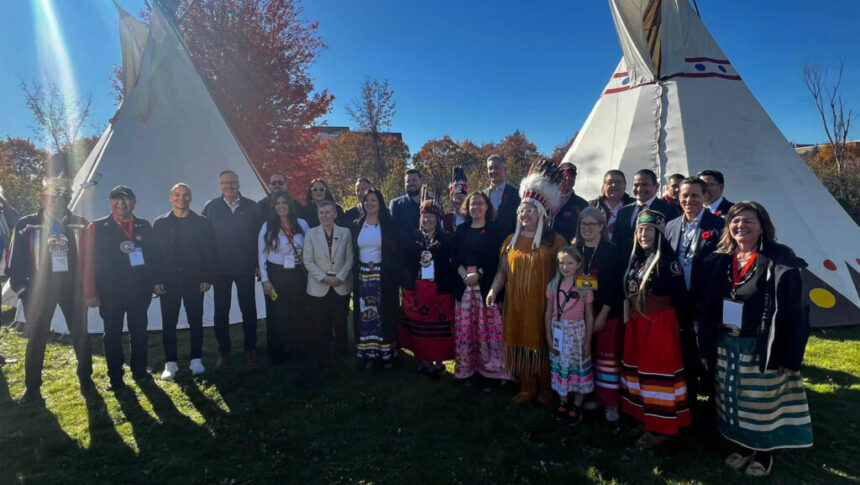
The first meeting between 200 First Nations leaders, Canada’s prime minister and most provincial premiers in over two decades delivered promising announcements in Ottawa October 26, but received mixed reviews. Aiming to chart “a new path forward,” Assembly of First Nations National Chief Cindy Woodhouse Nepinak took aim at Prime Minister Mark Carney’s major projects legislation. “The national interests must also include the proposals, law and policy reforms that First Nations seek,” she said. Carney said threats to Canada’s sovereignty – and the wealth generated by nation-building projects – justify new laws that give the government power to sideline consultation and environmental requirements. Woodhouse Nepinak countered that nation-building “can’t just be about ramming through major projects” as quickly as possible. Before the meeting, the AFN hosted a ceremony attended by several premiers or their ministers. Many had expressed skepticism about Bill C-39, which mandates a one-year decision-making timeline for so-called major projects and exempts some from environmental laws. Outside the meeting, protesters denounced what they called limited access and inadequate representation. Ramon Kataquapit from the Chiefs of Ontario’s Youth Council argued there was “economic coercion” happening behind closed doors. Onion Lake Cree Nation had previously issued a cease-and-desist notice for the AFN to speak on its behalf. Welcoming guests with a reminder that Ottawa sits on unceded Algonquin territory, Algonquin Grand Chief Verna Polson asserted that her Nation was “still waiting for justice.” Reflecting that the Algonquin have always shared the land, she said “we are ready to work with you” but “expect respect in return.” Speaking on behalf of Treaties 6 to 8 and the Blackfoot Confederacy, Chief Sheldon Sunshine of Sturgeon Lake Cree Nation said this meeting must be about changing the relationship with Ottawa. Considering its potential to be historic, he said, “history will judge us by what we change.” Nishnawbe Aski Nation Grand Chief Alvin Fiddler described pressure to open his people’s territories in Ontario’s Ring of Fire to resource development –while they struggle with a water crisis, climate change impacts, addictions and suicide. If treaties were honoured, he said, prosperity would follow. “How can you expect a community like Marten Falls to effectively negotiate a meaningful agreement while trying to access clean water for themselves?” asked Fiddler. “They have been on the boil-water advisory list since 2004. The same as my community.” Manitoba Premier Wab Kinew surprised reporters by holding up his status card and declaring, “I think it’s time to abolish the Indian Act.” While some appreciated this initiative, which Carney promised to explore, others felt Kinew’s headline-grabbing statement was a distraction from the pressing issues on the agenda. “I think he hijacked the first ministers’ meeting because he didn’t want to address the substantive issues raised by the First Nations,” said former Cree Nation Grand Chief Matthew Coon Come. “Now if you look at the media, they’re just talking about the Indian Act.” Coon Come explained that the Cree Nation removed itself from the Indian Act through the constitutional framework of 1984’s Cree-Naskapi Act, with only the former’s tax exemption provisions and requirement to submit an annual audited financial statement continuing to apply. As AFN national chief from 2000 to 2003, Coon Come advocated replacing the Indian Act with Indigenous forms of governance, but was opposed by many First Nations. With established rights and essential service funding entangled in the Act, Coon Come said that transitioning would create uncertainty regarding governance structures and responsibilities. Invited to serve as a consultant for Alberta’s Treaty 6 and 7 First Nations, Coon Come drafted Chief Vernon Watchmaker’s speech. It called for revisiting the 1930 Natural Resources Transfer Acts that handed jurisdiction of crown lands and resources to the Prairie provinces. “The Treaty Nations didn’t receive any benefits from the extraction of natural resources from their lands,” Coon Come explained. “I was using Cree experience to find ways to correct historical injustices, restore treaty promises, to reclaim authority over lands and resources. The answer’s very simple: resource revenue sharing.” He believed the proposed terms of reference provide a starting point for exploratory discussions. Carney’s focus on accelerated project approvals has concerned First Nations across the country, including the Cree Nation. “The governments will always attempt to chip away at our rights,” said Coon Come. “For the Crees, the key question would be whether faster federal approvals will adequately protect the JBNQA, Cree rights, meaningful participation and established environmental review processes.” Carney expressed openness to new revenue-sharing mechanisms, including a potential First Nations Sovereign Wealth Fund. Expanding lending authority would better enable financing for First Nations projects. The feds announced $260 million would be spent over four years on Indigenous job opportunities created by major projects. Carney also announced over $2.5 billion over five years for emergency preparedness and wildfire response in First Nations communities, and more than $630 million over four years for First Nations and Inuit policing. An additional $140 million over four years will fund crime prevention and “culturally sensitive community safety initiatives”. With only three minutes for selected Chiefs to raise issues, some questioned the possibility for meaningful discussion. When Carney left for a state dinner, Chief Kelsey Jacko of Cold Lake First Nations felt snubbed that he wasn’t able to share his speech after arriving directly from two funerals at home. “Do you know some of our families still dig the graves by hand?” asked Jacko. “Lots of reserves don’t have the equipment to do that for them. When we talk about intergenerational trauma, we aren’t always talking about the stuff in the past.” While Mohawk Grand Chief Cody Diabo denounced the meeting as “butterflies and rainbows”, National Chief Woodhouse Nepinak concluded that “over these two days, we saw Canada as its best.” Coon Come told the Nation that most leaders felt Carney was sincere in wanting to address First Nations concerns and were waiting to see the upcoming federal budget. Carney was “saying all the right things but the First Nations have heard that talk before,” said Coon Come. “There’s always [skepticism], especially when you don’t control the agenda. You’re just making political speeches and there’s no real dialogue.”
Butterflies and Rainbows First Nations and Canadas historic first ministers meeting gets mixed reviews