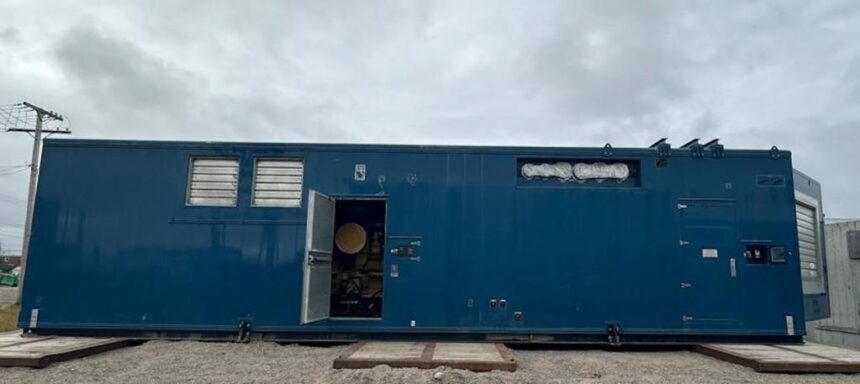
Arviat has enough generating capacity to meet expected winter electricity demand, but a delayed emergency generator installation has left the community with less protection against equipment failure than the Qulliq Energy Corporation (QEC) wants in place. Three of the plant’s four diesel generators are operating, while the fourth is undergoing an overhaul, according to QEC president and CEO Ernest Douglas. “We have more installed capacity than we expect the peak load to be in the winter,” Douglas said. “The question is, if we have a failure of one of the other units. That’s where it gets tricky.” The additional generator is intended to provide backup capacity at the community’s power plant, which was built in 1971. The situation was among the concerns raised by Arviat-South MLA Jamie Kablutsiak during a Nov. 3 discussion in the legislative assembly with then-QEC Minister Gwen Healey Akearok. “As the minister is aware, Arviat’s power plant was built over a half a century ago,” Kablutsiak said. He questioned the delay in completing a condition assessment of the power facility, which had been expected by mid-July. “Mr. Speaker, it is now November,” he said. “The site visits and the assessments themselves have been completed, the report is still being finalized,” Healey Akearok responded. The minister also confirmed that a tender for the emergency generator installation closed April 15, after two extensions, without receiving any bids. Contractor shortage Douglas acknowledged that the limited number of contractors capable of undertaking specialized electrical projects in Nunavut has complicated the installation. “A lot of the contractors that we would rely on to do this work are tied up,” he said. QEC is currently constructing four new power plants across the territory, although Douglas said he could not say precisely why the Arviat tender attracted no bids. Rather than delaying the project further while seeking another contractor, QEC decided to manage the installation itself, he said. The corporation purchased three emergency generator sets in 2024 and selected one for Arviat. The unit will be installed outside the existing plant and connected to its electrical system. Preparations included constructing a pad for the generator and demolishing a nearby building. Hazardous materials complicated the demolition, which has since been completed. Engineering work is continuing, but Douglas said there is a high probability the generator will not be installed and commissioned before QEC’s Nov. 30 winter readiness target. After that date, the corporation becomes increasingly reluctant to undertake commissioning work that could require interrupting electricity service during the coldest months. “We’re doing everything we possibly can without the essential folks to help us as we go,” Douglas said. The emergency generator installation is separate from the overhaul of the fourth diesel generator. Douglas expected an update on that work shortly. He also confirmed that QEC’s engineering team had received the final condition assessment report for Arviat’s power plant, although he had not yet discussed its findings or the resulting priorities. The plant is among 10 QEC facilities across Nunavut that have exceeded their designed lifespan. While the Arviat building dates to 1971, its generating equipment has undergone numerous upgrades. Arviat’s recorded peak electricity demand is just under two megawatts, compared with an installed capacity of more than three megawatts when all four generators are operational. Douglas said QEC identified the need for additional capacity in 2024 as electricity demand increased. The new modular housing factory is among the developments contributing to that growth, while future demand associated with the planned Inuit Nunangat University remains under consideration. But Douglas said the existing plant is operating as intended and he is unaware of any safety concerns. Funding issue Nevertheless, QEC has identified Arviat as a community requiring a replacement power plant, at an estimated cost of $80 million to $100 million. “The constraint I will add is that we do not have funding to do it,” Douglas said. In late September, QEC officials revealed that the utility had asked the federal government to assume responsibility for the power corporation’s debt, which exceeds $200 million. QEC is also working with Nukik Corporation, the proponent of the proposed Kivalliq Hydro-Fibre Link, to explore regional energy options. Douglas said the transmission project could influence future infrastructure planning, but diesel generation would remain necessary to provide backup electricity. For now, he said QEC will continue work on the emergency generator installation and the overhaul of Arviat’s fourth diesel generator while assessing operational requirements and contingency measures. Douglas said federal funding is essential to replace outdated electricity infrastructure across Nunavut. “When electricity goes out in the winter in Nunavut, it’s not an inconvenience, it’s an emergency situation,” he said. “So these critical upgrades are essential, and in order to do that, we need some funding.”
Arviat power plant faces winter with emergency generator installation unfinished