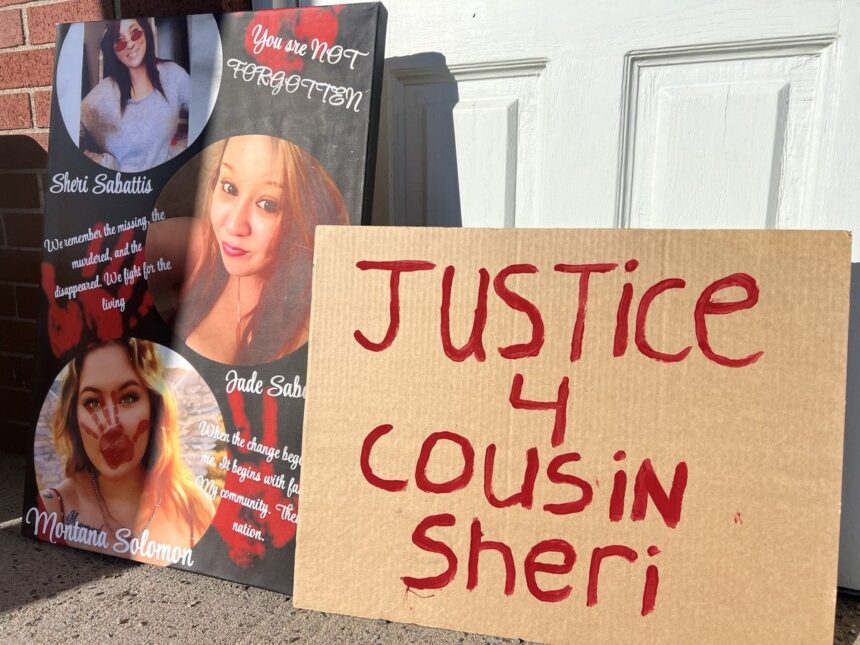
Victim after victim tell judge that Jared Smith forever changed their lives, and their First Nation, by taking away their loved oneAuthor of the article: John Chilibeck • Local Journalism Initiative reporterPublished Nov 20, 2026 • Last updated 5 days ago • 7 minute readPlacards honour Sheri Sabattis, an Indigenous woman killed by her intimate partner, along with other victims. Photo by John Chilibeck/ Brunswick NewsVictim after victim came forward, providing heart-wrenching testimony about their beloved sister, aunt and niece, killed at the hands of her intimate partner.THIS CONTENT IS RESERVED FOR SUBSCRIBERSSubscribe now to read the latest news in your city and across Canada.Unlimited online access to articles from across Canada with one account.Get exclusive access to the e-Edition, an electronic replica of the print edition that you can share, download and comment on.Enjoy insights and behind-the-scenes analysis from our award-winning journalists.Support local journalism and the next generation of journalists.SUBSCRIBE TO UNLOCK MORE ARTICLESSubscribe now to read the latest news in your city and across Canada.Unlimited online access to articles from across Canada with one account.Get exclusive access to the e-Edition, an electronic replica of the print edition that you can share, download and comment on.Enjoy insights and behind-the-scenes analysis from our award-winning journalists.Support local journalism and the next generation of journalists.REGISTER / SIGN IN TO UNLOCK MORE ARTICLESCreate an account or sign in to keep reading.Access articles from across Canada with one account.Enjoy additional articles per month.Get email updates from your favourite journalists.THIS ARTICLE IS FREE TO READ REGISTER TO UNLOCK.Create an account or sign in to continue with your reading experience.Access articles from across Canada with one accountShare your thoughts and join the conversation in the commentsEnjoy additional articles per monthGet email updates from your favourite authorsArticle contentSome of them yelled and swore at Jared Smith, demanding that he look at them. He most often looked straight ahead and sat impassively in the courtroom prisoner’s box.Smith, 40, had already pleaded guilty to manslaughter in the killing of Sheri Sabattis, his girlfriend and the younger sister of a First Nation chief, in a drug-fueled rage two years ago, shocking in its level of violence.On Friday, in the Burton courthouse outside Fredericton, 11 family and community members who knew the victim were asked to testify at his sentencing hearing.They spoke of a large family and tight-knit Wolastoqey community forever changed by the horrible crime. A flag is hoisted on a pickup truck honouring missing and murdered Indigenous women and girls outside the Burton courthouse on Thursday. Photo by John Chilibeck/ Brunswick NewsErin Sabattis, Sheri’s baby sister, discovered her loved one’s dead body upstairs in the bedroom of the victim’s home in Welamukotuk, or Oromocto First Nation, just a short drive from the courthouse.She first saw bloody footprints outside and blood on the front door handle, according to the police investigation. Those blood prints led all the way up the stairs.Article contentErin would find her older sister, who had just turned 54, lying in a large puddle of blood, almost “unrecognizable” because of the disfiguring blows. There was blood splatter all over the ceiling. The blood had also seeped through the floor, gone down the stairs, and leaked into the basement.Erin testified that her sister had always been her “safe place,” the person she could talk to whenever she needed help, someone who never judged her.Sheri was suffering from cirrhosis of the liver and desperately needed a transplant for the vital organ. Erin said she had been preparing to live without her but had imagined a peaceful ending.Instead, she ran from her sister’s body screaming all the way outside.“I f***ing hate you,” she yelled at Smith. “You don’t even have the balls to look at me or Sheri’s daughter!” Jared Smith, who pleaded guilty to killing his girlfriend Sheri Sabattis of Oromocto First Nation, is led away by sheriffs at the Burton courthouse. Photo by John Chilibeck/ Brunswick NewsKayla Sabattis, Sheri’s daughter, also stood up to read her statement through tears. One side of the courtroom, with about 20 members of the Sabattis family and their supporters, stood up as she testified. Most of them wore red shirts with a photo of Sheri emblazed on them.By signing up you consent to receive the above newsletter from Postmedia Network Inc.Article contentArticle contentHer mother had struggled with drug addiction, along with Smith.“Growing up, my biggest fear was always losing my mother. I was always scared something bad would happen to her,” she said sobbing. “And of all things, I feared in my life, you made my biggest fear come true, and I will never, ever forgive you for that. And I said multiple times to leave my mother alone, and you kept coming back. And I watched you take advantage of her struggles with drugs, and it makes me sick, knowing that I try to protect her from you. I’ll always be angry about that.“Why? Why did you kill my mother?”Shelley Sabattis, who was the First Nation’s chief at the time of her sister’s killing, spoke for nearly 15 minutes of the woman she jokingly called her “twin-dian” because they were so close. Like many others, she spoke at length about how much her sister was adored and trusted.Looking at the perpetrator, Shelley said: “This is too much. One life, taken like that, is too much. You took the best things of my life away from me. Her company, her spirit, her face. You deserve to lose everything, and everyone in your life. I hope you find it impossible to be ever happy again. Jared Smith, you make me sick.”Article contentSmith, his head shorn and wearing blue prison scrubs, only occasionally glanced at the former chief.About 10 members of his family, sitting on the other side of the courtroom, looked on uncomfortably.The last to testify was Aspen Bear, a young councillor for the First Nation. She read the statement provided by the new chief, Scott Paul, a retired RCMP officer, at his behest.Stifling tears, Bear recounted that Sheri was a deeply loved member of the First Nation, who had more than 50 family members in the small community.“She did not go looking for trouble or curry ill feelings for others,” she read. “I can’t adequately explain the depth of the loss.”Talking to other community members, the chief said there was widespread fear caused by her death. Most people in the First Nation now lock their doors and look at outsiders suspiciously.“This has caused lasting harm to our entire nation,” the chief wrote.Once the victim impact statements had been read into the record, Justice Cameron Gunn asked the Crown prosecutor and defence lawyer to give their sentencing arguments on a joint recommendation.Article contentThe two sides had agreed to a 10-year sentence, minus time spent in remand on a credit basis. Former First Nation Chief Shelley Sabattis wears a shirt in honour of her dead sister. Photo by John Chilibeck/ Brunswick NewsAt the previous hearing, the judge had admonished the lawyers to provide better examples of previous court cases dealing with manslaughter. Smith had originally been charged with second-degree murder, but as part of a bargain, pleaded guilty to the lesser charge of manslaughter.In particular, the judge said he wanted to ensure the lawyers took into serious consideration that the victim was an Indigenous woman killed by an intimate partner. Canadian law is strict on this point due to the high number of Indigenous women and girls killed by their husbands and boyfriends.Crown prosecutor Rodney Jordan recounted some new facts in the case that Smith agreed should be on the record.After the killing, Smith had wandered outside, covered in blood. Witnesses who saw him outside that morning testified they thought he was wearing gloves until they realized his hands were blood stained. His pants were soaked in blood, and he had a few minor injuries visible on his face.Article contentMost of them described him as disoriented and confused. He told many of them he’d been in a fight.Eventually, his father took him to the Oromocto Public Hospital just before noon, where police arrested him, having already discovered Sheri’s body.Smith had been smoking drugs outside the OFN Lounge in the First Nation for much of the night before the killing. He says he doesn’t remember anything that happened during the fight with his partner, but the evidence showed he killed her with blows to the head, neck and back. No weapon is believed to have been used. He killed her with his bare hands.The prosecutor said Smith was born in Fredericton and had a good upbringing with a supportive family. He became trained as a red-sealed electrician, worked as a lineman and had steady employment.But he slipped into drugs, including cocaine and opiates, and had several partners who were also drug addicted. Two of his children from a previous relationship were removed from his care and adopted by his father.Article contentThe prosecutor listed aggravating and mitigating factors that the judge would have to consider. The aggravating elements, which would lead to a harsher sentence, included the brutally violent crime and the fact that Sheri was a small and sickly woman who was very vulnerable. The victim was killed in her own home, where she should have felt safe. Making matters worse, Smith sought help for himself but not Sheri.Mitigating factors, which would make the case for leniency, included Smith’s guilty plea, his addiction, a positive upbringing and employment record, a limited criminal record (he was found guilty of common assault once and it wasn’t against an intimate partner) and his willingness to complete courses while in custody.During defence lawyer Gilles Lemieux’s sentencing arguments, the judge had to intervene when some of the victim’s family members began ridiculing and questioning the lawyer.One agitated young man refused to stay silent, prompting Gunn to say, “If you talk again, you’ll be removed.”Article contentLemieux noted that manslaughter was one of the most difficult sentences for judges, as the range can be anywhere from probation to 20 years.But the lawyer argued that Smith was a good candidate for rehabilitation.“He’s not a hardened criminal. He’s not a hired killer.”Lemieux also said that if the case went to trial, it would have been problematic, because of conflicting witness testimony.The prosecutor brought up that members of the Sabattis family had been charged in a vigilante justice case, which is still before the courts. Several members, including Shelley Sabattis, are accused of attacking Anthony O’Blenis and Sonya Atwin at their Welamukotuk home on April 29, 2024, just a couple of days after Sheri’s death.Both of those victims, the prosecutor said, had been with Smith when he was smoking drugs at the OFN Lounge. This messy affair, he insisted, would make any prosecution of Smith very complicated.The judge, however, wasn’t happy with the examples that had been presented to him by the two sides, many of which were old cases or didn’t include the aggravating circumstances of an Indigenous woman killed by her partner.Article contentGunn said that changes to the criminal code in 2019, that stemmed out of the findings of the Truth and Reconciliation Commission of Canada, made it crucial for the lawyers to find better examples.He told the sides he wanted them to look carefully at case from the Manitoba Court of Appeal in 2022 that landed an Indigenous man 18 years in prison for manslaughter after he killed his Indigenous wife. That crime was also a drug-fueled killing in which the original charge had been second-degree murder.The judge said he wanted the two sides to go back to the drawing board. Their next submissions will be heard in court Dec. 8.Gunn also warned them if he wasn’t satisfied with their recommendations, he had the option of asking Smith to withdraw his guilty plea to manslaughter so that he could be tried for second-degree murder.Article content
‘Why? Why did you kill my mother?’ Court hears anguished testimony