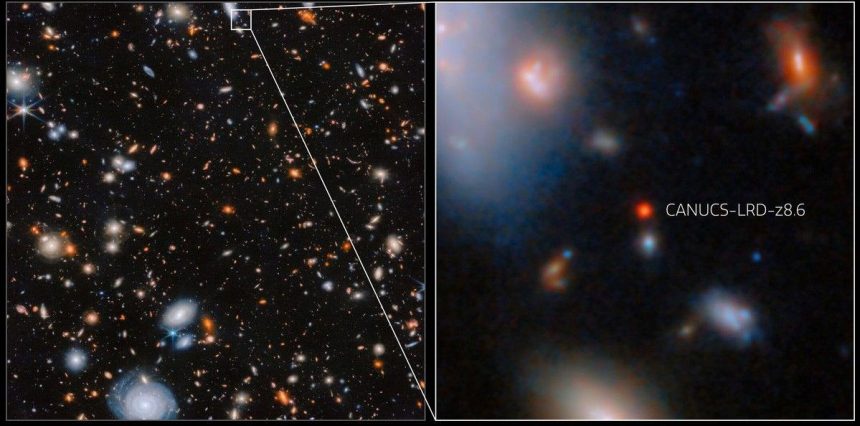
Article contentAt first, astronomers thought they might have found a new type of stellar atmosphere, as MoM-1’s brightness exceeded that which a stellar body of that scale could generate from nuclear fusion. To understand MoM-1 formation, astronomers developed a computer model in which MoM-1 contained a massive black hole surrounded by a dense cocoon of gas, giving MoM-1 the appearance of a huge star-like object. Article contentThe model demonstrated that the dense envelope of hydrogen would absorb and scatter the object’s radiation, thereby producing its unusual red shift colour and distinctive spectral pattern. The black hole’s immense radiation would also be strong enough to be able to pass through the dense cloud of gas, and to be detected by the JWST. Article contentMoM-1 may be related to unexplained ‘little red dots’Article contentAstronomers also discovered evidence that MoM-1 may have increased in brightness by approximately 30 per cent over a two-month period, behaviour typical of massive black holes rapidly feeding on surrounding material, confirming their theory that MoM-1 was, in fact, a black hole masquerading as a star. Article contentArticle content This image shows the location of galaxy CANUCS-LRD-z8.6 in galaxy cluster MACS J1149.5+2223, as seen by the NASA/ESA/CSA James Webb Space Telescope’s Near-Infrared Camera (NIRCam). CANUCS-LRD-z8.6 is part of a class of small, very distant and strikingly red galaxies called Little Red Dots (LRDs), which have been spotted in increasing numbers by Webb’s surveys of the early Universe. It is located in the constellation Leo (the Lion), and is seen by Webb just 570 million years after the Big Bang. ESA/Webb, NASA & CSA, G. RihtarArticle contentThere is a theory that the MoM-1 object might possibly be related to a yet-as-unexplained group of astronomical sources referred to as “little red dots”. Little red dots are mysterious red sources of light found in photographs of the early universe that are believed to be black holes surrounded by dense ionized gas. Interestingly, these little red dots do not appear in astro-photographs from more recent cosmic periods. Article contentWhatever their origin, little red dots and black hole stars such as MoM-1 are proof that the universe is still quite capable of demonstrating how very little we know and, more importantly, understand the universe in which we dwell. No doubt, there are many more astronomical mysteries such as MoM-1 waiting to be discovered. Article contentThis week’s sky Article contentMercury (mag. -1.4, in Cancer – the Crab) will pass behind the sun (superior solar conjunction) on Aug. 27 and therefore will not be observable this coming week. On Aug. 27, Mercury will begin its passage around the far side of the sun, referred to as superior solar conjunction. Article contentArticle contentVenus (mag. -4.4, in Virgo – the Maiden) becomes visible around 8:25 p.m. ADT, 8 degrees above the southwest horizon as dusk gives way to darkness, before sinking towards the horizon and setting about 9:25 p.m. ADT. Article contentMars (mag. +1.3, in Gemini – the Twins) rises in the eastern, predawn sky around 1:45 a.m. ADT, reaching 36 degrees above the eastern horizon, before fading from view by about 5:30 a.m. ADT. Article contentJupiter (mag. -1.8, in Cancer) rises around 4:35 a.m. ADT, reaching 12 degrees above the eastern horizon, before fading from view by about 6 a.m. ADT. Article contentSaturn (mag. +0.4, in Pisces – the Fish) becomes accessible 10 degrees above the eastern horizon around 10:45 p.m. ADT, reaching its highest point in the sky 46 degrees above the southern horizon shortly before 4 a.m. ADT, before being lost to the dawn twilight 40 degrees above the southwest horizon around 5:45 a.m. ADT. Saturn and the Moon will make an apparent close approach (an appulse) with one another, as viewed from Earth, at 11:32 p.m. ADT on Aug. 30.
A black hole masquerading as a star