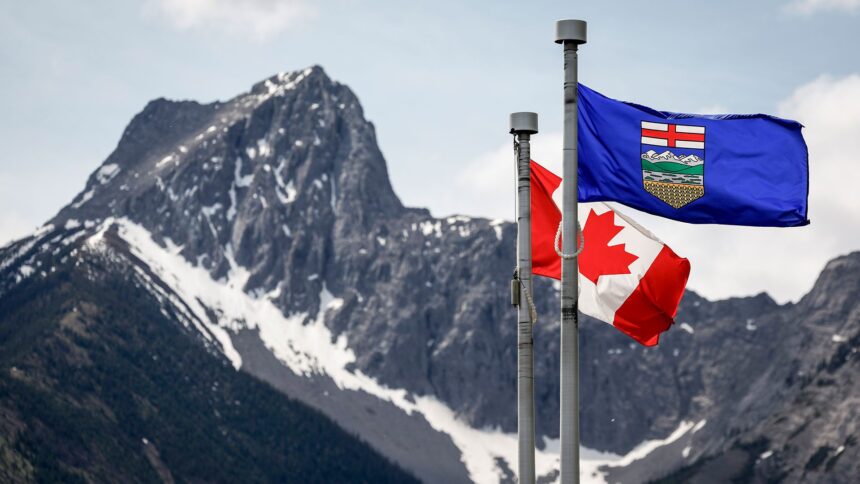
An Indigenous political activist and advocate says chiefs in Alberta, along with grassroots organizers says they’re doing everything they can to get First Nations people out to vote in the Oct. 19 referendum which could open a path for Alberta to pursue a formal separation process. With the vote less than a week away, a key strategist says mobilization has been underway since Premier Danielle Smith introduced legislation making it easier for separatists to mount a successful petition to force a referendum. “It really started in May 2025 when the chiefs called an emergency meeting, and the response back then was to her first legislative piece, Bill 54. The chiefs came in very firm 100 per cent opposed to separation prepared to fight. They ordered her by letter, and they all signed off on the letter to cease and desist on her separation intention,” Cara Currie Hall told APTN News in an interview. Chief Sheldon Sunshine of Sturgeon Lake Cree Nation is pictured speaking with the Assembly of Treaty Chiefs in March. Photo: NDP Caucus Bill 54 was an omnibus bill that received Royal Assent in May, 2025. It included a number of changes related to the electoral process in Alberta including lifting the ban on corporate and union political donations for provincial elections and direct democracy processes like referendums and introduced a $5,000 annual contribution limit and a $5 million general election spending limit for political parties. The separation question is number 10 on the ballot. It reads: “Should Alberta remain a province of Canada, or should the Government of Alberta commence the legal process required under the Canadian Constitution to hold a binding provincial referendum on whether or not Alberta should separate from Canada?” Voters are then given two options to choose from: Option 1: Alberta should remain a province of Canada or Option 2: The Government of Alberta should commence the legal process required under the Canadian Constitution to hold a binding provincial referendum on whether or not Alberta should separate from Canada. Currie Hall was a key figure in the Rock the Indigenous Vote movement in Canada in 2015 and helped organize Indigenous voters in the United States to back Barack Obama in his presidential run. She’s lending her considerable political savvy to the chiefs in Alberta and contends it was easy to see what Smith’s intentions were in making legislative changes. “Because by then, [Smith] already lowered the threshold of signatures required to advance a referendum, and she lowered it from 60 per cent required signatures… to only 10 per cent, which is how she got away with only needing a hundred and seventy seven thousand signatures to push forward for a referendum. So, she accommodated that right from the get go.” Currie Hall has been working alongside chiefs and grassroots people at her home First Nation of Maskwacis, 96 km south of Edmonton, to inform members of the importance of this vote. That work follows legal challenges mounted by several First Nations against Alberta over the constitutionality of the referendum. A courtroom is seen at the Edmonton Law Courts building, in Edmonton on June 28, 2019. Photo: The Canadian Press/Jason Franson Lawsuits Athabasca Chipewyan First Nation and the Blackfoot Confederacy (including Siksika Nation, Piikani Nation, and Blood Tribe with a total of at least five to six distinct First Nations/groups) brought successful judicial reviews and legal challenges that led the Court of King’s Bench to quash the separation petition and rule that the province breached its constitutional duty to consult. Sturgeon Lake Cree Nation is suing the Alberta government, the chief electoral officer, and the federal attorney general in a separate lawsuit over Bill 14 and the separation petition process. Sturgeon Lake Cree said the referendum breached the treaties which pre-dated the province of Alberta. APTN requested an interview with the chief but were advised he is not giving interviews at this time. Instead, in an emailed statement Sunshine said they’ve been informing and educating members “ever since Danielle Smith announced there would be an unconstitutional, expensive, and divisive referendum…” “We hope that when all votes are counted Albertans will have repudiated this farcical anti -Treaty, anti-immigrant, and anti-democratic process,” Sunshine said. Onion Lake Cree Nation which straddles the Alberta-Saskatchewan boundary also revived a separate lawsuit against Alberta’s broader Sovereignty Within a United Canada Act over related constitutional and treaty concerns. It claimed the provincial legislation infringes on constitutionally protected treaty rights. The Alberta Court of Appeal ruled that the province failed its duty to consult Treaty First Nations regarding a separatist referendum question and petition drive. The court affirmed that pre-existing treaty agreements supersede provincial political efforts. Currie Hall said the chiefs have stood firm united against the referendum since the former chief of Mikisew Cree Nation, Billy-Joe Tuccaro threw a copy of Bill 54 in the air at a news conference. “And he said, ‘this is what we think of your bill. It’s garbage. You’re on treaty land.’ So, the chiefs are very steady and very firm in the pushback and the rejection of any efforts for referendum. And, so the chiefs united…they did the cease and desist. They went to court. They won in court. And, the courts determined that the referendum was unconstitutional,” Currie Hall said. Crees of Quebec voters are seen casting ballots in 2025 election. Photo: APTN Currie Hall likens the chiefs’ fight against separation to what the Crees of Quebec did in turning back that separation initiative during the 1995 Quebec referendum. “And it was the Crees under the leadership of Matthew Coon Come, who was the grand chief at the time, that defeated Quebec and saved Canada,” Currie Hall said. Coon Come lent his voice and support to Alberta chiefs at the Assembly of First Nations (AFN) Annual General Assembly on July 16, where chiefs passed a landmark resolution put forward by Confederacy of Treaty No. 6 First Nations Grand Chief Joey Pete, alongside Coon Come who was appearing as a proxy from the Cree Nation of Nemaska, Que. “No province has the legal authority to alter, diminish, or extinguish Treaty Rights or the constitutional relationship between First Nations and the Crown,” the resolution said. Grassroots boots on the ground getting the vote out Meanwhile, Currie Hall has been getting help on the ground in Maskwacis from her sister Shelli Yellowbird. “In Alberta, we only have 145,000 First Nations that are registered (to vote), that’s small” Yellowbird shared in an interview with APTN. “On the ground, [there are] a lot of uncertainties and not understanding the real purpose and intention of the October 19 vote, but also to a lot of misconceptions about why should we vote. But a lot of it is actually pretty good. The boots on the ground initiative is working really well in terms of getting to the grassroots people, where everybody’s got an assignment to do. Mine is strictly social media blitz,” she said. Yellowbird has been creating TikTok videos with some getting shared more than 30,000 times. “And then it works by going door to door. We are using every means that we have in the community, the radio, social media, and word-of-mouth-signage,” Yellowbird said. Yellowbird described their efforts as “a four nation initiative” at Makwacis primarily at Sampson Cree the biggest nation in Maskwacis. Ermineskin Cree Nation is also doing its own work alongside Montana First Nation and Louis Bull Tribe, the smaller nations that make up Maskwacis. Yellowbird is hosting a rally at the nation on Saturday, Oct. 17 which will coincide with rallies and protests by First Nations across Alberta. There will also be a rally at the Alberta legislature on Sunday, a day ahead of the referendum. Advance polls open through Friday Advance polls opened Monday with some voting locations having to stay open extended hours on Tuesday, “to reflect late location openings,” according to Elections Alberta. It was to afford voters the fully advertised number of hours to vote. “Late openings were due to various and separate technology issues that have been resolved,” it said. Of the 311 total advance voting locations open Tuesday, 17 were affected. Read more: Beyond the ballot: Why the Alberta referendum is about more than separation Conservative MP Morin urges Albertans to vote for Canada in upcoming referendum Elections Alberta reports more than 655,000 requests for special ballots for Oct. 19 referendum Assembly of Treaty Chiefs in Alberta demand treason investigation into Premier Danielle Smith and UCP Kehewin Cree Nation band member concerned new election code will create ‘career politicians And voters will need some time to ponder all ten questions on the referendum ballot.Aside from the contentious separation question, they’ll also be answering “yes” or “no” to nine additional questions, ranging from immigration to abolishing the Canadian Senate. A video by Indigenous social media creators says “No to the Nine, Option 1 Stay on Question 10,” in an effort to simplify the ballot choices for voters. Questions one through five which voters will vote “Yes” or “No” to deal with immigration and voter eligibility requirements. These questions focus on shifting immigration and social spending controls away from federal models, covering increased provincial control over immigration levels and job priorities, restricting provincially funded services to citizens, permanent residents, and approved statuses, implementing 12-month residency requirements for temporary residents to receive services, introducing newcomer fees for select services, and requiring proof of citizenship for provincial voting. Questions six to nine deal with Constitutional changes which voters will say “Yes” or “No” to. The questions propose pursuing constitutional amendments alongside other provinces regarding provincial judicial appointments, abolishing the federal Senate, allowing federal program opt-outs while retaining funding, and prioritizing provincial laws over federal laws in specific jurisdictions. 🗳️ We voted in the Alberta Referendum 2026 — OPTION 1! Our Treaty rights, laws and Nationhood remain, regardless of the vote. Make your voice heard! Help Elders, family and friends vote. 📅 Advance polls: Oct 13–17 📅 Referendum Day: Oct 19 📍 https://t.co/xfzFELxOS6 https://t.co/OwzDBm1gwr — Lowa Beebe (@LowaBeebe) October 13, 2026 “It’s really, really important for everybody to vote, not just the treaty nations. It’s really going to be important for all of Alberta and all of Canada to support this,” Currie Hall said. “Maskwacis is where I’m from. Our motto is treaty strong, which is why we’re voting. We have the right, the opportunity, and the responsibility to do something about this, and that’s why we’re voting.” Tags: Alberta referendum, Cara Currie Hall, Constitutional challenge, Ermineskin First Nation, Fort Chipawyan First Nation, Lawsuit, Louis Bull Tribe, Maskwacis First Nation, Matthew Coon Come, Montana First Nation, Onion Lake Cree Nation, Rock the Indigenous Vote, separation, Shelli Yellowbird, Sturgeon Cree Lake Chief Sheldon Sunshine Continue Reading
Advocate says chiefs, grassroots working to get 145,000 registered First Nations to vote in Alberta referendum


Leave a Comment