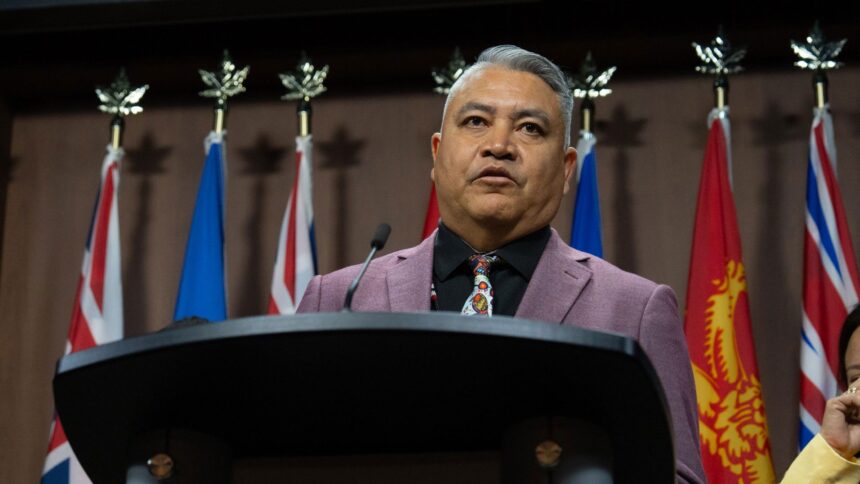
Chiefs in B.C. delivered a pointed message to the federal government around the climate emergency in that province and how fast tracking of major projects like the Pacific Link will only “exacerbate it.” It came after an address by the parliamentary secretary for the environment and climate change on day two of the BC Assembly of First Nations (AFN) general assembly. Wade Grant spoke about the federal government’s work on the proposed watershed security strategy, looking for support in the engagement process. But talk quickly shifted to the Pacific Link pipeline and its designation by Prime Minister Mark Carney as a project in the national interest. “We should really give our head a shake in terms of approval of such a major project that will outlive the Trump administration-that it’ll outlive perhaps the Carney administration. And it shouldn’t be taken so lightly. It needs the time,” said AFN Regional Chief Terry Teegee. “And to deem this as a project of national interest, it creates a real division in this country because the First Nations or let alone British Columbians or Albertans that are concerned about those projects will be deemed, I would say, an enemy, as an impediment to the interests of all this country. I’m not sure if anybody in any other provinces would give a care about British Columbia and Alberta if a pipeline breaks or if any environmental disaster happens because it’s not in their backyard, if you will.” Teegee said the project has not only caused a rift between non-Indigenous people and First Nations, but between First Nations who will benefit and those who won’t. “First Nations in this room that are on the pipeline route or, you know, a million barrels a year, those First Nations in the tar sands will be affected by the increased development,” Teegee pointed out. “And then it really demonizes us if we have concerns about that. So what the prime minister is doing is really creating some sort of division. We’ve already seen that Coldwater (First Nation) is bringing this to a judicial review, and I’m sure there’s going to be more court cases. As somebody told me, it’s a pipeline to more litigation…these are very difficult issues and very difficult discussions that need to be had.” Teegee said it also seems to be poor timing in the context of B.C. experiencing some of the worst fire seasons in recorded history. He noted that many communities in the province had to be evacuated to larger centres due to the wildfire threat including Summerland which had 20,000 people evacuated to Penticton. “Going back to the prime minister…I think in his haste to try to approve these projects (at a) fast rate, it actually may have the opposite that all this will get caught up in litigation over the next several years. Grant acknowledged the importance of water to First Nations. “When I was a child and during cultural ceremony, I’d go up and bathe in the creek. We can’t bathe in the creek anymore because of pollution, because our water security is at risk. The government of Canada is moving forward with engagement on a national water security strategy. And this strategy will only be as strong as the engagement and the consultation that we do with leaders like yourself,” he told the chiefs. Kúkpi7 of the Tkʼemlúps te Secwépemc, Rosanne Casimir said in discussions with government, there’s a “lack of desire” on the part of the Crown to accept “our inherent jurisdiction…to make decisions about the water in our territories,” and told Grant that jurisdiction has to be part of any dialogue. Another speaker noted that any one of the major projects Canada backs has the potential to cause an environmental catastrophe and asked Grant “if Canada can commit to major projects as a national interest, why can it not commit to water security as even a more important priority?” Grant tried to reassure the chiefs and said he is always available to talk. “And I’ve said it in in the House of Commons, we’re not shying away from free prior and informed consent. I’ve said it. It’s on record in there and the prime minister has said that…consultation and the rights of Indigenous peoples is not a thing that we should do. It’s a must. It’s a must do and one that we’re committed to doing,” Grant said. Head of the Major Projects Office On Wednesday, Dawn Farrell, CEO of the Major Projects Office told the assembly that the frustrations expressed over a lack of consultation on the Pacific Link pipeline made her feel like Canada is “never going to work,” but her office is determined to try to be better. Farrell said she agrees with the concept of national consultation standards but she wondered how such standards would work alongside the government’s accelerated timelines for project approvals. “I hear your pleas and I hear your discussions and I hear, you know, sort of a disbelief that it’s ever going to change, and a cynicism. And I feel like, ‘Oh my God, we can never get this country to work. Like it’s never going to work. We’ll never make it,’” Farrell said. She added that staff in her office have “very, very big scars” from working on projects like the Trans Mountain pipeline that didn’t have the depth of Indigenous consultation the Pacific Link pipeline “has after two months.” “Because we’re all committed in our office to try to do it better. Now, what does doing it better look like? It’s really hard to sit here and actually lay out what a day looks like and what the work looks like, and really, you’re not going to believe us at all,” Farrell said. “No amount of presentation that I’m going to give … is going to give you a sense of what we’re trying to accomplish. The only thing that will give you that sense of it is if we actually do, in action, get to a different place. “The best I can do is the best I can do. Our office is working hard to try to accommodate all the concerns you brought here today. And I totally get that you will not believe us until we deliver. And so we’ll mostly spend all of our time delivering, and maybe next year when we come back we’ll have some examples of how we try to deliver.” The federal government initially planned to hold consultations for one month on whether to designate the pipeline as a project in the national interest under the Building Canada Act. That was extended to two months after Indigenous leaders raised concerns about the tight timeline. A summary of those consultations posted online by the federal government says Indigenous groups decried a lack of information about the project, which they said prevented them from fully assessing its impact. With files from The Canadian Press. Continue Reading
AFN regional chief in B.C. calls Pacific Link pipeline to more litigation

Leave a Comment