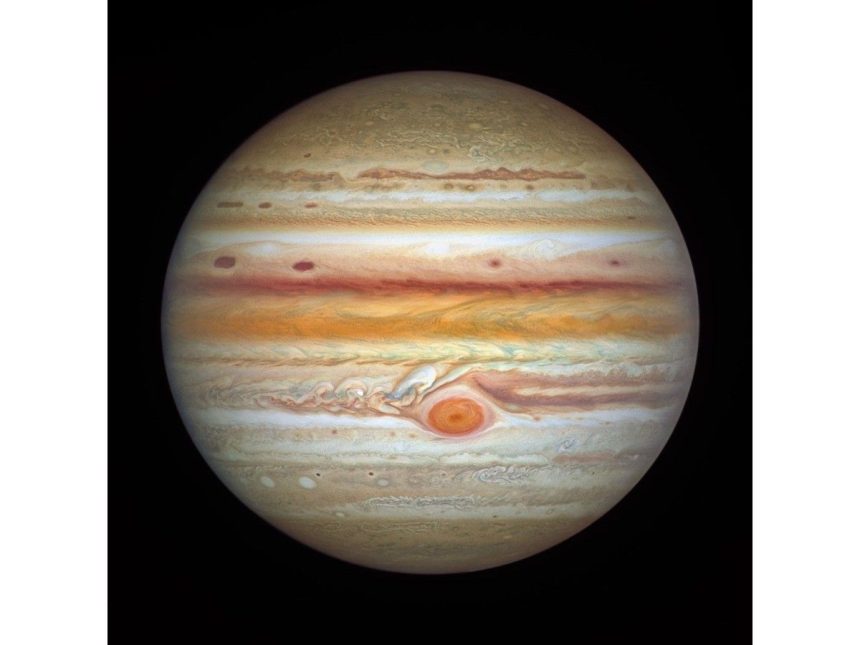
Recent missions are helping scientists learn more about the mysteries of our solar system’s biggest planetPublished Aug 13, 2026Last updated 1 hour ago8 minute readA 2021 photo taken from the Hubble Telescope of Jupiter displays the ever-changing landscape of its turbulent atmosphere, where several new storms are making their mark, and the pace of colour changes near the planet’s equator continues to surprise researchers. NASA, ESA, Amy Simon (NASA-GSFC)Article contentMost of us were taught in school that Jupiter is a huge ball of swirling gas, a “gas giant” planet.THIS CONTENT IS RESERVED FOR SUBSCRIBERS ONLY.Subscribe now to access this story and more:Unlimited access to the website and appExclusive access to premium content, newsletters and podcastsFull access to the e-Edition app, an electronic replica of the print edition that you can share, download and comment onEnjoy insights and behind-the-scenes analysis from our award-winning journalistsSupport local journalists and the next generation of journalistsSUBSCRIBE TO UNLOCK MORE ARTICLES.Subscribe or sign in to your account to continue your reading experience.Unlimited access to the website and appExclusive access to premium content, newsletters and podcastsFull access to the e-Edition app, an electronic replica of the print edition that you can share, download and comment onEnjoy insights and behind-the-scenes analysis from our award-winning journalistsSupport local journalists and the next generation of journalistsRegister to unlock more articles.Create an account or sign in to continue your reading experience.Access additional stories every monthShare your thoughts and join the conversation in our commenting communityGet email updates from your favourite authorsSign In or Create an AccountorArticle contentHowever, that perception is incorrect, an illusion.Article contentArticle contentWhile it may seem a contradiction, Jupiter is, in reality, a “liquid metal” planet.Article contentJupiter is known for its incredible size, the largest planet in our solar system — so large, in fact, that it is more massive than all the other planets in the solar system combined. Its mass is equal to 317.8 times that of Earth; a thousand Earths could fit inside Jupiter.Article contentArticle contentIt is the fifth planet in the solar system, orbiting the sun at an average distance of 483,879,000 kilometres, or 5.203 AU (1 AU, or astronomical unit, is equal to the average distance between the sun and Earth, or approximately 93,000,000 kms) once every 11.46 years.Article content Voyager 1 took this photo of Jupiter and two of its satellites (Io, left, and Europa) on Feb. 13, 1979. This photo was assembled from three black and white negatives by the Image Processing Lab at Jet Propulsion Laboratory. NASA/JPLArticle contentHow did Jupiter form?Article contentUntil the mid-1990s, the general scientific theory was that Jupiter likely formed out of a huge disk of rock, gas and dust spinning around a nascent sun in the early solar system. Over the course of millions of years, the individual chunks of material in the disk collided with one another, forming larger chunks that were large enough to possess sufficient gravity that, in turn, attracted more material, until the resulting conglomerate of material began attracting massive amounts of gas from within the disk.Article contentEventually, after millions of years, this swirling mass of rock, dust and gas would form the “gas giant” Jupiter that is seen in images today. This theory implies that Jupiter, in all likelihood, has a large, solid core of rock and metal.Article contentArticle contentAn alternate theory purports that Jupiter first formed as a gigantic cloud of gas outside the massive disk of material swirling around the sun. In time, this cloud of gas became so massive that it collapsed under its own gravity, forming a huge, dense ball of gas, similar to how it is believed our own sun formed billions of years ago. Eventually, this huge ball of gas, which would later become the planet Jupiter, was drawn in towards and settled into orbit around the sun.Article contentArticle contentThis theory suggests that Jupiter wouldn’t, therefore, have a rock core, but would, instead, be just a huge ball of gas with a series of layered gases.Article content Trapped between two jet streams, Jupiter’s Great Red Spot is an anticyclone swirling around a centre of high atmospheric pressure that makes it rotate in the opposite sense of hurricanes on Earth. NASA/JPL/Space Science InstituteArticle contentHow a comet changed our understandingArticle contentThe first close-up photos of Jupiter were taken by NASA’s Pioneer II mission in 1974, with the first moving, time-lapse images of Jupiter taken by the Voyager I spacecraft in 1979.Article contentAs interesting as these images were, they didn’t provide much information as to Jupiter’s true nature. It wasn’t until NASA’s Galileo mission, launched in 1989, arrived at Jupiter in late 1995 that a true understanding of Jupiter’s real nature began to emerge.Article contentJust a few months prior to Galileo’s arrival at Jupiter in December 1995, parts of Comet Shoemaker-Levy 9, travelling at an estimated speed of 216,000 km/hour, crashed into Jupiter’s atmosphere in July. As the comet passed by Jupiter, the planet’s massive gravity fractured the comet into multiple pieces, the largest of which was estimated to be two kms in diameter.Article contentUnfortunately, the comet pieces that crashed into Jupiter could not be imaged by NASA’s newly operational Hubble Space Telescope, as the pieces hit Jupiter on its far side, out of sight of Earth and the Hubble.Article contentFortunately, though, NASA’s Galileo spacecraft, on a mission to investigate Jupiter and its moons, arrived just as the comet pieces were striking Jupiter. On its approach to Jupiter, Galileo imaged 21 separate collisions of comet pieces with Jupiter’s atmosphere over the course of six days, with the largest comet piece generating an estimated energy detonation equivalent to 300 million atomic bombs.Article contentArticle contentThe Hubble was able to follow up Galileo’s images with its own images showing the effects of the collisions on Jupiter’s atmosphere, revealing multiple large black holes in the clouds that ejected massive plumes of debris thousands of kilometres above Jupiter. The Galileo spacecraft flew through the plumes, gleaning valuable information on what lay beneath the planet’s swirling clouds.Article content This image shows two of Jupiter’s large rotating storms, captured by Juno’s visible-light imager, JunoCam, passing over the planet on Juno’s 38th orbit, on Nov. 29, 2021. NASA/JPL-Caltech/SwRI/MSSS ImageArticle contentWhat has the Juno mission found?Article contentPerhaps the most significant discovery Galileo made was huge amounts of water in Jupiter’s atmosphere. This unexpected discovery led NASA to commence working on a new spacecraft designed to specifically seek, in greater depth, the true nature of Jupiter. This spacecraft would ultimately be the Juno spacecraft, launched in 2011 and arriving at Jupiter in 2016.Article contentThe Juno mission would make a number of interesting and surprising discoveries of its own about Jupiter.Article contentIt discovered that Jupiter, although appearing to be covered in thick layers of swirling clouds, is not made entirely of gas, and that the clouds only form the top layer, to an estimated depth of approximately 50 kms, of the planet’s atmosphere; it is this top layer swirling rings of colourful clouds and storms, such as the Great Red Spot, that are seen in the images of Jupiter.Article contentArticle content JunoCam, the visible light imager aboard NASA’s Juno, captured this enhanced-colour view of Jupiter’s northern high latitudes from an altitude of about 58,000 kilometres above the giant planet’s cloud tops during the spacecraft’s 69th flyby on Jan. 28, 2025. NASA/JPL-Caltech/SwRI/MSSS ImageArticle contentWithin this cloud layer, temperatures were found to be, on average, approximately -100 degrees Celsius. In that environment, water ice crystals interact with ammonia, acting as a natural antifreeze, thereby allowing water to exist in the upper cloud layer. As the water droplets collide with the ice crystals, the clouds become electrified, triggering gigantic lightning storms across the Jovian upper atmosphere.Article contentThe super-chilled water-ammonia mix eventually forms a sort of slushy hailstones that fall downward into the lower atmosphere, where they melt into rain, which then evaporates, rises back up into the upper atmosphere, and begins the process all over again.Article contentBelow the top cloud layer, the temperatures rise dramatically, the heat generated by pressure, the result of Jupiter’s enormous gravity. As the air molecules are compressed, they release energy in the form of heat, which becomes concentrated.Article contentAs Jupiter’s enormous gravity well pulls the material downward and squeezes it tighter and tighter, the more the pressure and heat increase, until, ultimately, at approximately 1,000 km below the upper cloud layer, the hydrogen gas transforms into a liquid state, forming a vast ocean of liquid hydrogen, the largest ocean in the solar system. Jupiter’s intense pressure raises the boiling point of the hydrogen so high that it can exist as a liquid at temperatures well in excess of 1,000 degrees Celsius.Article content An enhanced colour view of Jupiter’s south pole from the 2016 Juno satellite approach shows oval storms dotting the cloudscape. Enhanced image by Gabriel FisetArticle contentAs it is the lightest of the known elements, in an extreme gravitational environment such as that of Jupiter, this liquid hydrogen is the only thing that can stay afloat, as all the heavier elements sink towards the planet’s core. This ocean of liquid hydrogen is estimated to be about 20,000 kms deep.Article contentAt the bottom of Jupiter’s intense gravity well, the enormous pressure and temperature changes the liquid hydrogen to metallic hydrogen, akin to liquid mercury found in thermometers. The metallic hydrogen has the ability to conduct electricity; Jupiter’s intense gravity causes electrons to break free from the hydrogen atoms, and to roam freely throughout the metallic hydrogen, generating electricity in the process.Article contentDoes Jupiter have a solid core?Article contentData from Juno suggests that Jupiter does, in fact, have a core, just not a purely solid core.Article contentInitially believed to be a solid, dense object composed primarily of iron and rock, it is now theorized that Jupiter’s core exists in a kind of transition state between liquid metal and solid rock, with the two randomly mixing together into a somewhat fuzzy ball, comprising approximately half of Jupiter’s radius, that is not clearly delineated by hard, defined boundaries between the two states of matter.Article contentArticle contentIt is postulated that Jupiter’s interior could have been the result of a massive collision with another proto-planet in the early solar system; the energy generated by such a collision having scattered and diluted Jupiter’s solid core, perhaps explaining how Jupiter got as massive as it did.Article contentUnfortunately, numerous computer simulations of collisions between the proto-Jupiter and other proto-planets of different sizes failed to establish exactly how Jupiter formed.Article contentHow a planet as large as Jupiter came to be in the first place is not clearly understood, even today. It is quite possible that Jupiter’s inner liquid-metal composition is the consequence of normal processes within large proto-planets that begin their life as a swirling ball of gas.Article contentPerhaps future missions to Saturn, our solar system’s other “gas giant” planet — which is also massive in size and has a gaseous atmosphere — may provide the answers to how a planet can appear to be one thing, but, in reality, is something quite different.Article contentArticle contentThis week’s skyArticle contentMercury (magnitude -0.9, in Cancer – the Crab), soon to pass behind the sun (superior solar conjunction), is not observable this coming week, as it is no higher than six degrees above the eastern horizon at dawn.Article contentVenus (mag. -4.3, in Virgo – the Maiden) becomes visible around 8:40 p.m. ADT, 10 degrees above the western horizon as dusk gives way to darkness, before sinking towards the horizon and setting about 9:40 p.m. ADT.Article contentMars (mag. +1.3, in Taurus – the Bull) rises in the eastern, predawn sky around 1:50 a.m. ADT, reaching 33 degrees above the eastern horizon, before fading from view by about 5:20 a.m. ADT.Article contentJupiter (mag. -1.8, in Cancer) rises around 4:55 a.m. ADT, reaching 8 degrees above the eastern horizon, before fading from view by about 5:50 a.m. ADT.Article contentSaturn (mag. +0.4, in Pisces – the Fish) becomes accessible 10 degrees above the eastern horizon around 11:15 p.m. ADT, reaching its highest point in the sky 46 degrees above the southern horizon around 4:25 a.m. ADT, before being lost to the dawn twilight 44 degrees above the southwest horizon around 5:30 a.m. ADT.Article contentUranus (mag. +5.7, in Taurus) rises shortly after midnight ADT, reaching 47 degrees above the eastern horizon, before fading from view in the dawn twilight by about 4:50 a.m. ADT.Article contentNeptune (mag. +7.8, in Pisces) becomes visible 21 degrees above the southeast horizon by about 11:55 p.m. ADT, before reaching its highest point in the sky 43 degrees above the southern horizon around 3:45 a.m. ADT, and then disappearing into the dawn twilight around 4:50 a.m. ADT, 41 degrees above the southern horizon.Article contentUntil next week, clear skies.Article contentEvents:Article contentAug. 19 – First-quarter moonArticle contentAug. 22 – Moon at apogee (farthest point from Earth) at 5:20 a.m. ADT; approxitmately 406,700 kmsArticle content
ATLANTIC SKIES: You probably learned in school Jupiter is a gas giant planet but there’s much more to it