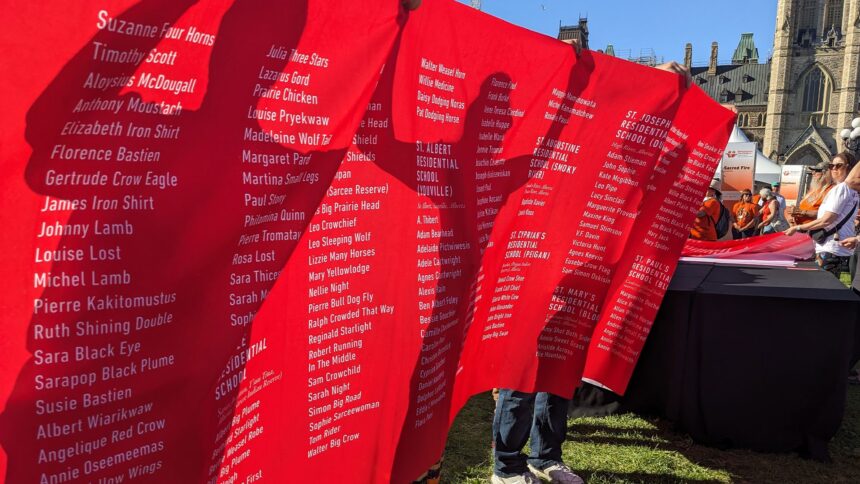
Chiefs in British Columbia at the Assembly of First Nations (AFN) gathering have passed a resolution calling for an extension to the deadline to have personal records related to residential schools. The resolution, Protecting Information Relevant to Missing and Disappeared Children, calls for an extension past September 2027, the deadline called for in the Independent Assessment Process and Alternative Dispute Resolution. A slide presented at the BC. AFN assembly said the resolution doesn’t “reopen claims or remove survivor choice.” When discussing the resolutions further, one of the attendees said: “Nothing happens if we don’t push.” “I support each and every one of these resolutions wholeheartedly. I went to residential school for many years, as did my parents. We were required to go to Indian residential school; there is still unfinished business,” he said. There are a number of groups lobbying the government to reconsider destroying the records. Residential schools operated from the 1800s until the 1990s. More than 150,000 Indigenous children attended the poorly resourced schools meant to strip them of their culture and identity. In 2008, former prime minister Stephen Harper apologized for the schools and the federal government agreed to the Indian Residential School Settlement Agreement that set up the Independent Assessment Process. It guaranteed that survivors’ testimony would not be released publicly. The records of more than 38,000 survivors are scheduled to be destroyed on Sept. 19, 2027 as per the agreement. Ontario coroner’s team says it has located the records of hundreds of children not listed on the NCTR memorial wall. In a presentation to the assembly, the lead investigator for Ontario’s Residential Schools Death Investigation Team says his office has now located the records of hundreds of children whose deaths are not listed with the National Centre for Truth and Reconciliation. “To date, we have also located almost 300 additional children whose deaths are not listed on the NCTR Memorial Wall,” Mark Mackisoc told the assembly. According to Mackisoc, his office has also located the records of the 436 known children who died while attending residential schools in the province. The National Centre for Truth and Reconciliation was created out of the Truth and Reconciliation Commission. It maintains a public memorial register of children who died or went missing while attending Indian residential schools. The Residential Schools Death Investigation Team was established in May 2022 inside the Office of the Chief Coroner for Ontario. Truth & Reconciliation Commission Calls to Action (April 22, 2022). Photo by: APTN According to the presentation, it’s made up of three experienced police investigators and an analyst. Mackisoc said it is the only coroner team in Canada that collaborates with communities and follows their lead to conduct the investigations at no cost to them. Under the Ontario Coroners Act, the team has the power to acquire documents from any source without restriction or redactions, including government, churches and funeral homes. Report about residential school students At Shingwauk Indian Residential School in Sault Ste. Marie, Mackisoc said his team has documented 99 deaths and created an individual story for each child. One example named on a slide was Jane Kitchejohn, 1967, Fort Hope. Kitchejohn’s story is one of many compiled into a roughly 250-page book report. Read More: Raising of Survivors’ Flag starts day of remembrance MP petition introduced to protect residential school testimony Mackisoc said the work does not end there. “Then the other thing that strikes me about that book, it’s a 250-page book of as much as we can tell of the stories of these 99 children. But that’s not the end,” he said. “The government’s approach is to look at that and say, okay, well, there, you’ve got your answers and now you can do your commemoration,” he said. “But I look at that and say it’s really just the beginning.” “The amount of information we know and that can be taken so much further by the families and the communities now that they have that basic information that frankly they should have had all along. Not only should have had, but could have had. I’ll tell you that right now. If we can do the work right now. There’s no technology or anything special we’re using. This is work that could have been done at any point over the course of history.” The Ontario team’s work sits alongside the National Centre for Truth and Reconciliation’s ongoing efforts to maintain the national memorial register. People affected by residential schools can call the Indian Residential Schools Crisis Line at 1-866-925-4419, the Hope for Wellness line at 1-855-242-3310, or the KUU-US Crisis Line at 1-800-588-8717. Continue Reading
B.C. AFN pass resolution to extend deadline for destruction of residential school records

Leave a Comment