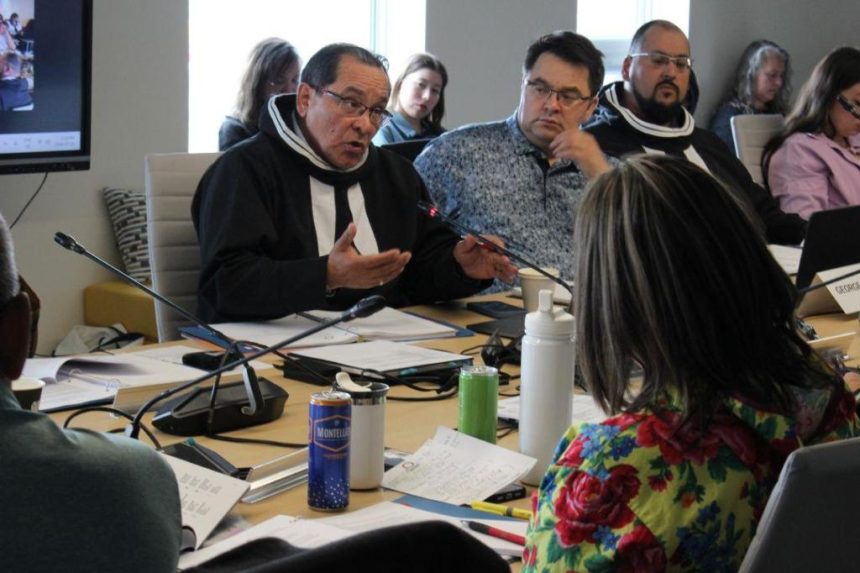
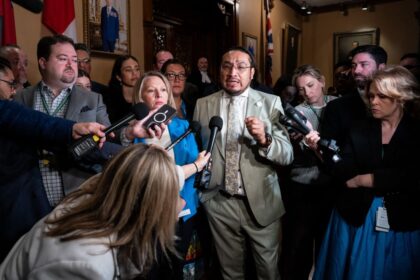
The Inuit Circumpolar Council recently reaffirmed its campaign to create barrier-free travel for Inuit across their traditional homelands in the Arctic. In its July 25 declaration on the final day of the organization’s general assembly in Iqaluit, the group said it would continue “calling upon states to provide for free and unrestricted movement for all Inuit across our heart and homeland.” Inuit Nunangat includes Siberia in Russia, Alaska, Yukon, the Northwest Territories, Nunavut, Nunavik (Northern Quebec), Nunatsiavut (Labrador) and Greenland. The idea has been part of the Inuit Circumpolar Council’s mandate since 1977. Having the Inuit region of Chukotka in Russia included in a free travel zone for Inuit is not likely in the near future, conceded Makivvik president Pita Aatami. But the Nunavik leader said he thinks there’s hope for unrestricted travel for Inuit from Alaska to Greenland. “I never had to come up with a passport to travel to Greenland. But coming back to Canada, I need a passport. It’s like who are you? We’re treated like criminals,” Aatami said. He cited the Jay Treaty between Canada and the U.S., which allows Indigenous people to freely cross the border without a passport, as long as they have at least 50 per cent blood quantum. He once accidentally drove across the border due to a GPS error that landed him Niagara Falls, New York, but he was accepted by U.S. border guards, he said. Canadian border guards were more suspect upon his return, according to Aatami. “I’m asking our government to help us in moving forward with this. The Government of Canada is aware of this,” he said. In 2023, Aatami held a meeting with Indigenous Services Canada about creating the free travel zone. The creation of an Inuit card, similar to a status card for First Nations people in Canada, would facilitate the barrier-free travel. “It is doable,” said Aatami. “Governments have come in after the fact — when we have been living as one people — putting boundaries that are are considered artificial by native people or Inuit people of the world.” He said the federal government is ready to help and that the Danish and U.S. governments still need to come to the table. Alaskan and Canadian Inuit communities are experiencing more barriers to travel than they did in the past, according to Darrel Nasogaluak, a director with the Inuvialuit Regional Corporation’s board. Nasogaluak said that immigration barriers arose for a marriage between an Inupiat (Alaskan Inuit) man and an Inuvialuit woman from the Northwest Territories. “Their relationship was at risk when Canadian immigration decided that they had a problem with his living in Canada. It took a whole lot of back and forth with the Inuvialuit Regional Corporation, and the U.S. customs, and the Canadians to resolve that situation. It caused a lot of grief for this this couple and the communities,” Nasogaluak said. Crossing the border from Yukon into Alaska has also become more difficult recently, he added. Border patrol now requires travellers to Utqiagvik, formerly called Barrow, Alaska, at the state’s northern tip to go through Anchorage or Fairbanks, over 1,000 km away. “It would be like going to Hawaii to go to California,” said Nasogaluak. The federal government is required to reduce travel barriers for Inuit in accordance with the United Nations Declaration on the Rights of Indigenous Peoples, according to Immigration, Refugees and Citizenship Canada. Right now, the immigration agency has a temporary resident exemption for Indigenous people coming into the country from Alaska under certain circumstances. Immigration, Refugees and Citizenship Canada is still working on a longer-term solution for Inuit entering Canada from Alaska, according to Jeffrey MacDonald, a communications advisor for the immigration service. “Although Inuit from Greenland are not currently included in the public policy, the policy does acknowledge the connection to Inuit in Greenland,” MacDonald said. Indigenous Services Canada said it was talking with Inuit organizations about what would go into creating an Inuit card. “Any potential Inuit identification card would require consideration of legal, policy, operational and security-related factors, including those related to international travel,” said Jacinthe Goulet, a media relations employee at Indigenous Services Canada. The parliamentary Inuit-Crown Partnership Committee is exploring proposals from national organization Inuit Tapiriit Kanatami, including one related to an ID card. Economic ties At the IRC general assembly, Aatami pitched creating businesses shared by Inuit across Canada, the U.S. and Greenland. Airlines, hotels, and a water bottle business using melted icebergs could empower Inuit communities to make more money from their homeland, he suggested. A hotel owned by Nunavik, Greenland and Alaskan Inuit is already on its way. “We’re looking at for the next six months, hopefully, that we can finalize this because we already have our focus on building something in Greenland as three parties,” Aatami said. A future hotel in Nome, Alaska, could also be in the works for the three groups, he said. Operating the businesses “at cost” to help Inuit access goods and services is part of Aatami’s plan. Leveraging Makivvik’s wholly-owned Air Inuit across the Arctic is another goal for Aatami. “We have an airline company that could be utilized to travel freely from Alaska to Greenland without having to worry about borders, and this would open some trade between the Inuit, whether it’s for art, whether it’s for food,” he said. Makivvik used to own Canadian North alongside the Inuvialuit Development Corporation, before selling the company in July 2025. Aatami said he’s tried to deepen economic ties with Nunavut in the past. “We actually did have a business arrangement in the shipping with the Qikiqtani Inuit Association, but, unfortunately, they went somewhere else. They pulled out the partnership,” he said. On paper, Alaska, Canada and Greenland should already have a free trade zone. Canada has the CUSMA agreement with the U.S., formerly called NAFTA, and a free trade agreement with the European Union that Greenland has access to. However, no specific trade agreement has been signed between Canada and Greenland, leaving some products open to barriers, according to the World Bank. Trade relations between Canada and the U.S. have worsened since President Donald Trump was elected in 2022. “The American government is always tariff, tariff, tariff. You want to bring in the goods, you want to sell us goods, here’s the tariff. So that’s why it’s important that we come up with a free trade with the three countries,” Aatmi said.
Barrier-free travel for Inuit across Alaska, Canada, and Greenland is a human rights issue, leaders argue