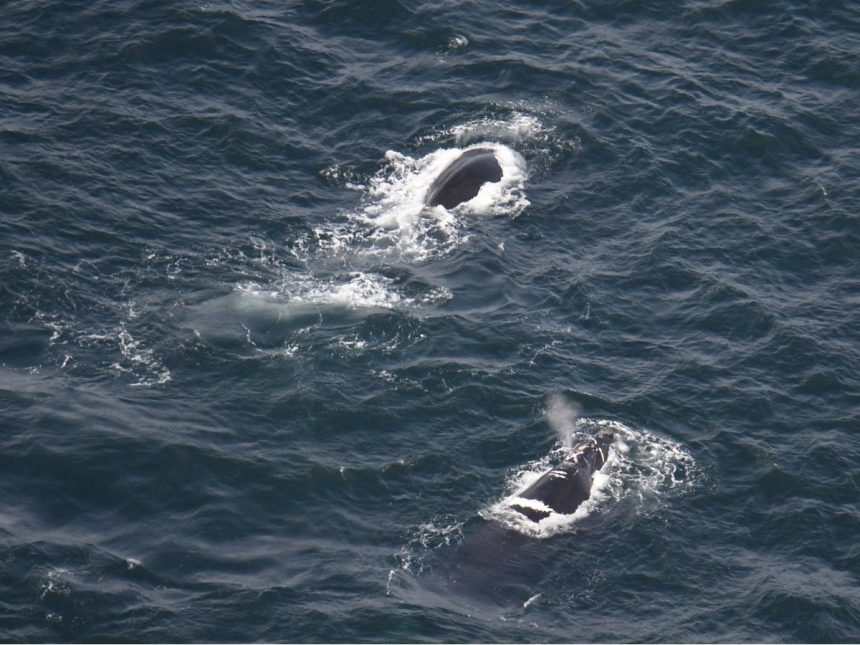
Conservation of threatened species, like the right whale, is not resistance to evolution, writes Geoffrey Hurley, “it is evolution at its most evolved.” Photo by Department of Fisheries and Oceans /ContributedArticle contentWhy do we insist on defying Darwin’s verdict, pulling species back from the brink when evolution has always been content to let them fall?THIS CONTENT IS RESERVED FOR SUBSCRIBERS ONLY.Subscribe now to access this story and more:Unlimited access to the website and appExclusive access to premium content, newsletters and podcastsFull access to the e-Edition app, an electronic replica of the print edition that you can share, download and comment onEnjoy insights and behind-the-scenes analysis from our award-winning journalistsSupport local journalists and the next generation of journalistsSUBSCRIBE TO UNLOCK MORE ARTICLES.Subscribe or sign in to your account to continue your reading experience.Unlimited access to the website and appExclusive access to premium content, newsletters and podcastsFull access to the e-Edition app, an electronic replica of the print edition that you can share, download and comment onEnjoy insights and behind-the-scenes analysis from our award-winning journalistsSupport local journalists and the next generation of journalistsRegister to unlock more articles.Create an account or sign in to continue your reading experience.Access additional stories every monthShare your thoughts and join the conversation in our commenting communityGet email updates from your favourite authorsSign In or Create an AccountorArticle contentStand on the cliffs of Cape Breton, scanning the grey Atlantic for a spout that may never come. Walk the banks of dying rivers, where salmon once leaped so thickly you could nearly cross on their backs — and find only silence. The North Atlantic right whale numbers around 340. Three hundred and forty. That is not a population; it is a funeral procession.Article contentArticle contentArticle contentThe Atlantic salmon returns dwindle each year despite millions spent on restoration. The cod moratorium was declared in 1992, and still the stocks have not recovered. We pour our hearts, our dollars, our desperate science into saving these creatures, and the tide keeps rising against us. It can feel, at times, like trying to bail out the ocean with a thimble. And yet we persist.Article contentThe question lingers: why?Article contentArticle contentDarwin’s distorted mirrorArticle contentCharles Darwin taught us that extinction is nature’s slow way of weeding out the less adaptable. “Survival of the fittest” conjures images of the strong triumphing, the weak fading. But Darwin never saw a whale entangled in rope so deeply it could not feed. He never watched a river run warm and toxic, choked by dams and runoff from our own fields.Article contentThe “survival of the fittest” assumes a fair fight. What we have created is not fair. It is a gauntlet of our own making.Article contentWhen we read of another right whale death — another mother unable to free herself from our gear — we confront an uncomfortable truth: this is not evolution. This is annihilation by indifference. And we are part of the species doing the annihilating. How do we save anything when we belong to the very force destroying it?Article contentArticle contentCuriously, the ancient story of Noah’s Ark — far older than Darwin — recognized a sacred duty: to salvage a pair of every living thing when the waters rose. Today, the waters are rising in their own way — warmer, more acidic, crowded with our noise and nets. Noah built an ark; we are building excuses.Article contentArticle contentPerhaps that old story endures because it speaks to a truth we cannot escape: preserving life is not optional. It is the oldest covenant we made.Article contentArticle contentRedefining the fittestArticle contentHere is where Darwin’s philosophy takes an unexpected turn. “Survival of the fittest” does not have to mean survival of the most ruthless. In nature, the fittest are often those that co-operate, adapt, and protect their young. Think of the lobster hiding in eelgrass, the herring schooling for safety, the whale teaching its calf ancient migration routes.Article contentFitness is not just about claw and tooth — it is about community, resilience, and care. Perhaps our greatest evolutionary trait is not our intelligence or our opposable thumbs. Perhaps it is our capacity for empathy — our ability to look at a dying whale and feel its loss as our own. That empathy is itself a product of evolution. It is what made us human. And it is what compels us to defy the narrowest reading of Darwin’s law.
COMMENTARY: Darwin’s reckoning: Why we must fight for evolution’s castaways