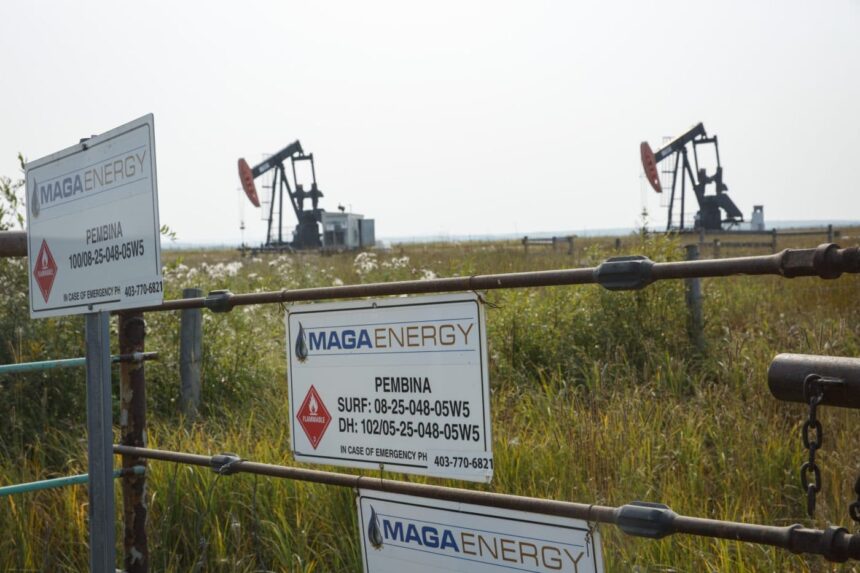
Documents obtained by The Narwhal offer new insights into what went on behind the scenes at the Alberta Energy Regulator when it transferred 170 oil and gas wells and related facilities to beleaguered oil and gas company MAGA Energy in 2024. The documents, obtained through an access to information request, reveal a flurry of correspondence between the regulator and the company. MAGA, which said it was facing “severe hardship,” proposed the transfer as a “solution” to its financial woes. “We believe this will further enhance our financial position and contribute positively to our stakeholders,” the company wrote in May 2024 as part of its pitch. Summary In 2024, MAGA Energy was a struggling Alberta oil and gas company, eyeing ways to dig itself out of its financial woes, including a plan to take on more oil and gas wells. Documents show what went on behind the scenes at the Alberta Energy Regulator when MAGA Energy made its pitch, which was ultimately approved. As part of the process, the regulator appears to have overlooked the fact that some documents submitted by the company were out of date and the company was in violation of rules about outstanding municipal taxes. The deal was ultimately approved, apparently without the regulator independently verifying some of the evidence submitted by the company to move the deal forward, according to The Narwhal’s review of the documents. Records show MAGA Energy submitted payment plans with three municipalities to cover taxes owed by the company to the regulator in June 2024. In Alberta, oil and gas companies are not allowed to obtain new licences if they owe more than $20,000 in back taxes. Past reporting by The Narwhal showed the company owed in excess of $200,000 to Sturgeon County alone, and that it violated a repayment agreement with the county four months before submitting it to the regulator as proof of compliance. The tax arrears, however, were just one symptom of a company in freefall. In October, just weeks after approving the transfer, the regulator said it had completed an analysis of the company’s finances and concluded “MAGA was at risk of not meeting its end-of-life obligations.” Jennifer Stephenson is one of many Alberta landowners who MAGA Energy failed to pay lease payments to. She says the Alberta Energy Regulator “dropped the ball” when it approved MAGA’s expansion. Photo: Isabella Falsetti / The Narwhal The regulator said it performed a holistic assessment prior to approving the transfer. It’s unclear what, if anything, changed in the month after it was approved. Eighteen months later, with mounting regulatory violations and mounting debts, the regulator ordered MAGA to cease operations. It has left landowners with MAGA sites on their property frustrated. “The Alberta Energy Regulator dropped the ball,” Jennifer Stephenson, who has four wells on her property near Drayton Valley, Alta., said. “What are they going to do to fix it? Where’s their accountability?” ‘The agreement was already breached’ The regulator touts its “holistic assessment” of oil and gas companies as a critical element in analyzing licence transfers. And with hundreds of millions in unpaid taxes from oil and gas companies across the province, it’s also required to block transfers when that $20,000 threshold is met. On June 11, 2024, the documents show the regulator informed MAGA that it was in violation of those tax requirements and that it needed to submit proof of payment, or proof of a certified payment plan within a week or the transfer would be rejected. That same day, Mark Ross, MAGA’s then-vice-president of operations, responded. “Proof of active and approved property tax payment plans for the three counties, Westlock, Sturgeon and Parkland are attached,” he wrote. MAGA Energy submitted tax arrears payment plans to the Alberta Energy Regulator as part of its application to take over additional oil and gas wells in 2024. The application was approved — even though MAGA had already failed to honour at least one of those payment plans. Photo: Isabella Falsetti / The Narwhal Sturgeon County inked its payment plan with MAGA in October 2023 in an attempt to recoup unpaid taxes. But the county confirmed to The Narwhal that MAGA violated that agreement in February 2024 after making seven payments. “If this agreement was submitted as proof of compliance in June 2024, the agreement was already breached as of February 2024 and was reported to [the Alberta Energy Regulator] in March 2024,” Josephine Mah, the communications manager for Sturgeon County, said in an email. Municipalities do not report directly to the regulator, but submit information to the Ministry of Municipal Affairs, which then provides regular updates to the regulator. Tony Kulbisky, the chief administrative officer for Westlock County, which also had a tax agreement with MAGA, said the company was in compliance at the time of the transfer, but defaulted in February 2025. Parkland County, the third municipality in question, said it could not confirm any details, citing Albera’s access to information laws. Parkland County also provided a letter of support for the transfer to the regulator in June 2024. “MAGA is an active business in Parkland County where most of its assets are predominantly located, accounting for 90 per cent of their operations and productions,” Jeff Dyck, then the county’s chief administrative officer, wrote. “The resumption of its stranded production is essential for MAGA’s success.” By email, the regulator told The Narwhal there was “no evidence provided during the application review showing any of the payment plans … were in default,” when asked about the Sturgeon agreement, which the county said it alerted the regulator about. The regulator said it does not maintain a database on unpaid municipal taxes. “Municipalities work directly with the ministry of municipal affairs to report up-to-date information on outstanding arrears.” When asked how often it confirms the tax agreements submitted by companies, the regulator said it “requires listed licencees to provide the required evidence upon every application for a new well or well licence transfer.” The regulator refused to clarify how it accesses tax information, how regularly and where that information is stored. Jack Alarie, the press secretary for the minister of municipal affairs, did not directly answer questions emailed by The Narwhal, but did provide a statement. “Municipal Affairs collects property tax arrears information from municipalities and provides regular updates to the Alberta Energy Regulator,” he wrote. “Sturgeon County’s March 2024 report on MAGA Energy Operations Ltd. was included in the next update to the [regulator], following the department’s standard process.” Alarie did not answer questions about when that update was provided to the regulator. Emails to MAGA’s management team, including Ross and chief financial officer, Patrick Amantea, were not acknowledged. It’s unclear if all of the company’s executives are still employed at MAGA. Pleas and hand-delivered cheques MAGA’s implosion started in October 2023, when another company — Tidewater — shut down a gas processing plant near Acheson, Alta., that was critical to MAGA’s operations. Without it, the company resorted to flaring off gas and cutting production. A graph provided to the regulator by Ross shows MAGA’s production fell off a cliff shortly after the plant was shut down. It never recovered. That calamity was a central part of the company’s pitch to the regulator. If it could just take over these new sites, it said, it could make more money and find its footing.In a presentation prepared for the regulator, Ross argued the plan would ensure “MAGA’s financial sustainability” and its ability to pay taxes, lease payments to landowners and royalties to government, as well as paying its mandated fees to the regulator and the Orphan Well Association, which oversees cleanup of sites with no viable owner. The signs of the company’s dire situation were clear. During the evaluation of the transfer request, documents show MAGA was also forced to pay outstanding administrative fees and mandatory Orphan Well Association levies to the regulator or its application would be rejected. The company had set up a payment plan for those fees but failed to make its first payment on time, the documents show.The company’s then-chief financial officer, Patrick Amantea, hand delivered a cheque for those fees to the tune of $235,617 on the last possible day for payment. The company was also delinquent on its mandatory spending for well cleanup and had significantly more inactive wells than active wells in its inventory: 73 per cent, compared to an industry average of 38 per cent, according to the documents. When MAGA Energy filed its application with the Alberta Energy Regulator, 73 per cent of its wells were inactive — almost double the industry average. Photo: Isabella Falsetti / The Narwhal Further, the regulator later said the company was informed in January 2024, eight months before the transfer was approved, that MAGA’s compliance rate from field inspections was significantly lower than the industry average of 75 per cent. It’s unclear what MAGA’s rate was, but at the end of 2024, the regulator noted the compliance rate had only declined, hitting a low of 37 per cent. Despite those signs of distress, and the pleas by the company to approve the transfer as a last-ditch attempt at survival, the approval process continued. In late August 2024, the regulator issued a conditional approval of the transfer of 170 wells and related facilities to MAGA Energy — with the caveat that the company first pay a security deposit of almost $5.5 million. MAGA objected, arguing it should not have to pay the deposit for several reasons, including its claims that data on its reserves had been misinterpreted and that the sum would be “prejudicial given the already reduced cash flow as a result of Tidewater’s decision” to close its gas plant. Less than two weeks later, the regulator issued a revised approval of the transfer, with no security deposit required. When asked why the requirement for security was rescinded, the regulator said it wasn’t required, “based on the holistic assessment of the application.” The regulator also said correspondence from MAGA outlining its financial strain was not considered in the review process.“Financial capability alone is not a factor to determine licence transfer decisions,” reads the email, signed AER Media. “The Alberta Energy Regulator has no control over what licencees share verbally compared to the financial data that is considered in a licence transfer review.” The regulator refused to answer what changed between the assessment conducted during the review period and the assessment conducted one month later, which determined MAGA was at risk of not meeting its end-of-life obligations. An issue bigger than one company Just months after the transfer, MAGA Energy stopped paying some landowners to lease property on their land for its newly licensed wells and facilities. In one instance, it pleaded for patience from a landowner, saying the company was in “survival mode over the last 14 months.” It was not the only company struggling to meet its obligations even as it continued to operate. In Alberta, the government will cover costs owed to landowners if an oil and gas company stops paying its leases. In 2025-26, the province paid out $48.4 million to cover unpaid leases, a steep rise from $29.8 million in the previous year. Previous reporting by The Narwhal showed the government doled out almost $150 million to cover leases from oil and gas companies in the province between 2010 and 2024. The government only recovered $1.4 million from oil and gas companies in that same time — less than one per cent. In March, an Edmonton-area landowner set up a blockade to protest MAGA Energy’s failure to make lease payments. Photo: Jack Farrell / The Canadian Press Stephenson, whose property sits about an hour west of Edmonton, was one of the landowners left in the lurch who had to apply for compensation. “It took over a year through the government to get my money,” she said, adding she’s frustrated taxpayers foot the bill. “We’re all paying. You’re paying me,” she said. The Rural Municipalities of Alberta, an umbrella organization representing municipalities across the province, estimated in 2025 that companies owed more than $254 million in unpaid taxes and municipalities have written off an additional $200 million, money that will never be recovered. The organization says $100 million of the remaining taxes are owed by 201 companies that are still operating. Earlier this year, the organization collaborated with the province to draft a report with recommendations to address the ongoing issue of unpaid taxes, including clearer processes and more stringent requirements for transferring oil and gas licenses. The government has not yet implemented changes in response to that report, but Alarie said the government has accepted the recommendations, “including more detailed reporting from municipalities to support the [regulator’s] oversight.” MAGA Energy has until September 2027 to safely seal its oil and gas sites. In Alberta, landowners like Jennifer Stephenson cannot refuse an oil and gas company that wants to drill on their property. Landowners are entitled to compensation, but when companies fail to pay, taxpayers pick up the bill. Photos: Isabella Falsetti / The Narwhal In the meantime, landowners like Stephenson are stuck. She said she’d be happy to see a responsible company take over the wells and resume operations, but wants to see the regulator and the government do a better job of preventing bad actors from taking over wells in the first place. She wants accountability in the long run, but simple acts could have some short-term impact. “Even if there was an apology or they said the ball was dropped, that would probably — even for myself — go a long way,” she said.
Docs shed light on Alberta regulators decision to transfer more wells to struggling MAGA Energy