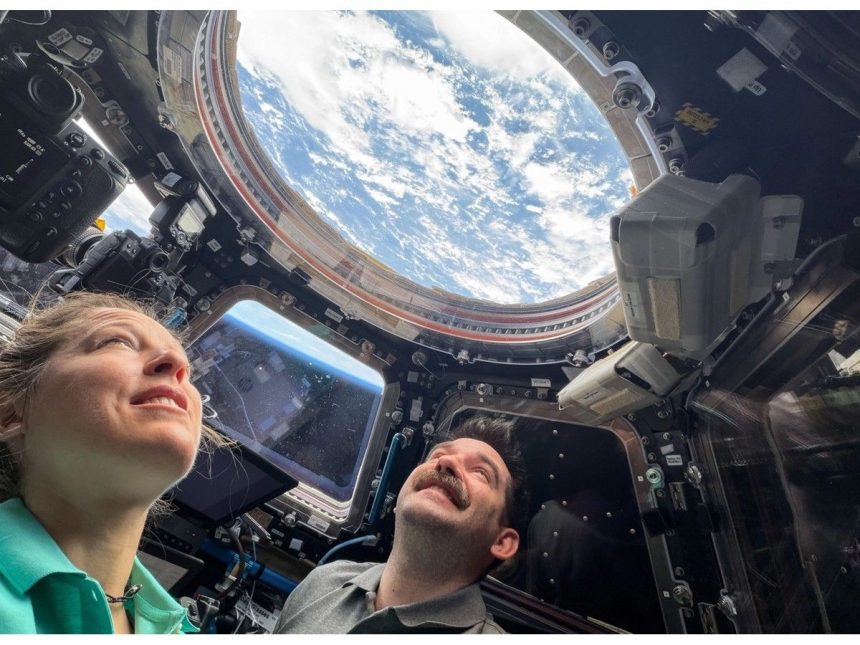
Article contentThe Chandler wobbleArticle contentThere is another wobble, called the Chandler wobble, that affects Earth’s motion much quicker. Named for the American astronomer Seth Carlo Chandler (1846-1913), the Chandler wobble is a small deviation in our planet’s axis of rotation relative to the solid Earth. This wobble, which has a period of only 433 days, causes a change of approximately nine meters to the point at which Earth’s axis intersects its surface.Article contentIn addition to its rotation and axial precession, Earth is also bobbing up and down in space. This bobbing up and down also slightly alters Earth’s axial tilt. An axial tilt is the apparent angle between an object’s rotational axis and its orbital plane around another object. In the case of Earth, our planet’s axial tilt is currently around 23.4 degrees (although it can vary between 22 and 24 degrees) perpendicular to the ecliptic, the perceived path of the Sun, Moon and across the sky as seen from Earth.Article content Astronauts Sophie Adenot of the European Space Agency and Jack Hathaway of NASA, both Expedition 74 flight engineers, look out a window in the cupola, monitoring the automated approach and docking of the SpaceX Dragon cargo spacecraft to the International Space Station on May 17. The orbital outpost was soaring 416 kilometres above the Indian Ocean just west of the Maldives at the time of this photograph. Photo by Sophie Adenot /European Space AgencyArticle contentEarth rotates around the Sun once every 365.26 days on average, giving us our calendar year However, our planet’s orbit around the Sun is not a perfect circle, but, rather, an ellipse. Within this ellipse, the foci of Earth is located closer to one end of the ellipse than the other. This results in Earth, as it follows its orbital path, being farther away from the Sun (aphelion) two weeks after the summer or June solstice (early July), and closer to the Sun (perihelion) two weeks after the winter or December solstice (early January).Article contentArticle contentHowever, each time our planet returns to its perihelion point, that point is in a slightly different place. Earth’s perihelion point shifts in space slightly from year to year, meaning the shape of Earth’s annual elliptical orbit around the sun is also changing slightly.Article contentMilky Way galaxy moving at break-neck speed to the Great AttractorArticle contentOur solar system, as a whole, is also in rotation within the Milky Way galaxy. Traveling at an estimated speed of 792,000 km/hr, our solar system completes one full rotation of the galaxy (referred to as a galactic year) approximately once every 240 million years.Article contentEarth’s forward motion within and along the galactic plane causes it to trace a helix or corkscrew path. In addition, as it accompanies the Milky Way galaxy in its galactic rotation, the solar system, along with our planet Earth, moves up and down, routinely crossing the galactic plane, spending time both above and below the plane. Queasy yet? Our wild ride isn’t quite over yet.Article contentArticle content The Artemis II crew captured this view of Earth setting on April 6, as they flew around the Moon. As the astronauts flew over the Moon’s far side, the crew photographed and described terrain features including impact craters, ancient lava flows, and surface cracks and ridges formed as the Moon slowly evolved over time. The image is reminiscent of the iconic Earthrise image taken by astronaut Bill Anders 58 years earlier as the Apollo 8 crew flew around the Moon. NASAArticle contentFinally, our Milky Way galaxy, along with all the other galaxies that form what is referred to as the local group of galaxies, is moving, or, rather, being drawn towards the Great Attractor, a region of elevated gravitational attraction in space located approximately 150-250 million light-years from the Milky Way galaxy.Article contentOur galaxy, including our solar system and its planets, are being pulled towards the Great Attractor region at a mind-boggling speed of approximately 2,304,000 km/hr. In reality, our solar system will not exist in its present form by the time the local group of galaxies arrive at the Great Attractor.Article contentWhile we can step outside your home and go about our daily activities without being spun in any given direction, our planet is subject to a variety of kinetic forces which cause it to trace a series of elaborate and complex movements through the universe.Article contentFortunately for us, although we experience the direct results of some of these motions, such as the diurnal pattern of day and night, and the changing of the seasons, we don’t experience any ill effects of our planet’s wild roller coaster ride through the universe. I, for one, am quite glad about that.
Earth’s wild cosmic ride through the universe