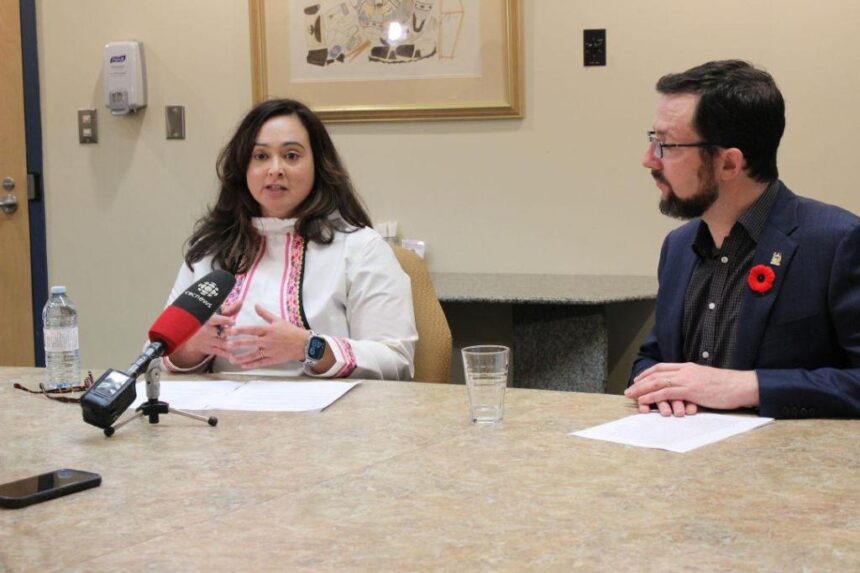
Published 11:45 am Wednesday, November 4, 2026 By William Koblensky Varela Local Journalism Initiative Northern News Service Family Services Minister Gwen Healey Akearok and Premier John Main promised to follow through on the recommendations from the auditor general’s report on foster children, and it will take until 2027-2028 to make the changes, they said. A lack of contact between Department of Family Services employees, the foster children and foster families was a major concern highlighted by the auditor general. Foster children were contacted on average every two months, well below the minimum once-per-month guidelines, and foster parents were contacted every four-and-a-half months, according to the report. “New standards have been implemented that ensure there are checks monthly, minimum contact checks, as well as quarterly reviews,” Healey Akearok said. Those new standards were put in place since the last audit in 2023, when the auditor general made a third warning to Family Services over its supervision of foster children. Healey Akeorok said putting the new standards into force is an ongoing process, and the “implementation is underway.” Ensuring foster homes are safe for children and running criminal background checks on foster parents were areas where Family Services made progress in the six months since the report concluded, according to the minister. Foster homes were inspected for safety in just 52 per cent of cases before a child was placed there, and foster families had missing or late criminal record checks in 53 per cent of cases. Since the report ended on March 31, Healey Akearok said Family Services has completed 97 per cent of home inspections and 92 per cent of criminal background checks. An external review of those statistics provided by Family Services won’t happen until the next auditor general’s report. Foster parents were not informed of a child’s history of trauma or illness in 32 of 44 cases reviewed by the auditor general. A survey has been sent to foster parents over the past year, and the foster parent manual is being updated to address the lack of pertinent information, according to Healey Akearok. The Government of Nunavut will not publicly disclose if it plans on firing any employees over the state of the foster care system, Main said. “When individual government staff cease to be employed with the Government of Nunavut, these things happen regularly across departments as part of ensuring accountability, ensuring that performance is adequate, but we don’t communicate that to the media,” Main said. Poor recordkeeping relating to how many children the GN has in its care and what their conditions are has been a challenge at Family Services, as highlighted by multiple auditor general reports. All foster children’s files are now stored in one electronic system called Matrix, Healey Akearok said, something the auditor general noted was not the case as recently as March 31. Getting Family Services employees to use Matrix has been one of the hurdles to proper recordkeeping. “At this point, 90 per cent of our frontline staff have been trained in Matrix, and over 80 per cent of other staff have also been trained in Matrix, so the training continues,” Healey Akearok said. Getting all foster children’s files in one place, reviewing whether a foster child has special needs, implementing foster care training that includes Inuit cultural connections, making regular payments to foster families and reviewing foster parent payment rates were all part of the auditor general’s reccomendations. On Sept. 2, Family Services increased payments to foster families by 45 per cent. There were approximately 400 children in foster care as of March 31. The auditor general’s report did not cover foster children placed outside of Nunavut.
Family Services could take until 2028 to meet auditor generals recommendations on foster care