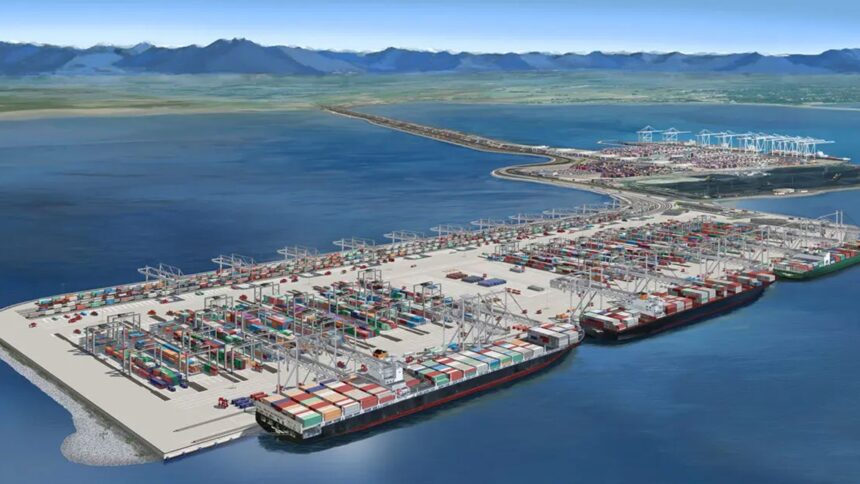
A large-scale port expansion to be located off the coast of Delta, B.C., has been labelled as a ‘project of national interest,’ a designation which, according to environmental advocates, could result in the extinction of the Southern Resident Killer Whales. In an email sent to APTN News on the heels of the announcement, Julia Levin, the associate director of national climate at Environmental Defence, wrote that not only is this “bad news for orcas,” but that it may be “a run-around on the Species at Risk Act, given that was the only approval that the project didn’t have.” Robert Banks Terminal 2 is an expansion of the Port of Vancouver, operated by the Vancouver Fraser Port Authority (VFPA) and located on 130 hectares (about 200 soccer pitches) of marine land off the B.C. coast. According to a release from Ottawa, the project would add 2.4 million containers of annual capacity, increasing it by “approximately 50 per cent.” It would also support “up to $100 billion in annual trade,” therefore “helping Canada achieve its goal of doubling non-U.S. exports by 2035.” It meets the criteria of what can be considered a project in the national interest, according to Bill C-5, the Building Canada Act, which are that it must “strengthen Canada’s autonomy, resilience, and security”; “provide economic or other benefits”; “advance the interests of Indigenous Peoples”; and “contribute to clean growth and to meeting Canada’s climate change objectives.” Once this criteria is met, major projects may be exempt from certain laws, such as the Species at Risk Act. Prime Minister Mark Carney said in a statement that, “By listing Roberts Bank Terminal 2 as a project of national interest, we are better connecting our economy with the world and diversifying our trade. As the world competes for capital, Canada will not wait. We are building a stronger, more independent, and more competitive Canadian economy.” However, the project is also slated to be built in the Fraser River Estuary, which has already lost more than 85 per cent of floodplain habitat and supports 102 species at risk, according to Levin. “The estuary is critical habitat for salmon and SRKW, southern resident killer whales, as confirmed by DFO and the environmental assessment of the project – which assessed that the new terminal would result in destruction of the legally protected Southern Resident Killer Whale’s critical habitat,” she wrote. A 2020 environmental assessment for the project determined that it would cause “significant adverse environmental effects” on Chinook salmon, wetlands, and the resident whales, which have been listed as critically endangered since 2003. An application for a Species at Risk permit, which would allow the building of the Roberts Bank 2 port in the habitat, was filed on Oct. 28, 2024, with a deadline of Oct. 28, 2026 — two days ago, as of publishing. Read More: ‘An incredible animal’: B.C. port expansion could drive southern resident killer whales to extinction, advocates warn As of Friday morning, the tool used to track the permit’s progress on Canada’s website indicated it was overdue, but by the afternoon, the page had been wiped. Canada held a consultation period while it considered the national interest designation, which began In a letter sent to the Major Projects Office by Raincoast Conservation Foundation, the advocacy and research organization wrote that “Designation as a PONI is not an appropriate use of the Building Canada Act. “Raincoast is concerned that the national interest cannot be reduced to container capacity, trade volume and construction speed when the proposal is in the Fraser River Estuary. Promises and investments announced by the federal government … to ensure prosperity by combining regulatory certainty with environmental protection are an insufficient guarantee given the level of harm identified from this project.” Levin stated that, “by declaring this mega-port as a ‘project of national interest,’ Prime Minister Carney has dealt a devastating blow to the last remaining Southern Resident Killer Whales. “This political moment will pass, but extinction is forever.” Emma HoneybunOnline Journalist | WinnipegEmma is a Red River Métis with family roots in St. Malo, Manitoba. She graduated from RRC Polytech’s Creative Communications program in 2023 and went on to serve as a community journalist and photographer for the Free Press Community Review until she joined APTN in 2026. Equipped with a strong sense of justice, she enjoys covering stories in the central prairies for a larger audience. Her work has also appeared in Manitoba Inc. Magazine, the Free Press, and RRC Polytech’s student paper, The Projector. Continue Reading
Feds declare Roberts Bank 2 expansion project of national interest



Leave a Comment