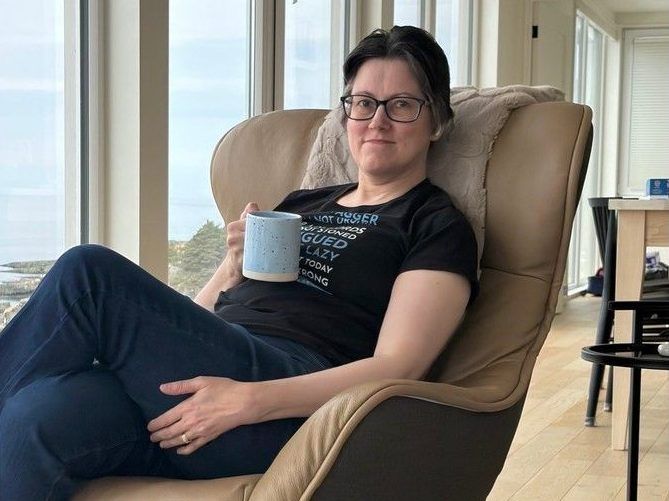
After years of knowing his wife had chosen MAID, Jamie Thornhill says he was still unprepared for the reality of her final day and the life that followedPublished Jul 29, 20268 minute readLorraine Thornhill, who lived with Huntington’s disease and knew for years that she would eventually choose medical assistance in dying. CONTRIBUTEDArticle contentJamie Thornhill had five years to come to terms with the fact that his wife, Lorraine Thornhill, would one day choose medical assistance in dying (MAID).THIS CONTENT IS RESERVED FOR SUBSCRIBERS ONLY.Subscribe now to access this story and more:Unlimited access to the website and appExclusive access to premium content, newsletters and podcastsFull access to the e-Edition app, an electronic replica of the print edition that you can share, download and comment onEnjoy insights and behind-the-scenes analysis from our award-winning journalistsSupport local journalists and the next generation of journalistsSUBSCRIBE TO UNLOCK MORE ARTICLES.Subscribe or sign in to your account to continue your reading experience.Unlimited access to the website and appExclusive access to premium content, newsletters and podcastsFull access to the e-Edition app, an electronic replica of the print edition that you can share, download and comment onEnjoy insights and behind-the-scenes analysis from our award-winning journalistsSupport local journalists and the next generation of journalistsRegister to unlock more articles.Create an account or sign in to continue your reading experience.Access additional stories every monthShare your thoughts and join the conversation in our commenting communityGet email updates from your favourite authorsSign In or Create an AccountorArticle contentBut when that day came, the reality of losing her was something he could never have been ready for.Article contentArticle content“I thought I was prepared, you’re never prepared,” he said.Article contentWhen Lorraine was diagnosed with Huntington’s disease, a progressive neurological condition that had already affected her father and other relatives, she raised MAID at her first appointment.Article contentArticle contentShe wanted to understand the process and know what would be involved when the time came, and Thornhill knew from then that she had made up her mind.Article content Lorraine Thornhill with her husband, Jamie Thornhill, and daughter, Chiara Thornhill, during a family trip together. CONTRIBUTEDArticle content“She walked into the hospital that morning, holding on to my arm, and an hour later, I walked out, and she was gone,” he broke.Article contentThe experience has left Thornhill with a complicated understanding of MAID, one that holds both the peace he saw in Lorraine’s final moments and the difficulties his family encountered around the process.Article contentTHE DATE LORRAINE CHOSEArticle contentLorraine had known for years that she wanted to decide on MAID when the progression of Huntington’s disease had taken her as far as she was willing to go.Article contentBy the time her MAID date was set, Thornhill said, she was mentally prepared.Article contentThen, just days before the appointment, the family was told the date would have to change because the doctor was unavailable.Article contentLorraine had chosen May 24, but the family was told they would have to wait until the following day.Article contentThe extra day meant more time together, but Thornhill said it was still difficult because Lorraine had been preparing herself for a specific day.Article contentArticle content“When someone picks their date mentally, they’re prepared for that date and time,” he said.Article contentLorraine was upset, although the delay also gave her another day with her family and friends.Article contentThe uncertainty continued into the morning of the appointment, when the family knew they were going to the Miller Centre but did not initially know exactly where they were supposed to go.Article contentThey were eventually told to meet at the palliative care unit and would be guided from there.Article contentLORRAINE’S FINAL MORNINGArticle contentThe family had to be at the hospital for 11:30 a.m., and Thornhill had barely slept.Article contentHe and Lorraine’s best friend Kim Mavin expected that the morning would be difficult for Lorraine, but she surprised them by carrying on with her usual routine.Article contentShe put bread in the toaster, ran a bath and ate her breakfast before sitting down to spend some time with her daughter, Chiara, cuddling on the couch.Article content Chiara Thornhill shares a hug with her mother, Lorraine Thornhill, during a moment together. CONTRIBUTEDArticle contentWhen Lorraine looked at the clock, she told them they had to leave.Article content“Guys,” she said, according to Thornhill, “we gotta get going. I can’t be late.”Article contentHe tried to make her laugh, joking that she was not going to a hair appointment and that nobody would care if she was late.Article contentThe family then made their way to the hospital.Article contentThornhill found that he could not immediately go into Lorraine’s room, needing some time to gather himself, while Kim and Chiara went in first.Article contentWhen Kim later told him about those first moments, she described Lorraine as calm and relaxed.Article contentLorraine was even wondering why her IV had not yet been inserted and why the process was taking so long.Article content“This is what she wanted. She was ready,” he said.Article contentEventually, Thornhill went into the room, where Chiara was lying beside her mother on the bed, and Kim was on the other side.Article contentHe stood above Lorraine, holding her hand.Article contentTHE MOMENT SHE PASSEDArticle contentOnce Lorraine was settled, nurses inserted her IV lines and the doctor came in to confirm that she still wanted to proceed.Article contentThe family had time to say their goodbyes, while a minister came into the room to pray with them.Article contentArticle contentThornhill, Chiara and Kim remained with Lorraine.Article contentWhen the doctor began administering the medication, Thornhill said everything happened quickly.Article content“When he put the first needle in, she lifted up her head, and she looked over at me, and she said, ‘I love you,’” he said.Article content“And with that, she was gone. It was that quick.”Article content Chiara Thornhill, Lorraine Thornhill, Jamie Thornhill and Kim Mavin enjoying one of the many moments they shared together, surrounded by Newfoundland’s natural scenery. CONTRIBUTEDArticle contentThe process involved three injections, with the first relaxing Lorraine’s body, the second putting her into a coma and the third stopping her muscles from functioning.Article contentFor Thornhill, the experience was unlike watching someone die after a prolonged illness, where families may spend months or years witnessing a loved one’s suffering.Article contentHe described Lorraine’s death as the most peaceful thing he had ever witnessed, despite the pain of losing her.Article content“There’s not this long death, I call it, watching someone suffering in the bed,” he said. “The family is suffering. But it is so peaceful for her.”Article contentHe believes that is something families considering MAID need to understand, while also recognizing that there is no way to truly prepare someone for what it feels like to be there.Article contentArticle contentTHE JOURNEY HOMEArticle contentThornhill does not remember leaving the hospital.Article contentFriends who had been with the family took his car keys from him and insisted on driving him home.Article contentHe had intended to drive himself, but those around him knew he was not in a state to do so.Article content Lorraine Thornhill, centre, with her husband, Jamie Thornhill, and fellow members of the Gander Lions Club at a club gathering. CONTRIBUTEDArticle contentThe group stopped at Tim Hortons on the way home, but Thornhill cannot remember going inside.Article content“To this day, I still cannot remember going into Tim Hortons,” he said.Article contentLooking back, he is grateful that his friends recognized what he needed in a moment when he could not see it himself.Article contentThe family had also been supported throughout the wider process by friends and relatives, as well as people Thornhill came to know through the Huntington’s community.Article contentHe specifically credits Jill Ford, a resource director, and David McGregor, a genetics counsellor, for their support throughout the years and on the day Lorraine died.Article content“Without them, I don’t know if I’d be here today,” he said.Article contentLORRAINE’S FINAL FAMILY TRIPArticle contentBefore Lorraine’s death, the family took one last trip together around Newfoundland, visiting three places as part of a journey Lorraine had wanted to make with him and Chiara.Article content“Just to see Lorraine’s face,” Thornhill said. “She was so happy and so at peace in Bonavista.”Article contentAs they travelled, Lorraine would often look out the window at the clouds. She would tell her family, “Oh, it won’t be too long now, I’m gonna be up there looking down at you.”Article content“I tell you… that was hard,” he broke.Article content Jamie and Lorraine Thornhill loved going camping and any outdoor trips together. CONTRIBUTEDArticle contentAfter Lorraine died, Thornhill and Chiara travelled to Nova Scotia to spread her ashes, returning to a place that had been an important part of their family’s life and where Chiara was born.Article contentThey also visited friends who had supported the family for years, but the trip carried the weight of another goodbye.Article content“We had our moments where we were spreading Lorraine’s ashes,” he said.Article content Chiara Thornhill and her father, Jamie Thornhill, who have been leaning on each other as they navigate life after Lorraine’s death. CONTRIBUTEDArticle content“That was difficult, just knowing that we were coming back here and a part of her was now there.”Article contentTHE GIFTS LORRAINE LEFT BEHINDArticle contentLorraine had not only prepared herself for her death; she had prepared for the people who would have to live with her absence.Article contentShe had cards and gifts made for Thornhill and Chiara, leaving them to be opened after she died.Article contentArticle contentThornhill kept his in a dresser for almost a month before he could bring himself to open it.Article contentLorraine had a card made for her husband with a message about how much she cared for him, along with other small gifts.Article content Lorraine, Chiara and Jamie Thornhill went on a family trip in April, as Lorraine’s last wish. CONTRIBUTEDArticle contentAfter 27 years of marriage, he said the experience also revealed something about his wife that he had not fully understood before.Article content“It blows me away. I never knew that she had this much strength,” he said.Article contentWHAT HAPPENED AFTERArticle contentThornhill said the support his family received from friends, relatives and healthcare professionals was invaluable, but the experience also left him with the feeling that families could benefit from more support after a loved one dies through MAID.Article content“For the MAID program itself, there is no support, there is nothing afterwards,” Thornhill said.Article contentThornhill said he understands the hospital sees many deaths, but believes the experience of a MAID death is different and that families could benefit from someone checking in with them afterwards.Article contentArticle content Lorraine Thornhill with her mother, Jane Cox, sharing a moment together. CONTRIBUTEDArticle contentThere were also moments during the process when Thornhill felt the family could have been treated with more consideration.Article contentOn the morning of Lorraine’s scheduled death, the family was waiting in the hallway while she was being settled into her room when a nurse told them they could not remain there.Article content“We could have been told this prior, that you can’t be in the hallway, but you don’t have to come out here while we’re waiting for my wife to be settled in the bed so we can go back in to see her,” he said.Article contentFINDING A WAY FORWARDArticle contentIn the months since Lorraine’s death, Thornhill and Chiara have been learning how to live without her together.Article contentThornhill has returned to work, while he and his daughter have kept busy and continued to spend time together.Article contentSome of the ways they remember Lorraine are rooted in the small things she loved, including maple liqueur, which she would have when she and Thornhill went out with friends at the Lions Club or attended a dance.Article contentThe family brought a bottle with them to the hospital on the day Lorraine died.Article contentWith permission, they stood around her bed and each had a shot.Article contentLorraine had three.Article contentOn July 24, what would have been her 55th birthday, Thornhill and Chiara went out for supper, then returned home and had a couple of shots of the same maple liqueur in her honour.Article content‘THE GOOD, THE BAD STUFF’Article contentThornhill has now signed up to volunteer with a MAID program, hoping to support families who are considering the decision or preparing for the death of someone they love.Article contentHis own experience has taught him that there is a difference between being told what the process will be like and actually living through it.Article contentHe wants to be able to talk honestly about both sides of that experience, including the peace his family found in Lorraine’s final moments and the difficulties they faced before and after her death.Article content“I want to share my story. The good and the bad stuff,” he said.Article content“Hopefully I can help families that have got questions or think that they’ve got to figure it out or think they know what’s going to happen, because it’s not what you expect. It’s really not.”Article content Lorraine Thornhill with her best friend, Kim Mavin, who was by her side during her final moments. CONTRIBUTEDArticle contentThe most important thing he would tell families is to make sure they have people around them who can support them through what follows.Article content“Make sure that you’ve got your support system in place,” he said.Article contentThornhill knows now that he could not have prepared himself for the moment Lorraine walked into the hospital holding his arm, or for the silence of the drive home afterwards.Article content“I just want to be able to make sure families that are making this decision understand,” he said.Article content
I thought I was prepared, youre never prepared: NL man reflects on wifes MAID death