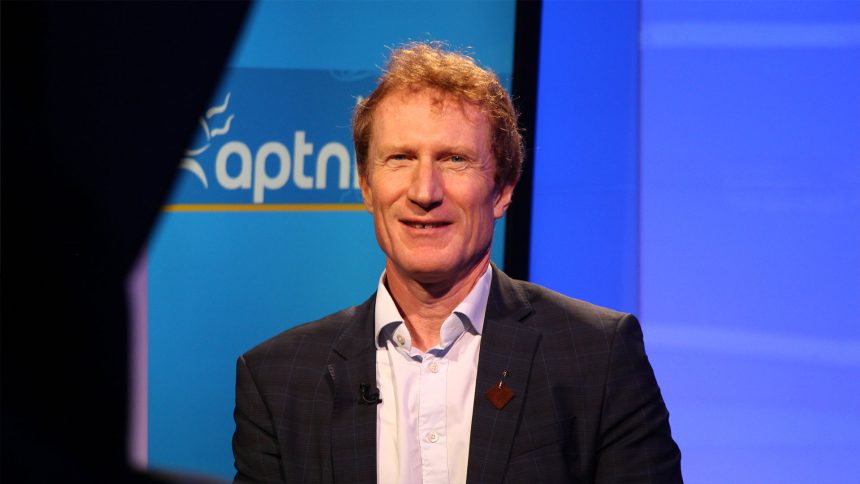
Federal Minister of Canadian Identity and Culture Marc Miller says that he does not believe changes brought on by Prime Minister Mark Carney’s Liberal government have been “at the expense” of reconciliation. “Quite simply, I wouldn’t have supported [Carney], or even probably his state of politics, if I didn’t get a sense for his dedication to reconciliation,” Miller said during a visit to APTN News’ Winnipeg headquarters on Wednesday. “It’s something he cares deeply about.” Miller said he had confidence in Carney’s leadership, but that the changes brought on under his rule have reflected changes in the whole world. In particular, he cited “direct threats from our southern neighbour,” whom Canada was previously able to count on as an ally. “That is something that has taken up a lot of the national and international focus,” he said, adding, “Every government has its flavour and directions, but I wouldn’t question the Prime Minister’s dedication to reconciliation.” When asked about comparisons between Carney’s approach to relations with Indigenous people and nations and that of former Prime Minister Justin Trudeau, Miller said “there’s been some changes,” but that reconciliation remains a priority. He said the government’s commitment is “evidenced primarily by actions that aren’t for the government to judge, but for Indigenous Peoples themselves,” and cited work by Indigenous Services Minister Mandy Gull-Masty and Crown-Indigenous Relations Minister Rebecca Alty as examples of how seriously the Carney government takes Indigenous issues. “Every Minister has to be dedicated to reconciliation,” he said, “but those two primary roles are assumed by two people who care very deeply about the relationship.” Indigenous Languages and the Office of the Commissioner Before being elected into his current role, Miller was Minister of Indigenous Services from 2019 to 2021, of Crown-Indigenous Relations from 2021 to 2023, and of Immigration, Refugees and Citizenship from 2023 to 2025. Since 2025, he has also been the Minister responsible for Official Languages. With respect to the Office of Commissioner of Indigenous Languages, Miller said those languages have a place “that is their inherent right” in the linguistic discourse that defines Canada. “But also,” he continued, “making sure people are reclaiming their language [with] a competent organization that is working extremely hard to do that.” On its 10th anniversary, he said he believes this is a “very important” year for the commission. “There will be a renewal of the leadership,” Miller said. “I think that’s important. But also, a renewal and a reflection on what the law [responsible for the commission] has yielded and not yielded in the past decade or so.” In May 2026, the federal government ordered a special financial audit of the Office of the Commission, following a series of anonymous complaints alleging misspent funds and a toxic workplace environment. Several anonymous sources, including ex-employees, told The Canadian Press that the office “has failed to move the needle on strengthening Indigenous languages and supporting research,” instead focusing on travel and hosting a $10 million conference in Ottawa amid instances of alleged bullying. Sources claimed employees quit in frustration, leaving important projects unfinished. Miller could not comment on the audit, saying those being investigated are not guilty until proven otherwise. “What I have seen, at least superficially, is concerning,” he said, “but it’s something ultimately that will be decided by the outcome of the audits that are not quite complete.” However, Miller said he understands people want answers. “I think [the Office] has an important role in making sure that Indigenous Peoples have the tools to claim and reclaim and vitalize their languages,” he said. “They’re being served by an Office that looks like them and understands the need.” This representation extends to media, Miller added. “The presence of Indigenous voices in the media is something that has been demanded by commission upon commission,” he explained. “It’s obvious people want to see themselves and their stories reflected on the national stage.” He said several media organizations, including APTN, have had to make sure Indigenous stories are better represented in national discourse. This, Miller noted, is why he is “dedicated” to keeping Indigenous media outlets funded. “News organizations across the country and across Europe and the United States are under a lot of stress financially through the prevalence of streaming online, people not necessarily paying their fair share into an ecosystem,” he said. “In the case of [CRTC] regulation, people should be abiding by it a little better and making sure that quality news is getting out and playing an important role in our democracy. “When it comes to Indigenous Peoples, that trust barrier is legitimately quite thin towards the government. [Indigenous news] plays a very important, bridging role in holding people like me to account, but also making sure that there are news stories that reflect Indigenous voices and getting them out in a timely fashion so people can see them properly.” With files from The Canadian Press Tags: Mandy Gull-Masty, Manitoba, marc miller, Mark Carney, minister of Canadian identity and culture, Office of Commissioner of Indigenous Languages, Ontario, Ottawa, Rebecca Alty, Reconciliation, Winnipeg Continue Reading
Identity Minister wouldnt question feds commitment to reconciliation


Leave a Comment