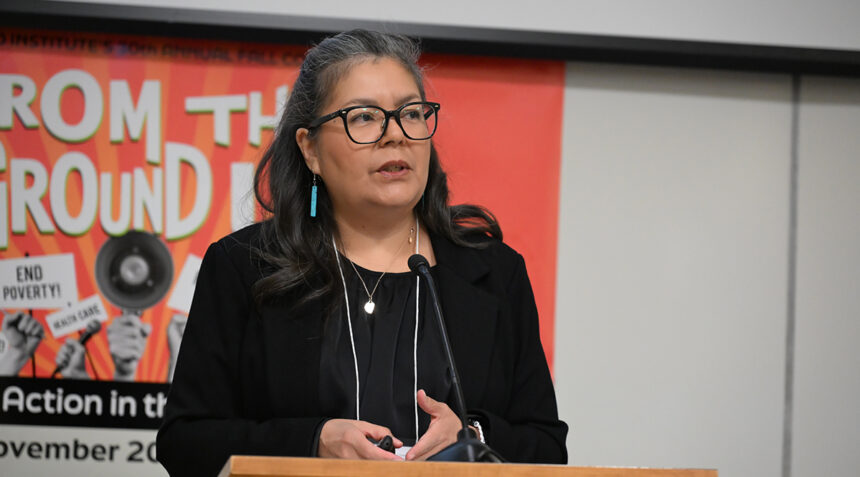
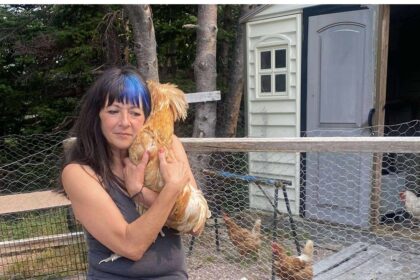
Tanya Kappo delivered remarks at the Parkland Institute’s annual conference at the University of Alberta on Nov. 22. Photo by Paula Kirman. By Jeremy Appel, Local Journalism Initiative Reporter (ANNews) – One of the co-founders of the Idle No More movement places the upsurge of Indigenous participation in Alberta’s 2026 referendum in the historical context of Indigenous resistance across Canada. Tanya Kappo delivered remarks at the Parkland Institute’s annual conference at the University of Alberta on Nov. 22, noting an ambivalence among Indigenous activists about participating in colonial processes to uphold their Treaty and inherent rights. “There’s a delicate balance in First Nations communities about whether or not First Nations should participate in federal or provincial elections or processes, and it’s always a very heated debate,” said Kappo. This tension goes back to the signing of the Treaties, beginning in 1871, and manifested itself again with the Red Power movement that emerged in response to Prime Minister Pierre Elliot Trudeau’s effort to abolish the Indian Act for assimilationist purposes in 1969. Fully understanding the reticence to get involved with colonial institutions, Kappo said that she determines the appropriate degree of engagement on a “case-by-case basis.” Tying together Idle No More and Indigenous mobilization in support of remain was a void of grassroots Indigenous organizing that needed to be filled, she said, emphasizing that she intended “no shade” on Indigenous groups or federalist organizers. She noted that Idle No More began in November 2012 as a series of teach-ins, which were intended to inform Indigenous people about weakening of land and water protections in a series of legislation proposed by then-prime minister Stephen Harper. Kappo herself organized a teach-in in Maskwacis. She put out a call for volunteers on social media and was amazed by the number of people willing to assist her. A local radio station offered to broadcast the teach-in for people who couldn’t attend in-person while others offered to bring bannock and recite prayers at the beginning. “It was as if the stars aligned,” she said. Kappo didn’t have experience as an organizer at the time, “but I was quickly learning and seeing what was important, what was necessary to get things moving,” she recalled. “One of the really powerful things about Idle No More,” said Kappo, “is it made everybody aware that they could be an organizer, they could do this kind of work, and it really built a strong community that way.” The Walking With Our Sisters movement, which Kappo was also involved with, began as an art installation to draw attention to missing and murdered Indigenous women and girls, but soon took on a life of its own through grassroots action. Also in 2012, artist Christi Belcourt put out a call on Facebook for people to send her moccasin vamps for the art project. She ended up receiving 18,000 pairs in the mail. “This was not going to be an art exhibit anymore,” said Kappo. “This is going to be a memorial, a ceremony, and it was to support families in any way we can and to raise awareness. “That was the goal. The guiding principles were love, volunteerism, protocol, ceremony, and humility; those had to be the foundation for any organizing going forward.” The one art exhibit transformed into a series of local events across the country centred around vamp art. Again, it was important that this be a grassroots movement, she added, with the families of missing and murdered Indigenous women and girls “involved in every possible way.” “Community conversations were critical because it had to be the community who was taking ownership of the efforts,” said Kappo. “We were there only to support and help them along the way, distantly.” From 2013 to 2019, she said, the exhibit travelled across the country, beginning in Edmonton and making its way through Regina, Parry Sound, Ont., Winnipeg, Sault St. Marie, Flin Flon, Man., Thunder Bay, Saskatoon, Yellowknife, Comox, B.C., Red Deer, Ottawa, Attawapiskat, North Battleford, Sask., Brandon, Halifax and Grande Prairie, among other locations. The time period overlapped with the 2015 federal elections and the release of the Truth and Reconciliation Commission’s final report, the 2016 Canadian Human Rights Tribunal ruling on the child welfare system and the 2019 Inquiry into Missing and Murdered Indigenous Women and Girls final report. When it came to the 2026 referendum, Kappo noted that First Nations mobilization centred around their exclusion from discussion on whether Alberta should remain in Canada, despite the question directly relating to their Treaty rights. “Not only was it necessary for me to go and vote personally,” she said, “it was so important that I had to try to convince other people that they need to go out and vote as well.” Mobilizing Indigenous voters to support remain meant tailoring messaging towards the defence of Treaty rights. “We’re not going to vote in the referendum because we really care about Canada per se,” Kappo said. Indigenous Peoples’ relationship with Canadian federalism is complicated, given its colonialist history and the largely unfulfilled promises of the Treaties. “Thankfully, a lot of the messaging resonated, and a lot of First Nations and First Nations organizations did end up stepping up, as they were able towards the end to really encourage and get First Nations people to vote,” said Kappo. As this newspaper previously reported, some polling stations on or adjacent to First Nations reserves had results as high as 99 per cent in support of remain.
Idle No More co-founder provides historical context for Indigenous referendum organizing