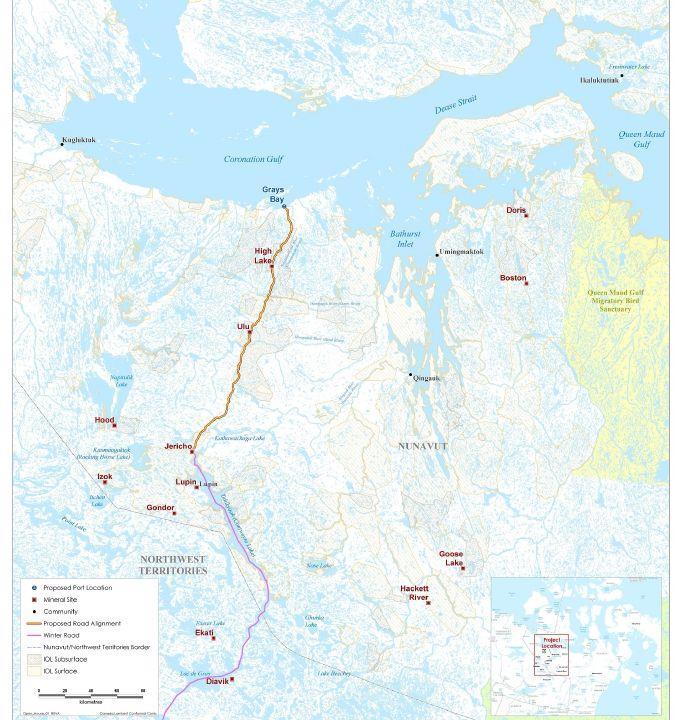
Published 9:58 am Wednesday, October 14, 2026 By William Koblensky Varela Local Journalism Initiative Northern News Service Inuit-owned West Kitikmeot Resources Corporation is aiming to answer 70 questions from the Kugluktuk Angoniatit Association by Oct. 23, hoping to clear another hurdle in the Grays Bay Road and Port project approval process. The project, proposed by West Kitikmeot Resources Corporation, would connect a deep-sea Arctic port to Canada’s highway system for the first time. That would allow for critical minerals like copper and zinc to be mined in Nunavut on an industrial scale. But the Kugluktuk Angoniatit Association, representing hunters and trappers, contends that the port and road project threatens caribou herds in the area. The road would run through the migration route of the Dolphin and Union caribou herd, which is already listed as endangered by the Government of the Northwest Territories. In June, the Kugluktuk Angoniatit Association submitted 70 questions to the Nunavut Impact Review Board regarding environmental impacts of the project. The following month, the harvesters group and World Wildlife Fund Canada released a 13-minute video opposing the project. In the video, Kugluktuk Angoniatit Association manager Amanda Dumond said that West Kitikmeot Resources Corporation was ignoring the harvesters’ concerns. West Kitikmeot Resources Corporation has met with the group five times since 2023, including a site visit and fishing trip last summer, according to the company’s CEO Brendan Bell. “Our discussions with their board members, staff and advisors have been constructive and helpful,” Bell said. Grays Bay Road and Port would connect the highway system in the Northwest Territories through areas with critical minerals deposits and end between Kugluktuk and Cambridge Bay, where a port would allow those minerals to be shipped to markets abroad. Inuit perspectives have been integrated into the project, according to Bell, and he said he’s disappointed that the hunters aren’t satisfied. Kugluktuk Angoniatit Association did not respond to a request for comment. Two Kugluktuk hunters told Nunavut News they see benefits and drawbacks of the proposed road and port. Nigel Allukpik is a former Kugluktuk Angoniatit Association board member and was featured in the video from July. He said there used to be so many caribou they would come through Kugluktuk. “It started to slow down after the exploration camps come around early 2020s,” Allukpik said, “exploration for possible mining, for zinc and copper.” Harmonic vibrations underground are disturbing the migration patterns of the caribou, according to Allukpik, who added that he’s been hunting since he could walk. These days, he said he’s lucky to see five or six caribou on his hunting trips when he used to see about double that. Despite believing that development is already affecting caribou herds, Allukpik also sees the potential benefits of the road and port project. “It is much more needed because then you feel some sort of connection to the rest of Canada, and with people wanting to start business that could be for their kids and their grandkids. Whereas hunting-wise, it’s like our great, great, great grandparents hunted there, and it’s still there for us today,” Allukpik said. The Grays Bay proposal could provide much-needed defence infrastructure for Nunavut, Allukpik noted, which he counts as an important aspect. Kevin Ongahak, also from Kuglutuk, was taught to hunt caribou by his father when he was four-years-old. There’s been a significant decline in caribou near the Grays Bay area, Ongahak said, but he’s also noticed a rebound in numbers over the past two years. He cited two reasons why he thinks the population of Dolphin and Union caribou herd has declined. “One thing was over-harvest. I know of multiple occasions people over-harvesting, like harvesting way too many,” Ongahak said. Climate change was also a factor, as the Dolphin and Union herd migrates across sea ice in the winter. “That ice forming a lot later, and the caribou trying to stick to their old migration patterns coming across the ocean — they’ll definitely run into thin ice. I’m pretty certain whole herds probably drowned from that,” Ongahak said. He also sees the potential benefits to the Grays Bay initiative, particularly from shipping goods up north by road, despite believing that hunting in the area will suffer. An airstrip and wharf platform for unloading ships will be built at a site east of Kugluktuk, thanks to a $50-million contribution from the federal government. The Grays Bay Road and Port is currently scheduled to start construction in 2029, if all necessary approvals are obtained. Between West Kitikmeot Resources Corporation and the Kitikmeot Inuit Association, proponents have been trying to get the project built since 2002. Correction: A previous version of this story failed to attribute comments specifically to West Kitikmeot Resources Corporation CEO Brendan Bell and should have described the proposed port location as between Cambridge Bay and Kugluktuk.
Kugluktuk hunters opposed to Grays Bay Road and Port could get answers by Oct. 23