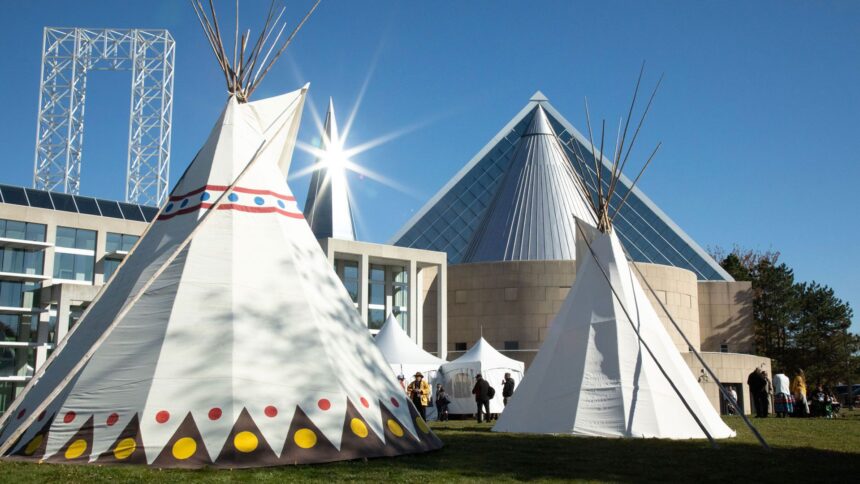
The John G. Diefenbaker Building on Sussex Drive was perhaps, in its own imperfect way, a fitting place for nearly 200 First Nations leaders, most of the country’s premiers and a prime minister to hold a meeting First Nations have wanted for more than a century. It’s actually two buildings mashed together: a modern glass construction, like a church nave, that lets light pour in from above and gives the hallways a sense of something sacred, while behind it, the old city hall rises as a plain grey slab, a maze of stairs leading to small, dark meeting rooms. Outside, the chief set up teepees that strangely echo the building’s peaks. Three very different structures, sharing the same address. “This is the first time in 119 years of Crown-First Nations relations that a first ministers meeting has focused solely on First Nations,” Cindy Woodhouse-Nepinak, the national chief of the Assembly of First Nations, has said many times leading up to the meeting and it’s a line she would repeat at the gathering. Of course, a hundred-year wait puts a lot of pressure on a meeting. After an opening prayer by Algonquin Elder Claudette Commanda, the mic went to Algonquin Grand Chief Verna Polson, who reminded everyone that Ottawa sits on unceded Algonquin territory, that the Algonquin have shared the land, been welcoming and “expect respect in return.” ”We are ready to work with you. That work must begin with respect for our land, our rights, and our responsibilities. Today, I welcome you as our people had welcomed others before you. Respect our land you’re on, listen to the people who have cared for it for generations, and carry the respect into the decision you make today and the years that go by,” said Polson. The national chief’s opening statement covered the hundred-year list of asks: sovereignty, treaty rights, the environment, land, water, natural resource rights, closing the gaps in health, racism in the health system, Jordan’s Principle, Joyce’s Principle, infrastructure, education, jobs, and income. Ultimately, the meeting seemed to be about everything, which made it hard even for those who had spent months preparing position papers, trying to compress a philosophy of survival worked out over generations, into the three minutes most were allotted to speak. “ Of course, three minutes is not nearly enough time,” said Assembly of Manitoba Chiefs Grand Chief Kyra Wilson. “And having one representative speak on a number of different issues, it’s very difficult to ensure that we’re getting everything forward in terms of what our needs are as First Nations and our respective regions.” Space was also limited, she added, “I’m somewhat disappointed that some of our leadership who should have definitely been in the room were not able to be in the room.” Chiefs crammed so much into each three-minute burst. In his opening remarks, Chief Sheldon Sunshine of the Sturgeon Lake Cree Nation, speaking on behalf of Treaty No. 6, Treaty Number 7, Treaty Number 8, and the Blackfoot Confederacy delegation, said the meeting must be about changing the relationship. “ I’ve heard people describe this meeting as historic. It certainly has the potential to be. But history will not remember us for gathering in a room, taking photographs, making speeches,” said Sunshine. “History will judge us by what we change. “Prime Minister, premiers, we need your commitment for a different way forward, one that is grounded in treaty, demonstrates the respect for treaty nations, and a shared responsibility and results.” Inside the room at the First Ministers Meeting Photo: Raven Brascoupe/APTN. Matthew Coon Come was back in the room, this time as a consultant on natural resource rights. He is a former AFN national chief who served from 2000 to 2003, and a former grand chief of the Cree in Quebec, credited with helping stop Hydro-Québec’s Great Whale project, which threatened to flood Cree and Inuit lands. “You’re right, I’ve been in a few meetings,” Coon Come joked when reporters asked for his insights on what would make this meeting a success. “One of the challenges of meetings of this nature is that you’re tempted to rehash history, repeat injustices, talk about unfulfilled obligations of the federal government. “If this First Ministers’ meeting is to succeed, it must come up with concrete measures for next steps. If they don’t do that, this is another meeting of just talks — ‘we’re going to do this, we’re going to do that’ — but nothing concrete,” he said. After opening remarks, the doors closed to the public, including the media, as is tradition for the non-Indigenous governments at the table. ”You know, we wish that the media could have been there for the entire day to see all the deliberations,” said Woodhouse Neepinak. So in a closed-door meeting about almost everything, how do you know if the thing that gets picked to work on is the thing that matters most and who did the picking? Chiefs came out with very different perspectives and pieced together the day’s key themes. The public statements and announcements from PMO After the Elder spoke Monday morning, Prime Minister Mark Carney made a public statement that set the context for the talks as he saw them: the economy, a nod to the outside threats to Canada’s sovereignty from the United States. The answer, he said, was to pull together. Then he reminded the room of what Canada has already committed to First Nations as measured in dollars: $3.5 billion more a year for education on reserve, more than $4 billion for housing, $4.5 billion for water and $6 billion for health. More, he promised, would come later in the day and in the budget. His job now, as he saw it, was to make that money work better and ensure First Nations share in the wealth from Canada’s projects. At the end of the day, after keeping the press and the national chief waiting more than an hour for a scheduled news conference, Carney arrived with pre-packaged announcements. There was $260 million to connect Indigenous (not First Nation-specified) workers with jobs tied to his economic vision for Canada through “major projects,” more than $2.5 billion for emergency preparedness and wildfire response, more than $630 million for policing, and a promise of changes to expand First Nations lending. Some of the funding announcements were high on a list of priorities. Chief Kirby Constant of James Smith Cree Nation, safety and policing are an issue. In September 2022, his community lived through a mass stabbing that killed 11 people and injured 17. This fall, it marked four years since the tragedy. “First Nation policing is big on our agenda in Saskatchewan, because we feel like without First Nation policing, the RCMP is not fulfilling their requirements to keep our community safe, so the public safety aspect of that is really big on our forefront,” he said. For others, the First Nations-led agenda still seemed to revolve around what the prime minister wanted. “The structure, format and agenda of this meeting were solely reflective of federal and provincial interest,” B.C. Regional Chief Terry Teegee said in a news release. “The limits placed upon First Nations to participate in this meeting are unacceptable. The Prime Minister and the Premiers have an obligation to meet directly with First Nations to engage in reciprocal dialogue on issues of shared importance, not simply those items which align with this government’s priorities.” Still others said program money wasn’t the point. They had come to change the relationship. “ Our nations are not obstacles to Canada’s future. We’re treaty partners. Our knowledge, laws, and solutions must be respected,” said Sunshine. “The question is not whether we can build a stronger Canada. The question is whether you are prepared to build a future that honours our treaties and includes our treaty First Nations.” What they came for: AFN AFN National Chief Cindy Woodhouse Neepinak addresses the First Minster’s meeting. Photo: Keelan Jacobs/APTN. In the days before the meeting, the Woodhouse Nepinak repeatedly told reporters she hoped it would not be “one and done,” and hoped for a follow-up in 2027, a sentiment Manitoba Premier Wab Kinew echoed on his way in. By the end of the day, the prime minister made it clear that was unlikely, saying success isn’t measured by how often they meet and that timing might be right again in two years, depending on progress. For Chief Jeff Copenance of Onigaming First Nation, the idea of ongoing talks at any table is hopeful. He advised former prime minister Paul Martin on the 2005 Kelowna Accord, which was never implemented after the government fell. “Paul Martin’s government held 18 months of talks, and then held a meeting; the Carney government seems to want to do the opposite, hold the First Minister’s meeting then hold 18 months of talks. I’m keeping my mind open,” said Copenance. The AFN also floated the idea of a sovereign wealth fund during one of their meetings, pooling money so communities can own part of projects built on their land. The idea started with Chippewas of the Thames First Nation and the Anishinabek Nation. The AFN brought it to the table as a national project proposal, though details on how it would work, if it ever comes to fruition, remain up in the air. The prime minister said he was open to exploring the idea. Then Carney committed to a process that moves Canada beyond the Indian Act, after Manitoba Premier Wab Kinew flashed his status card at the press mic during the midday break, and, as the prime minister put it, “other participants in the meeting” raised it too, though “not everybody.” How did the Indian Act come into it? With so much of the day spent on the United Nations Declaration on the Rights of Indigenous Peoples, or UNDRIP, and on First Nations rights, it was a strange turn to start talking about the trappings of a Canadian law. Abolishing or somehow fixing the Indian Act, is a commitment made before. More than one prime minister has regretted tinkering with the Act. Jean Chrétien tried it in 1969 with the White Paper. At the time, Canada’s constitution didn’t recognize land and treaty rights, and the courts barely did, having heard very few cases because a longstanding clause of the Indian Act made it illegal for First Nations to hire lawyers to pursue claims. Wiping out the Act then would have wiped out reserves without leaving land title or treaty rights in their place. In more recent attempts, after many court cases, constitutional amendments, and UNDRIP, the question was no longer whether to get rid of the outdated Act, but how. In 2012, Stephen Harper’s government backed a private member’s bill to repeal it. Justin Trudeau tried it in 2018 with his rights framework. Each time, the Indian Act has outlived the promise. Even the Carney government’s latest attempt at a narrow fix to Indian status, through Bill S-2, has sparked controversy. Many First Nations openly support a Senate amendment that would end the second-generation cut-off. Indigenous Services Minister Mandy Gull-Masty has been consulting instead on band membership, which is separate from legal status. Natural resource ownership For many chiefs, economic reconciliation came down to land, and who owns what lies beneath it. Signed in 1930, the Natural Resource Transfer Agreement (NRTA) handed control of Crown lands and resources from Ottawa to Alberta, Saskatchewan and Manitoba. First Nations were not part of those talks. The agreements also narrowed hunting, fishing, and trapping rights to hunting for food, cutting off the commercial rights First Nations understood the treaties to protect. “ Right now, the province has full control and authority over the lands and resources within each province of Manitoba, Alberta, Saskatchewan,” said Grand Chief Kyra Wilson. “And of course, we know that’s not something that was identified in the treaties. It was all about sharing the lands, the resources, and the wealth, and First Nations have not seen that, and we continue to see decisions imposed on First Nations when it comes to lands, resources, and water.” Inside the meeting, Okimaw Vernon Watchmaker, chief of Kehewin Cree Nation and former grand chief of the Confederacy of Treaty 6 First Nations, raised the issue. Matthew Coon Come was in the room, this time as a consultant on natural resource rights and the architect of the proposal. “The NRTA remains an unfinished matter that Canada must be prepared to address,” Coon Come said. “The question is not simply who controls the resources; it is whether the transfer of resource jurisdiction in 1930 properly accounted for the rights, interests and constitutional relationship of First Nations. “Today we are asking to establish a formal negotiating table,” he added. “We are not asking for every question to be resolved today. We are asking governments to agree that these questions deserve a fair, structured and good-faith process.” What chiefs want, he said, is “constructive constitutional negotiations.” According to Coon Come, Saskatchewan Premier Scott Moe said in the meeting that he was willing to set up a table for discussion, and the prime minister said he would comment later. Questioning if the transfer of natural resources to the provinces is even legal was a difficult topic to raise in a room where the prime minister had spent the morning talking about fast-tracking major projects, many of them on First Nations land. Read More: Carney open to conversations around ‘moving beyond’ the Indian Act Protest outside First Nations–First Ministers Meeting decry closed doors and ‘economic coercion’ Diplomats and disruptors: First Nations get set for a meeting with Canada’s leaders with ceremony For Chief Christine Longjohn of Sturgeon Lake First Nation in Saskatchewan, it came back to the treaties. “Our land is important to us. We know that when the treaties were signed… our Elders tell us that when we signed the treaties, we agreed to share the land to the depth of a plough. I have travelled all over the world, all over Canada, and I have seen what has been built over the depth of a plough throughout our country,” she said. Modern Treaty Chiefs Nisga’a Lisims Government President Eva Clayton, co-chair of the Land Claims Agreements Coalition, spoke for 29 nations with modern treaties and self-government agreements. She said they came to help. Canada has ambitious nation-building projects underway, she said, “and the modern treaties are ready for that.” For her, participation means being “involved right from day one.” When asked by reporters, she also said she was not worried about Bill C-39. Bill C-39, the Building Canada Strong Act, is almost certain to pass in the Liberal majority government; it would let Ottawa fast-track major projects, exempt some from environmental laws, and set a one-year timeline for decisions. Several regional First Nations organizations have rejected it, saying it overrides their rights and squeezes consultation into federal timelines. The prime minister says it only speeds up Ottawa’s own work, “not a timeline on section 35 consultations.” But Clayton pointed to what sets First Nations with modern treaties apart. “We are constitutionally protected and we have rights that differ from the other First Nations because of that.” Her message to First Nations worried about the bill was to look at “how they can benefit and how they can glean from the opportunities that arise out of Bill C-39.” Bread and butter issues Chief Kelsey Jacko holds up his speech, which he says he never got to read: Photo: Karyn Pugliese/APTN. For Nishnawbe Aski Nation Grand Chief Alvin Fiddler, none of it could be separated. In a press statement, Fiddler said several communities are being pressured to open their territories to resource development while trying to address the impacts of climate change, dealing with boil water advisories and losing young people to addictions and suicide. Marten Falls First Nation, a partner in the proposed road into the Ring of Fire, is a case in point. “How can you expect a community like Marten Falls to effectively negotiate a meaningful agreement while trying to access clean water for themselves? They have been on the boil water advisory list since 2004. The same as my community,” he said. “My message to you, Prime Minister, and to the Premiers, is this: our Treaties should not be seen as obstacles to your economic agenda. They should be viewed as the foundation of our relationship. That is the only way we can make meaningful progress — if there is respect on both sides.” Chief Kelsey Jacko of Cold Lake First Nations said he felt snubbed when he was told he could not close out the meeting because the prime minister had to leave to host a state dinner for the Crown Prince of Abu Dhabi, Sheikh Khaled bin Mohamed bin Zayed Al Nahyan. Jacko took a red-eye to the meeting because of two funerals at home, and he wanted to share that story in the speech. But, in the end, he never got to read it. “Do you know some of our families still dig the graves by hand? Lots of reserves don’t have the equipment to do that for them. For all the colonial leaders in this room, when we talk about intergenerational trauma, we aren’t always talking about the stuff in the past,” he said. Jacko has been an outspoken leader on treaty rights, and his community is challenging Ottawa’s decision to designate the Pacific Link pipeline as a project in the national interest, but most of his speech was conciliatory. “We need each other now more than ever and I hope we can count on Canada and the provinces to be there for us the same way First Nations were for them,” he said. Everything Else With so much on the table, from economic reconciliation to treaty rights to the bread-and-butter issues that keep too many First Nations in poverty, it was hard to know what the prime minister would carry out of the room. “Over these two days, we saw Canada as its best,” said National Chief Woodhouse Nepinak. “I think he knew that 39 was going to be a problem. He understands the sovereign wealth aspect and what that can mean. I think the prime minister also understands the social issues affecting our communities, which are very real and have been made clear to me by my leadership. But what that understanding will translate into is still unknown at this point,” said Ontario Regional Chief Abram Benedict. So what to make of it all? This was a First Nations-led meeting, but it happened in the prime minister’s context: one project, one year, everything faster, to save Canada’s sovereignty. For First Nations still waiting on their rights and on the most basic bread-and-butter issues, the problems a century of being left out created may not be solvable on a one-year clock. If it’s possible, they’re up for it. But is it possible? It’s a hard message for a prime minister in a hurry. Correction: This story was updated to say that Chief Watchmakers is the former grand chief of the Confederacy of Treaty No. 6 First Nations. The current Grand Chief is Joey Pete, who was not in attendance. We regret the error. Karyn PuglieseOnline Journalist | OttawaKaryn, aka Pabàmàdiz, is an award-winning journalist who taught for 5 years at Toronto Metropolitan University. She is known for her work on the national political beat, press freedom issues, and her reporting on Indigenous communities. She got her start in APTN’s Parliament Hill bureau and returns as our national affairs correspondent in Ottawa after working at CBC and Canada’s National Observer. Karyn is a citizen of the Pikwàkanagàn First Nation in Ontario. Tags: AFN, Assembly of First Nations, Chiefs, Cindy Woodhouse Neepinak, First Minister’s meeting, Mark Carney, National Chief Cindy Woodhouse Neepinak, Ottawa, Premiers, resources, Treaty Rights, UNDRIP Continue Reading
Nearly 200 First Nations leaders, the prime minister and premiers gathered for a historic meeting about almost everything. Now what?

Leave a Comment