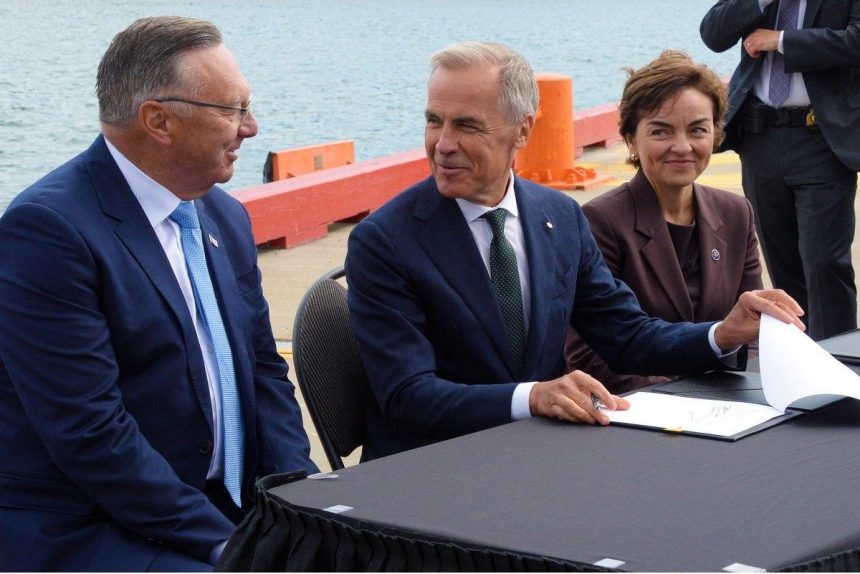
Some critics and analysts are ready to temper the positive spin on the latest deal to develop Labrador’s energy resourcesAuthor of the article:By Gary Kean • The TelegramPublished Aug 20, 20267 minute readPrime Minister Mark Carney (centre), Newfoundland and Labrador Premier Tony Wakeham and Quebec Premier Christine Fréchette at Monday, Aug. 17, 2026 announcement regarding Churchill Falls. Some critics and analysts are ready to temper the positive spin on the latest deal to develop Labrador’s energy resources. Photo by Keith Gosse/The TelegramArticle contentThe sheen has started to wear off the shiny new Churchill Falls energy agreement for some of the analysts who have begun scrutinizing the deal.THIS CONTENT IS RESERVED FOR SUBSCRIBERS ONLY.Subscribe now to access this story and more:Unlimited access to the website and appExclusive access to premium content, newsletters and podcastsFull access to the e-Edition app, an electronic replica of the print edition that you can share, download and comment onEnjoy insights and behind-the-scenes analysis from our award-winning journalistsSupport local journalists and the next generation of journalistsSUBSCRIBE TO UNLOCK MORE ARTICLES.Subscribe or sign in to your account to continue your reading experience.Unlimited access to the website and appExclusive access to premium content, newsletters and podcastsFull access to the e-Edition app, an electronic replica of the print edition that you can share, download and comment onEnjoy insights and behind-the-scenes analysis from our award-winning journalistsSupport local journalists and the next generation of journalistsRegister to unlock more articles.Create an account or sign in to continue your reading experience.Access additional stories every monthShare your thoughts and join the conversation in our commenting communityGet email updates from your favourite authorsSign In or Create an AccountorArticle contentThe Definitive Cooperation and Implementation Agreement between Newfoundland and Labrador Hydro, Hydro-Québec and Churchill Falls (Labrador) Corporation Limited was announced by the premiers of Newfoundland and Labrador and Québec and Prime Minister Mark Carney in St. John’s on Aug. 17.Article contentArticle contentArticle contentThe agreement is meant to right the wrongs of the 1969 Churchill Falls contract between the two provinces that has heavily favoured Québec and is not set to expire until 2041.Article contentIn the decades since that deal, Québec has been buying electrical power below market prices from the hydroelectricity plant in Labrador and has generated billions from selling it. Newfoundland and Labrador has received a mere fraction of the profits.Article contentThe new deal also replaces the memorandum of understanding reached between former administrations of the two provinces in December 2024, an agreement Newfoundland and Labrador’s current premier, Tony Wakeham, had committed to renegotiating.Article contentIt promises both provinces more hydro power than the 2024 MOU, adds in 2,000 megawatts of wind power thanks to assistance from the Canadian government, and promises $13 billion more in revenue for Newfoundland and Labrador.Article contentFrançois Bouffard, an associate professor in the Department of Electrical and Computer Engineering at McGill University in Montreal and an expert in Québec’s power systems, still sides with the assessment that the deal is a win for all involved because it is economically advantageous to both provinces.Article contentArticle contentQuébec, said Bouffard, wants to be able to generate more hydro power and none of its river resources compare with the potential and feasibility of what the Churchill River offers.Article content“When you’re looking at Churchill Falls and juicing the current turbines by modernizing them to today’s standards and then expanding with the construction of Gull Island, it’s a no-brainer …. This is the best renewable energy project in North America, without a doubt,” he said.Article contentBouffard said making amends for the infamous 1969 contract was important and acknowledged any new deal will come with apprehension that Newfoundland and Labrador will get taken advantage of once again by Québec.Article contentThe revised arrangement, though, promises Newfoundland and Labrador much-needed new revenue from selling its power and significant economic opportunities from access to more power, particularly for the mining sector in Labrador, noted Bouffard.Article contentHe sees the biggest win for Newfoundland and Labrador being the opening of a corridor to send as much as 985 megawatts of power through Québec for sale into the American marketplace.Article content“From what I understood in the technical briefing yesterday that we had with Hydro Québec, they will be able to loop Muskrat Falls through that transmission corridor,” said Bouffard. “So, if the (Maritime Link) subsea cable (delivering Muskrat Falls power to Nova Scotia via Newfoundland) goes down, like it’s happened in the past, they’d have an alternative path for the power from Muskrat Falls to flow to the continent.Article content“So that’s really good news, from a from a technical standpoint.”Article content‘EXACTLY LIKE THE ORIGINAL 1969 CONTRACT’Article contentGabe Gregory was one of a group of five notable, independent experts in business, finance, law and energy who had urged Wakeham to overhaul the 2024 MOU.Article contentWhile he has yet to discuss the ins and outs of the latest iteration of a deal with his group, noting an agreement of this magnitude takes considerable time to analyze in detail, Gregory’s initial concern is that little has changed with regard to the Gull Island component of the deal.Article contentArticle contentHydro Québec, said Gregory, still has the same 40-per cent ownership and control of the Gull Island project, but has now taken the responsibility of the construction of transmission with Labrador from what had previously been Newfoundland and Labrador Hydro’s responsibility.Article content“Hydro Québec remains in control of all decisions related to the Gull Island development, including the entire decision as to when and if it will ever get built,” said Gregory. “There is a plan now to add more capacity at Gull Island with an additional generator. We can assume this is to produce more peak energy when required to backstop wind developments that are planned.Article content“So, while Newfoundland and Labrador puts up 60 per cent of the investment cost, Hydro Québec will take 84 per cent of the energy at a fixed cost for 50 years. It is a deal exactly like the original 1969 contract with no re-openers, no provisions, for price change due to increased market value over time.”Article contentGregory’s preliminary take on the new deal is that Newfoundland and Labrador is also giving up its right to review and increase royalty and rents on the water once the deal is signed.Article contentArticle content“Today, Newfoundland and Labrador has the legal right to add new tariffs or royalties and water rents on power production,” he explained. “In the new deal, it is giving up that right. Québec is ensuring that any future Newfoundland and Labrador government will have absolutely no rights to any water royalties or water rents beyond what is in place today, which is extremely low, next to nothing, as the water rents and royalties are controlled by the 1961 lease and have never changed.”Article content Former Newfoundland premier Joey Smallwood stands near the Churchill River in Labrador before the 1969 Churchill Falls power agreement was signed with Quebec. CONTRIBUTEDArticle content‘TIME IS ON OUR SIDE, NOT THEIRS’Article contentThe finer details of the 71-page agreement are also being pored over by Greg Roberts, a Newfoundland and Labrador businessman who has penned a series of in-depth social media posts about the Churchill Falls issue that he says are based on research and consultations with a long list of experts on the subject.Article contentIn his first post since the agreement was announced, Roberts said Tuesday that the federal government’s willingness to invest $10 billion into the project is a good thing and there are some improvements on the 2024 MOU, but Newfoundland and Labrador’s negotiating team still had to contend with a problematic framework of a deal to start with.Article content“This deal is the 1969 contract, written again,” wrote Roberts, who did not respond to a Postmedia request for an interview on Wednesday. “Same result. More pages. More complicated language.”Article contentAnd that complication, he continued, is on purpose.Article content“Hydro-Québec’s negotiators built it that way so it would be harder for the N.L. government and its people to see what is being given up,” said Roberts. “When you strip the 71 pages down and do the arithmetic on the numbers in their own annexes, using their own price forecasts, the answer is the same as 1969. Québec gets our power for a fraction of what it is worth, and keeps the difference. For 50 more years. Starting in 2027.”Article contentRoberts vowed to show that this is the case with more detailed analysis of the agreement in the weeks to come.Article contentIn advance of that, he noted how Québec’s own senior negotiator has said the December 2024 MOU was the same deal as 1969, how Newfoundland and Labrador’s own Independent Review Committee said that MOU was not in the province’s long-term interest and how Québec’s own utility and premier have said the newest deal is even better for Québec than the 2024 one, at a lower cost, worth $200 billion in savings to them over 50 years.Article contentArticle content“Every one of those statements is on the public record,” wrote Roberts. “Every one of them is true. And every one of them says the same thing when you put them together: What was 1969 for us in 1969 is 2027 for us in 2027.”Article contentRoberts said he understands much hard work has gone into this file, especially in recent years, and there are big expectations from government, the utilities and the general public to see a final deal.Article contentThe legacy such a massive, historic deal leaves should trump all those hopes and dreams, he urged.Article content“A legacy built on a flawed deal of this scale is not a comfort,” he said to the decision makers. “It is a source of pain — for the rest of your own working life, and for your children and grandchildren, who will live inside its consequences long after the signing ceremony. Legacies that come from difficult, principled resets — from saying no when saying yes was easier — are the ones that hold up over time. The 1969 negotiators believed they had done the right thing too. It is not their memory people wrestle with today. It is the terms of the contract they signed.”Article contentArticle contentRoberts suggested Newfoundland and Labrador bring in even sharper expertise that better matches Québec’s, and to take the time to work out a definitive agreement that does its population justice.Article content“If they are not ready to meet us on those terms, we wait,” said Roberts. “Time is on our side, not theirs … The Churchill River is not a wasting asset. It is an appreciating one. Every year we hold, the value of what we own increases, and the cost of what Hydro-Québec would otherwise have to build to replace it increases with it.”Article contentRoberts also believes the five-decade agreement is far too long and should be reduced to 25 years with mandatory five-year price openers to revisit the economics.Article content“Every serious modern large-hydro contract with real market discipline uses openers of that kind,” he said. “Fifty years without them is not a financing requirement. It is a negotiating outcome — theirs, not ours.”Article content
Not everyone thinks new Churchill Falls agreement is a ‘win-win-win’