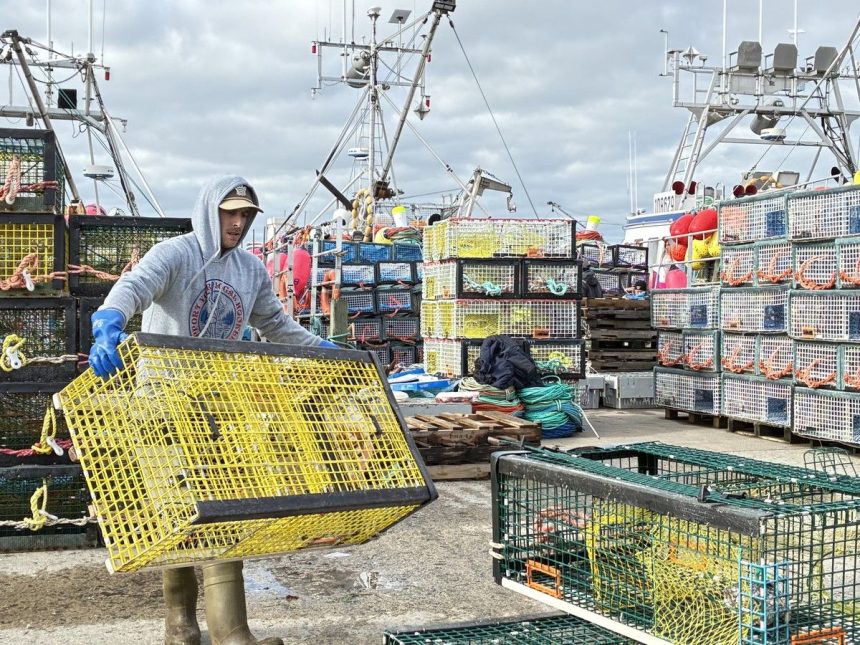
A fisherman carries a lobster trap at the Falls Point wharf in Woods Harbour, N.S., while gearing up for the opening of the lobster fishery season in November. Photo by Kathy JohnsonArticle contentTwenty seafood and aquaculture companies across Nova Scotia received a share of $2.22 million in provincial funding to reduce their use of fossil fuels and cut greenhouse gas emissions.THIS CONTENT IS RESERVED FOR SUBSCRIBERS ONLY.Subscribe now to access this story and more:Unlimited access to the website and appExclusive access to premium content, newsletters and podcastsFull access to the e-Edition app, an electronic replica of the print edition that you can share, download and comment onEnjoy insights and behind-the-scenes analysis from our award-winning journalistsSupport local journalists and the next generation of journalistsSUBSCRIBE TO UNLOCK MORE ARTICLES.Subscribe or sign in to your account to continue your reading experience.Unlimited access to the website and appExclusive access to premium content, newsletters and podcastsFull access to the e-Edition app, an electronic replica of the print edition that you can share, download and comment onEnjoy insights and behind-the-scenes analysis from our award-winning journalistsSupport local journalists and the next generation of journalistsRegister to unlock more articles.Create an account or sign in to continue your reading experience.Access additional stories every monthShare your thoughts and join the conversation in our commenting communityGet email updates from your favourite authorsSign In or Create an AccountorArticle contentThe money is from the third round of the Fisheries and Aquaculture Energy Efficiency Innovation Fund, a three-year program administered by Efficiency Nova Scotia. The fund is expected to provide a total of $6.5 million for projects aimed at helping seafood companies adopt new technology and improve energy efficiency.Article contentArticle contentArticle contentAmong the projects being funded are hybrid propulsion systems for fishing vessels and solar panel installations.Article content“The seafood sector is a pillar of Nova Scotia’s economy and culture, and we’re thrilled to offer this support,” Nova Scotia Fisheries and Aquaculture Minister Kent Smith said at the funding announcement at Deep Cove Ocean Products in Blandford, N.S., a coastal fishing community about 70 kilometres southwest of Halifax.Article contentNova Scotia exported $2.4-billion worth of seafood in 2024, maintaining its position as Canada’s top seafood exporter.Article content Kent Smith, Nova Scotia minister of fisheries and aquaculture (left), speaks with Andy Schnare, president of Deep Cove Ocean Products, during a tour of the company’s facility in Blandford, N.S. Photo by Province of Nova ScotiaArticle content“The energy efficiency technology that organizations are able to adopt with this funding decreases their carbon footprints and reduces their operational costs,” said Smith. “It’s a win-win.”Article contentDeep Cove Ocean, a live lobster holding and wholesale export operation, received $60,000 to install floating head refrigeration and a heat exchanger at its holding and processing facility. Deep Cove president Andy Schnare said the investment will immediately reduce energy costs and the company’s carbon footprint while allowing it to continue investing in energy-saving equipment.Article contentArticle content“Deep Cove is putting together an energy-reducing technology program that we hope, in less than three years, makes our business net zero and saves us hundreds of thousands of dollars over the next 15 years,” Schnare said in a news release.Article contentArticle contentThree companies received the largest amount of funding, at $350,000 each.Article contentGlooscap Fisheries, which operates facilities along the Bay of Fundy, will use the money to build a lobster boat with a hybrid propulsion system, while Fat Tuna Fisheries of Bayfield will convert a multi-species fishing vessel to hybrid propulsion.Article contentTown Point Oysters of Antigonish will use its $350,000 to electrify an oyster barge that will be charged with its existing solar infrastructure.Article contentTwo other companies received six-figure funding.Article contentDSB Fisheries of Antigonish got $348,800 to convert its lobster fishing vessel to hybrid propulsion. NovaCan Live Seafoods received $100,000 to install a solar photovoltaic system with battery storage and a wind turbine at its live seafood holding and processing facility in Arichat, on the southeastern tip of Cape Breton Island.
Nova Scotia seafood companies get $2.2 million to cut energy costs, emissions