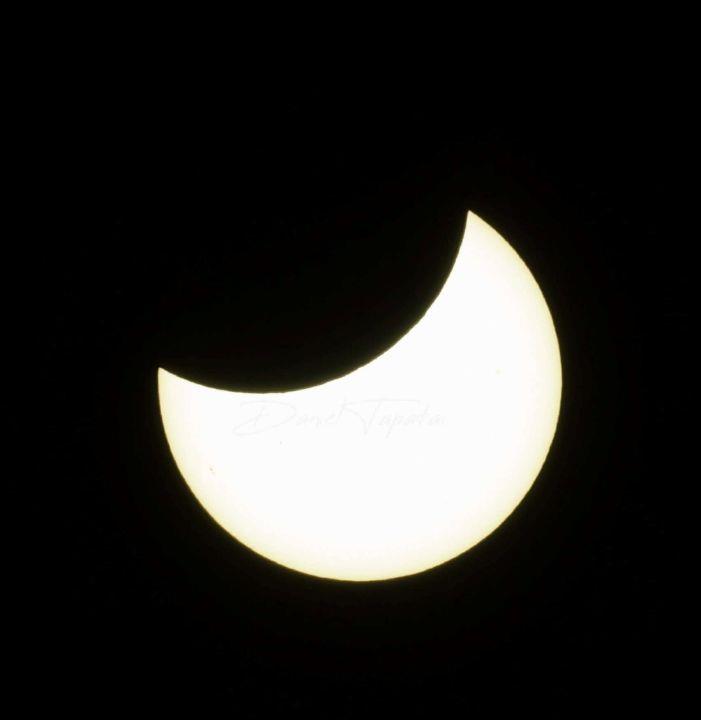
Published 12:40 pm Thursday, August 13, 2026 By William Koblensky Varela Local Journalism Initiative Northern News Service A partial solar eclipse lasted for four-and-a-half hours on Aug. 12, but was mostly visible across Nunavut. Photographer Daniel Tapatai, from Baker Lake, said he used protective glasses known as neutral density filter 64 to watch the event. He also had a filter on his camera to protect it from damaging solar rays. “Witnessing a partial eclipse for the first time was pretty cool,” Tapatai said. In Iqaluit, Sandi Chan observed the eclipse from outside her office using protective glasses she’s owned for the past eight years. Chan lent her glasses to co-workers, people leaving the gym, and a passing taxi driver to watch the eclipse from a nearby parking lot for five minutes. “It felt pretty magical,” Chan said. “This one was really high contrast. It felt really, really big.” She’s watched a few other eclipses in the past, and got her protective glasses when an astronomer visiting town handed them out at Ecole des Trois-Soleils. The Canadian Space Agency predicted Iqaluit would experience significantly more of the eclipse than other parts of the country. One day earlier, the Department of Health advised Nunavummiut to stay safe during the solar event. “Directly viewing the eclipse without appropriate protection can lead to serious and permanent eye damage,” said Charmaine Deogracias, manager of communications for the Department of Health. No opticians, pharmacists, or other retail stores were selling eclipse glasses in Iqaluit ahead of Aug. 12. Certified eclipse glasses or hand-held solar viewers block ultraviolet, infrared and intense visible light from damaging your eyes during an eclipse.
Nunavummiut watch partial solar eclipse