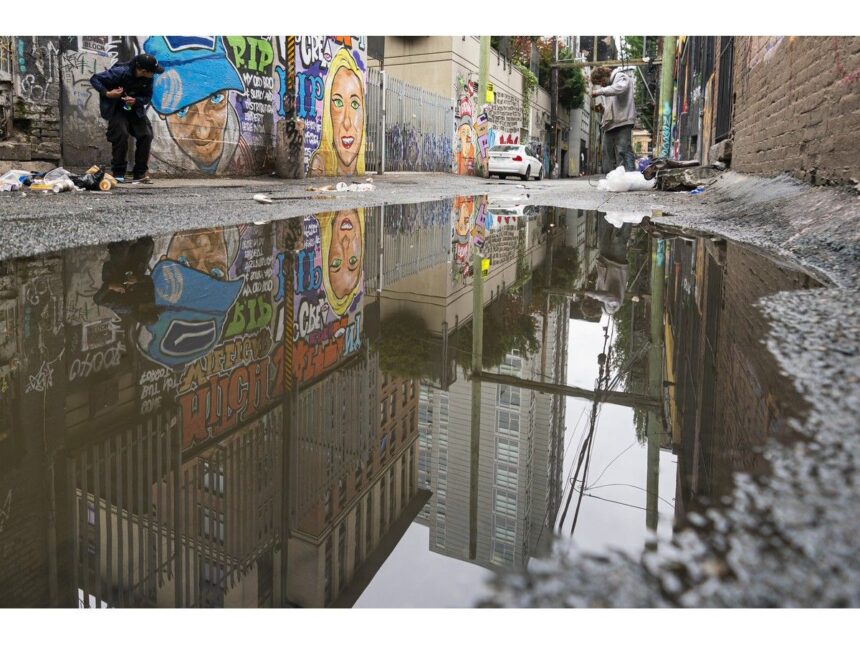
An eye-opening trip was made to VancouverPublished Oct 03, 2026Last updated 20 hours ago13 minute readA condo tower is reflected in a puddle in an alley in the Downtown Eastside area in Vancouver. Photo by RICH LAM /NATIONAL POSTArticle contentI went west expecting to learn more about homelessness, outreach, harm reduction and the systems built to respond to them, and I came home thinking mostly about suffering, about how much of it we are willing to tolerate, how quickly we can become accustomed to seeing it, and what happens when we spend more time debating where suffering is allowed to exist than asking why we have allowed so much of it to exist at all.THIS CONTENT IS RESERVED FOR SUBSCRIBERS ONLY.Subscribe now to access this story and more:Unlimited access to the website and appExclusive access to premium content, newsletters and podcastsFull access to the e-Edition app, an electronic replica of the print edition that you can share, download and comment onEnjoy insights and behind-the-scenes analysis from our award-winning journalistsSupport local journalists and the next generation of journalistsSUBSCRIBE TO UNLOCK MORE ARTICLES.Subscribe or sign in to your account to continue your reading experience.Unlimited access to the website and appExclusive access to premium content, newsletters and podcastsFull access to the e-Edition app, an electronic replica of the print edition that you can share, download and comment onEnjoy insights and behind-the-scenes analysis from our award-winning journalistsSupport local journalists and the next generation of journalistsRegister to unlock more articles.Create an account or sign in to continue your reading experience.Access additional stories every monthShare your thoughts and join the conversation in our commenting communityGet email updates from your favourite authorsSign In or Create an AccountorArticle contentArticle contentThe contrasts began before I made the journey to downtown Vancouver. In Whistler, outreach teams work among some of the most extraordinary wealth in the country; in Nanaimo, food banks, Goodwill, churches and community organizations respond to growing need alongside communities that can otherwise appear prosperous; and in Port Alberni, the social consequences of profound economic change are much harder to miss.Article contentArticle contentPort Alberni was built around forestry, an industry that has undergone decades of restructuring, mill closures, curtailments and job losses. Its 2025 point-in-time count identified at least 180 people experiencing homelessness, including 107 people sleeping unsheltered, compared with 163 people counted in 2023 and 125 in 2021.Article content Abbotsford Police Department Street Outreach Team member Sgt. Ryan Gray does a wellness check at a homeless encampment in Abbotsford, B.C., in January 2025. Photo by Jason Payne /PNGArticle contentA point-in-time count is only a snapshot and almost certainly an undercount, but the direction matters.Article contentEconomic devastation rarely stays economic. It becomes housing instability, food insecurity, declining health, family stress, migration and poverty, while the systems left behind absorb the consequences. Eventually those consequences become visible on sidewalks, in emergency departments, shelters, food banks and encampments, and somehow the conversation shifts from everything that happened to people before they arrived there to how inconvenient their presence has become now that we can see them.Article contentArticle contentThen I walked Hastings Street.Article contentOpen-air drug market Article contentFrom Cambie toward Main, for more than a kilometre and over a dozen city blocks, on both sides of the street, there were hundreds upon hundreds of people, at times it felt like thousands. It is difficult to adequately describe the scale because there was no single scene to absorb and move beyond, it simply kept going.Article contentExtraordinary wealth existed only blocks away from extraordinary poverty, while an open-air drug market operated in plain sight and people smoked methamphetamine, crack cocaine and fentanyl with the same casual familiarity the rest of us might drink beer on patios on summer nights.Article contentStreet outreach workers responded with oxygen to lifeless bodies on sidewalks while citizens stepped around them and continued on with their day.Article contentThat may have been the most difficult thing to comprehend. Not simply the drugs, tents or poverty but how ordinary all of it appeared to have become.Article contentWatching people walk past bodies reminded me of the World Vision commercials we watched when we were kids, images of suffering so profound and so far removed from our own lives that eventually they almost stopped feeling real. Except these people were not somewhere else, they were lying at our feet in one of the wealthiest cities in one of the wealthiest countries in the world.Article contentMunicipal workers used leaf blowers to clear sidewalks where people were living, using and dying, while all around them were towers, expensive real estate, restaurants, tourism and enormous investment in infrastructure and appearance. The juxtaposition was almost absurd.Article contentVancouver can look spectacularly prosperous, and if you avoid certain streets you could spend days there without understanding the depth of the crisis happening only blocks away.Article contentProsperity does not automatically reach people who are sick, poor or vulnerable, sometimes it simply grows around them.Article content A man smokes drugs from a pipe in an alley in the Downtown Eastside area in Vancouver in September. Photo by RICH LAM /NATIONAL POSTArticle contentExploitation opportunities Article contentThere were other things that were harder to put into words. I watched well-dressed men walking alongside young women who were visibly sick, impoverished and vulnerable, and while I cannot know the circumstances of any individual person I passed, the imbalance was impossible not to notice.Article contentIt looked like something from a time I thought we had moved beyond, young women whose vulnerability appeared almost transactional, walking beside men who looked completely at home in a world that was destroying the women beside them.Article contentArticle contentHomelessness is not simply the absence of a house. It is the absence of privacy, security and power, and that creates opportunities for exploitation we do not talk about nearly enough.Article contentThe Downtown Eastside felt, at moments, like the actual realm of hungry ghosts, block after block of illness, poverty, trauma, desire, survival and need existing on top of one another. Activists and drug-user organizations that have fought for people for decades looked exhausted not because they had stopped caring but because they have spent years burying people while fighting policy, stigma and an extraordinary amount of public apathy.Article contentWhat I saw also challenged the image many of us still carry about substance use. Injection drug use has fallen dramatically in British Columbia, while smoking has become the most common mode of consumption associated with unregulated drug deaths. There were places so many substances were being smoked the air itself felt thin.Article contentArticle contentOur harm reduction systems were largely built around injection, needles and supervised injection spaces, while the people we are trying to keep alive have changed how they consume substances faster than many of our systems have changed how we respond. The larger misconception is that substance use somehow belongs to homelessness in the first place.Article contentIt does not.Article contentConditions for substance useArticle contentSubstance use occurs overwhelmingly among housed people because most people are housed. Statistics Canada found that 3.8 per cent of Canadians aged 15 and older met the diagnostic criteria for a substance use disorder in 2022, while broader national surveys show substance use across every income level, community and social class.Article contentWhat changes dramatically with homelessness is not the existence of substance use but the conditions surrounding it. A person using drugs in a home may have running water, food, a telephone, privacy, somewhere to sleep and another person nearby who could notice when something goes wrong. Someone using outside may have none of those protections. Research found that people experiencing homelessness represented less than one per cent of Canada’s population but 8.9 per cent of accidental substance-related acute toxicity deaths examined in one national study.Article contentHousing is not incidental to this crisis, it is part of keeping people alive. That became painfully clear in conversations about palliative street care.Article contentThere are people living in shelters and outside who are hoping housing will be built quickly enough for them to die inside with dignity. Until then, some use drugs outside and in plain sight because visibility can be what keeps them alive. If this dose is the one that stops their breathing, somebody might see them, administer naloxone, provide oxygen or call for help.Article contentThink about the threshold we have reached when the aspiration is no longer to live well but simply to die inside.Article contentI walked by a United Church where people had been sleeping in the pews and where the building is being transitioned to housing. In a city where faith communities have had to decide what sanctuary actually means when the people needing it are homeless, poor and using drugs, I heard it affectionately referred to as the “Diocese of the Safe Injector.”Article contentArticle contentThere was something almost perfect about that name, irreverent and compassionate at the same time, because it acknowledged the reality rather than pretending faith and substance use could never occupy the same building.Article content A tent is set up in the Downtown Eastside area of Vancouver in May. Photo by NICK PROCAYLOArticle contentMeaningful voice createdArticle contentAt the Vancouver Area Network of Drug Users, people who use drugs have spent decades organizing, advocating, educating and keeping one another alive, insisting on the fairly basic principle that people affected by policies should have some meaningful voice in creating them. While we were there, a wedding was being planned.Article contentIn the middle of the Downtown Eastside, surrounded by homelessness, overdose, illness, poverty and death, unhoused and marginalized people were figuring out how to celebrate two people who loved one another, determined to show their community that they deserved love and celebration, too.Article contentOf course they do.Article contentPeople do not stop needing joy because they are poor, they do not stop falling in love because they use drugs, and they do not stop wanting weddings, birthdays, friendship, sex, laughter, privacy and belonging because they sleep outside.Article contentArticle contentThere was something incredibly beautiful about a wedding being planned in the middle of what otherwise felt like the place where hopelessness was being handed out as often as narcan.Article contentThe same insistence on dignity was everywhere at the Dr. Peter Centre. The centre grew directly from the HIV and AIDS movement, from a time when people living with AIDS were themselves treated as dangerous, immoral and disposable. The champions and pioneers who fought those battles built models of care around the radical idea that people did not have to become socially acceptable before they deserved to be cared for, and decades later that work continues with people living with HIV alongside poverty, homelessness, mental illness and substance use.Article contentTheir model integrates health care, harm reduction, food, counselling, medication support, supervised consumption and community rather than expecting people to become well enough, sober enough or uncomplicated enough before they are entitled to care.Article contentWe talked about the changes surrounding St. Paul’s Hospital and what the movement of health services means financially, socially and medically for people who have spent years building relationships with care in that neighbourhood, while the Dr. Peter Centre continues navigating the familiar contradiction of people supporting services in principle while not necessarily wanting the people who use those services nearby.Article contentAlcohol is readily acceptedArticle contentOne conversation stayed with me, about adult spaces and the strange moral distinctions we make about which adults deserve places of their own. We readily accept spaces designed around drinking alcohol. We have bars, pubs, breweries, micro small-batch locally owned artisanal breweries, beer gardens and patios, places where adults gather specifically to consume a drug, and their existence requires very little explanation.Article contentWe have gyms, clubs and countless other spaces built around what adults choose to do with their bodies and their time.Article contentArticle contentYet create a space for marginalized adults who use other substances and suddenly the very concept of an adult space requires a moral defence.Article contentWe also have a tendency to paint over the past and pretend adult spaces have historically been something more respectable than they actually were. They have always contained sex, intoxication, risk, excess, relationships, bad decisions, community and human connection. Perhaps the question should not be whether we approve of every choice another adult makes but why safety and belonging become conditional when the choices involved make us uncomfortable.Article contentVancouver has been wrestling with these questions for generations. In 1971, about 2,000 people gathered in Gastown for the Smoke-In, protesting marijuana laws and aggressive drug policing. Police moved into the crowd with mounted officers and batons, dozens of people were arrested and many were injured. A judicial inquiry was highly critical of police conduct.Article contentArticle content A member of the Vancouver Police walks along Hastings Street in the Downtown Eastside neighbourhood. Photo by RICH LAM /NATIONAL POSTArticle contentGastown event remembered wellArticle contentThere are stories attached to that history about police throwing the first brick and newly issued billy clubs that have become part of the retelling of Gastown, although I cannot substantiate every detail well enough to present them as fact. What is documented is enough to understand why the event remains important more than 50 years later. The substances have changed, the neighbourhood has changed and the buildings surrounding it are worth considerably more money, yet we are still arguing about drugs, policing, public space and whose behaviour society is prepared to tolerate.Article contentAll of this brought me back to a very simple question. What exactly do we believe happens if we remove the services?Article contentClose the shelter and people do not disappear, they gather somewhere else. If they gather around the food bank and we close that, hunger does not disappear, people move to the YMCA. Close that and they move toward the hospital, courthouse, mental health office, library or whatever other place still has a door they are permitted to walk through.Article contentIf the objective is simply to get “those people” out of downtown, eventually we have to close downtown. We cannot service-cut our way out of human need. Removing services does not remove homelessness, poverty, mental illness or substance use, it simply determines where their consequences appear next.Article contentThat is why doing less was never the option. The question is what more actually looks like. More housing before homelessness becomes chronic, more outreach before people lose every connection to the systems around them, mental health care that can be accessed before crisis, treatment when someone wants treatment, harm reduction that reflects how people actually use substances today, palliative care that does not end because someone has no address, and enough food, income and community support that survival itself does not consume every hour of someone’s life.Article contentGovernments have responsibilitiesArticle contentIt also means accepting that nonprofits cannot carry this alone. Municipal governments have responsibilities around land, zoning, infrastructure and public space. Provinces hold enormous responsibility for housing, health care, mental health, treatment and income supports. The federal government has a role in housing investment, poverty reduction and the toxic drug crisis.Article contentArticle contentHealth systems need to reach people beyond hospital walls, businesses need to be part of solutions that extend beyond asking vulnerable people to move away from their storefronts, and churches and community organizations have buildings, land, relationships and influence that can either sit idle or become part of something useful.Article contentCommunities have a responsibility, too, because “not in my backyard” eventually becomes not on my street, not near my business, not beside my child’s school, not downtown, not near tourists and not anywhere that makes the rest of us uncomfortable. There is nowhere left after that.Article contentThe trip changed something for me professionally. I found myself invited to national policy and advisory conversations alongside Dr. Sarah Davidson, Michael Vonn and Jason Altenberg, people whose work and knowledge I respect, and realized that I was not there simply to listen from the edge of the room. I was there as an equal and a peer.Article content Scenes from the homeless encampment at Crab Park as the city of Vancouver enforces an eviction order, in Vancouver in November 2024. Photo by NICK PROCAYLOArticle contentThere was recognition of the work happening here, of our dedication and resilience in fighting for people through systems, resistance, community noise and the persistent idea that people dying outside are somehow less worthy of the care and comforts the rest of us expect for ourselves.Article contentArticle contentI will also be given a national audience on an award-winning podcast, alongside an award-winning author, to talk about our “response out east,” what we have learned, what has worked, what has not and what communities should be considering before the problems become exponentially larger.Article contentI travelled west expecting to learn from people who have been doing this work for decades, and I did. What I did not expect was for them to want to learn from us, too.Article contentDifference in scaleArticle contentVancouver is ahead of us but perhaps not as far ahead as we would like to believe.Article contentThe scale is different and will likely remain different, but the ingredients are already familiar: inadequate housing, poverty, an unpredictable toxic drug supply, limited mental health care, exhausted health systems, overstretched nonprofit organizations, economic disruption and increasing public pressure to make vulnerable people less visible rather than less vulnerable.Article contentWe still have something many communities living with this crisis at scale no longer have in abundance.Article contentTime.Article contentWe still know the names of the people sleeping outside here. We know their families, their histories, the schools they attended, the jobs they once had and sometimes the exact moment everything began to fall apart.Article contentWhat I saw in the Downtown Eastside was suffering, complete and absolute suffering. At times it brought to mind the historical images of leper colonies, quarantine settlements and refugee camps, not because those experiences are interchangeable, they are not, but because of the unmistakable feeling of a population concentrated into a geographical area, separated from the prosperity surrounding it and somehow abandoned in plain sight.Article contentYet the Downtown Eastside was not without hope. Outreach workers ran toward bodies other people had learned to step around, nurses and physicians cared for people without first requiring them to prove they deserved it, activists and drug-user organizations kept fighting after burying far too many people, churches opened doors and people continued feeding, housing, treating and caring for one another.Article contentArticle contentI did not come home believing Vancouver is a failed city, nor that the Downtown Eastside proves services do not work. I came home understanding what happens when need is allowed to grow faster than our willingness to respond to it, when systems spend decades catching people after they fall instead of changing the conditions that keep pushing them down, and when suffering becomes familiar enough that the rest of us learn how to walk around it.Article contentWhat I saw is not inevitable here, but neither can I call it unimaginable anymore. We still have time. The question is what we choose to do with it.Article contentAshley Legere is executive director of the Cumberland Homelessness and Housing Support Association in Amherst.Article content
Opinion: What happens when suffering becomes routine?