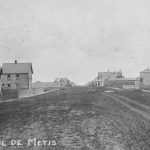
OMG secretary of culture and harvesting Grant Lacombe. By Jeremy Appel The Otipemisiwak Métis Government (OMG) has asked the Town of St. Paul to return to its original name of St. Paul des Métis, but one of its secretaries says the town has only responded through media reports. “I just wanted to have a discussion right from the very start, and it’s not happening,” OMG secretary of culture and harvesting Grant Lacombe told Alberta Native News. The original St. Paul des Métis community was established by the Canadian government in 1896 as a Métis agricultural settlement overseen by the Catholic Church. In 1908, the church asked the federal government to open the community up to French settlement and the government opened it up to general homesteading. By the time the town was incorporated in 1936, ‘des Métis’ had been dropped from its name. “The history of St.-Paul-des-Métis mirrors the larger story of the Métis in Alberta — a people who helped build this province, only to be repeatedly pushed to the margins by government decisions,” wrote OMG president Andrea Sandmaier and Lacombe in an Aug. 11 Edmonton Journal opinion piece. Restoring the town’s original name, they added, might “not return the lost land or undo the harm caused when others had controlled Métis homes and futures, but it will restore the truth.” This issue is personal for Lacombe, who originally hails from St. Paul and has deep familial ties to its Métis community. Lacombe is a descendant of Father Albert Lacombe, the Oblate Missionary who originally requested that the land become a Métis agricultural community, as well as the great great grandson of Laurent and Eleanor Garneau, one of the first families to settle St. Paul des Métis. He recalled in an interview that he grew up hearing stories from his family about the town’s Métis origins. The town’s name “should have never changed,” Lacombe told this newspaper. “The time has always been right … Why not now?” The OMG is also asking the town to install a traditional wooden Red River cart at one of the entrances to the municipality to honour its Métis heritage. The cart, which was traditionally used for transporting furs and hunting materials, river crossings and shelter, is “one of the pillars of our cultures and traditions,” Lacombe explained. According to the Municipal Government Act, a municipal government can request a change to its name, but the ultimate decision rests with the province. The OMG first wrote to St. Paul Mayor Glenn Anderson and town council in May to request the name change, which town council accepted as information – a formal gesture that doesn’t commit the government to any action. Two additional correspondences from the OMG went unanswered. “I’ve heard more from media,” Lacombe told this newspaper. “I have not had one conversation with the mayor and town council. No return of my letters. Nothing.” A Town of St. Paul spokesperson didn’t acknowledge a voicemail requesting comment for this story. Steven Jeffery, chief administrative officer for St. Paul, told the CBC that town council didn’t direct administration to reach out to the OMG. But he said the municipality “would absolutely be open to having representatives from the Métis Nation to meet and discuss this initiative further with council so that everyone can have the same understanding of the ask.” “The Town of St. Paul prides itself on being an inclusive community and we would like to learn more about the Nations’ plans so that we can work together toward a common goal.” Jeffrey added. Lacombe said this is precisely what he wants. “It shouldn’t take three letters to get this type of question out there and responded to,” he said. “I’m really hoping that they contact us, so we can have a discussion eye-to-eye at the table.” Jeremy Appel is a Local Journalism Initiative Reporter.
Otipemisiwak Métis Government asks Town of St. Paul to restore its original name