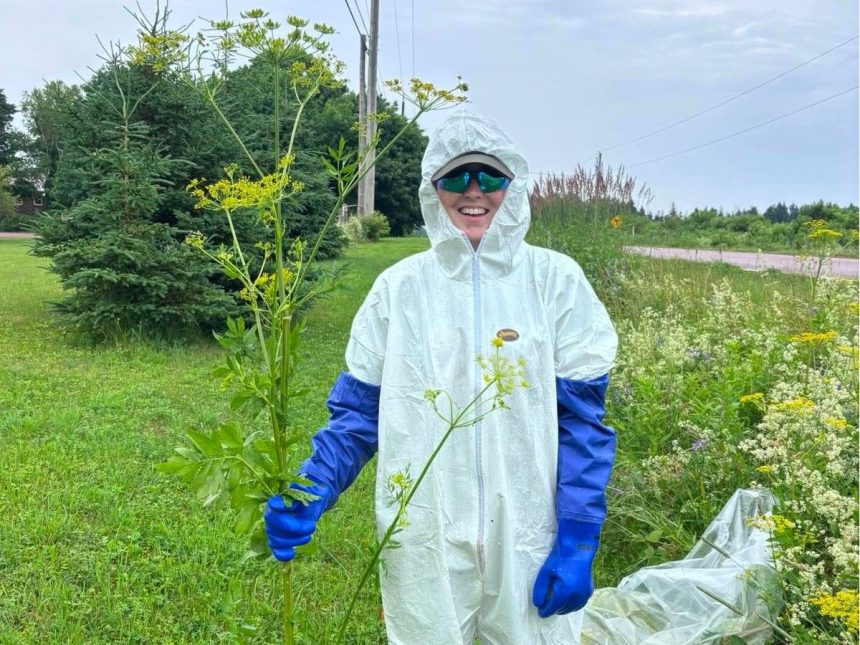
Drew Hackett, with the Tignish Watershed Management Group, is dressed from head to toe in protective gear as she handles wild parsnip on Route 14 in Tignish. When the invasive plant is fully mature, it can can cause burns and blistering to people and animals. ContributedArticle contentThe P.E.I. Invasive Special Council is gathering up and destroying a plant that is harmful to humans and animals if touched.THIS CONTENT IS RESERVED FOR SUBSCRIBERS ONLY.Subscribe now to access this story and more:Unlimited access to the website and appExclusive access to premium content, newsletters and podcastsFull access to the e-Edition app, an electronic replica of the print edition that you can share, download and comment onEnjoy insights and behind-the-scenes analysis from our award-winning journalistsSupport local journalists and the next generation of journalistsSUBSCRIBE TO UNLOCK MORE ARTICLES.Subscribe or sign in to your account to continue your reading experience.Unlimited access to the website and appExclusive access to premium content, newsletters and podcastsFull access to the e-Edition app, an electronic replica of the print edition that you can share, download and comment onEnjoy insights and behind-the-scenes analysis from our award-winning journalistsSupport local journalists and the next generation of journalistsRegister to unlock more articles.Create an account or sign in to continue your reading experience.Access additional stories every monthShare your thoughts and join the conversation in our commenting communityGet email updates from your favourite authorsSign In or Create an AccountorArticle contentChase Guindon, co-ordinator of the group, and members of the organization were on the Confederation Trail in Charlottetown on July 31 trying to spot wild parsnip.Article contentArticle contentIf a person were to touch a fully mature plant, the sap from the plant could cause burns or blistering once the affected area encounters sunlight.Article contentArticle contentGuindon and his team were doing a bike survey while conditions that day were overcast. They were just trying to spot it, mark where it was spotted in order to return, remove it within a week and deposit it at the P.E.I. Energy Systems plant in Charlottetown, located near the Queen Elizabeth Hospital.Article content“It reacts with the sunlight to cause a photodermatological reaction, meaning that it causes a chemical burn on your skin that will persist for several years,” Guindon said.Article contentWhen members of the council work at removing the parsnip, they have to dress in protective clothing and wear special head gear.Article content Chase Guindon, co-ordinator for the P.E.I. Invasive Species Council, removes a Himalayan balsam plant from the Confederation Trail in Charlottetown on July 31. The plants are not dangerous to humans but bad for ecology. The plant was found on the trail near Lower Malpeque Road. Photo by Dave Stewart /The GuardianArticle contentThe co-ordinator said if a person thinks they have come into contact with it do not expose the area to sunlight. Go home, dab it off and do not rub it because it is oil-based. Use soap and water and consult a physician.Article content“We managed it last year as well and found more this year so it will probably be a few years until all the seeds that are already existing in the ground have grown up and been pulled,” Guindon said.Article contentArticle content“The key for us is to get the plants before they go to seed, before the seeds go into the ground. If we do that for five years or so we would have depleted the seed bank and there will be no more wild parsnip, as long as we get it all.”Article contentArticle contentGuindon and his team are using funding from the national Trans-Canada Trail, a federal program that began in 1992.Article content The P.E.I. Invasive Species Council supplied this photo to The Guardian showing what a wild parsnip plant looks like when it is fully mature. The council warns that this plant should never be touched. Doing so can result in burns and blistering when an affected area of the skin comes in contact with sunlight. The council are in the process of removing the plant from public areas such as the Confederation Trail as well as other locations across the province. Photo by Green Thumb Photography /Special to The GuardianArticle contentGuindon said it is a five-year commitment to ridding an area of wild parsnip.Article contentWild parsnip can be found in a variety of areas in P.E.I. – in the eastern portion of the province near Murray Harbour and Wood Islands, along the Confederation Trail and it is has been found in Tignish.Article content“It’s a public health concern so we want to protect people’s safety. We want people to be able to use the trail without being worried about the plants they may come in contact with.”Article contentGuindon said wild parsnip is also an ecological concern, explaining that they out compete other plants and create monocultures so there is a decrease in biodiversity.
P.E.I. Invasive Species Council on hunt for plants harmful to humans