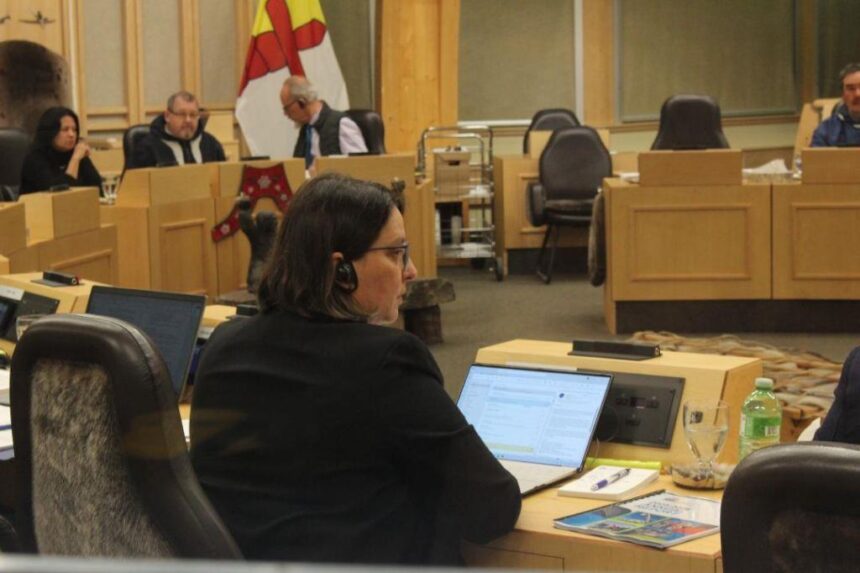
Published 8:40 am Thursday, October 1, 2026 By William Koblensky Varela Local Journalism Initiative Northern News Service The Qulliq Energy Corporation has not received a formal response from the federal government following its requests to unload more than $200 million of historic debt. Crown Indigenous Relations and Northern Affairs Canada along with Natural Resources Canada have not responded to QEC, according to Emilia Tihon, the Nunavut utility’s chief financial officer. “We don’t have any answers at this point from the federal government. There’s discussions at this point, but there’s no concluded outcome on how we can transfer it and if we can transfer this debt to the federal government,” Tihon said. She revealed the state of negotiations at a committee hearing in the legislative assembly on Sept. 23 in response to a question from Pangnirtung MLA Johnny Mike. QEC accumulated the debt because the cost of operating and maintaining its diesel power plants in Nunavut’s communities has been more than 150 per cent of what it makes from customers since 2023. As of 2024, QEC’s long-term debt was $218 million. The territorial government and QEC will begin figuring out how to manage the debt on Nov. 1, Tihon said. She was unable to provide QEC’s long-term financial strategy when questioned by Mike. But she did say the utility is looking at financing that doesn’t burden the federal and territorial governments with future costs. “It’s difficult to fund those capital infrastructure needs with third-party debt. As a result, we are looking for options,” said Tihon. “We’re not necessarily looking at the federal government. We’re looking at different options on how we can support that financial need.” The utility is also struggling to keep track of its equipment and supplies. During the committee hearing, representatives from the Auditor General of Canada said QEC has an inventory management problem going back to 2023. In 2025, the auditor general’s team found poor storage of spare parts and lubricant inventories in Iqaluit, Cambridge Bay, Rankin Inlet, Coral Harbour, Kugluktuk, Naujaat and Arviat. “It’s very important that you know what you have in inventory to figure out whether you need to buy new inventories,” said Fera Awada, a principal at the Office of the Auditor General. “Or maybe they’re double buying things.” QEC employees can’t always access their inventories to see if equipment is in transit or outdated, Awada said. Part of that is due to the power corporation not keeping track of when equipment is received. Tihon said QEC has a plan in place to address the storage issue, but it will take time to implement a fix. “Resolving this issue requires more than just a single year. It requires reliable procedure across the inventory cycles from receiving, purchasing, receiving usage, identification of deleted items, and the inventory count itself,” Tihon said. The president and CEO of QEC, Ernest Douglas, was supposed to attend the hearing but that plan was scuttled by a flight cancellation, the legislative assembly was told.
QEC asked the federal government to take over its $200 million debt, but hasnt heard back