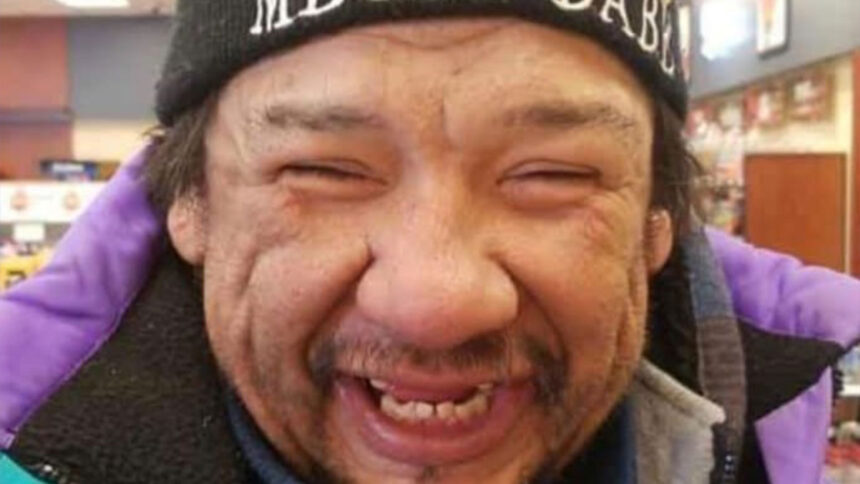
Jeremy Ettawakapow remembers celebrating with his dad John when the Winnipeg Blue Bombers won the Grey Cup championship in 2019. But it wasn’t the joyous event one might expect. Instead of cheers and fireworks for his favourite team, Jeremy visited a cemetery to give a gift to his father, who died only a month earlier in an RCMP holding cell. “I got that championship winning hat, I wrote a little note in there and I left it at his grave site,” Jeremy recalled in a recent interview with the IJF. “Even though it’s so many years later … It hits me and I still miss him.” John Ettawakapow is one of about 100 people in Manitoba whose police-involved deaths did not result in charges against officers following investigations by the Independent Investigation Unit of Manitoba (IIU), the police watchdog responsible for probing all serious incidents involving police since 2015. Of the 59 people whose identities have been made public, an IJF analysis confirms at least 63 per cent were Indigenous. Indigenous people make up about 18 per cent of Manitoba’s population, according to Statistics Canada’s 2021 census. The IJF’s ongoing investigation into the IIU’s handling of police-involved death investigations found Manitoba police have been charged in the deaths of only two people in the last eleven years, one of whom was a First Nations person. The IIU investigations for both concluded in 2017 and the charges eventually led to convictions. The IJF spoke with people connected to three police-involved deaths of Indigenous people in Manitoba to learn about the IIU investigation process and how they were impacted by the IIU’s decision not to charge officers in these specific cases. They shared concerns including the IIU allegedly withholding use of force details involving a weapon in one investigation, that immediate family members have to wait years just to learn how their loved ones died, and that mental health supports are not provided to those intimately affected by police-involved deaths throughout the investigation process. The IJF requested an interview with the IIU but it was declined. Bronwyn Dobchuk-Land, an associate professor of criminal justice at the University of Winnipeg, said it can leave a lasting impact on surviving family members when officers are absolved of any wrongdoing in the deaths of their loved ones — which has been the case in 98 per cent of police-involved deaths in Manitoba in the last decade-plus. “So then where are the families left? They are essentially told the death at the hands of the state of your loved ones was acceptable. And that’s devastating,” says Dobchuk-Land. She said it might be beneficial for families to “stop expecting a sense of resolution from the IIU. Because even when those [investigations finish], they often produce the very opposite of a sense of justice. They produce the sense of like there’s still unanswered questions.” John Ettawakapow, 54, Moose Lake John Ettawakapow was arrested for public intoxication and lodged in an RCMP detachment in The Pas, a town in northern Manitoba, on the evening of Oct. 5, 2019. Only an hour later, the 54-year-old man “stopped moving forever” after a sleeping inmate’s leg accidentally rolled on top of his neck and face. However, guards didn’t find him dead until five hours later. The IIU concluded no charges would be authorized against police personnel or guards after consultation with the Manitoba Prosecution Service, who stated there was “no basis” for criminal charges, according to the IIU’s final report. The IIU created a brief timeline of events using video surveillance from the cell including when John was placed inside and when he was found dead by a guard. The timeline detailed the leg was on top of John’s neck for approximately 40 minutes before the inmate moved it in his sleep and that John appeared not to move again afterwards. “That was a very difficult time when I actually got to look at that report,” Jeremy said. “The images I was grasping in my head were hurtful because it did show he did have signs of life there and then it just stopped.” The majority of information is withheld from the public during an IIU investigation until the final report is released, which took more than two years in John’s case. But Jeremy wouldn’t learn the specific details of his dad’s death until the 2024 inquest, which examines a fatality’s circumstances to find ways of preventing it from happening in the future. It does not assign blame or determine guilt. Provincial court Judge Brian Colli presided over the inquest and found John “died in police care from a preventable cause” — information Jeremy waited five years to hear. “Would he possibly be alive today? We were left a very long time without knowing that answer,” said Jeremy, who attended each day of the week-long inquest. The inquest into John’s death concluded he ‘needed help but he did not receive it’ while in the RCMP’s care. Photo courtesy: Jeremy Ettawakapow. The inquest found that the guards insufficiently monitored John’s holding cell due partly to a lack of training. RCMP policy states physical checks on inmates are to be done every 15 minutes, a fact missing from the IIU’s final report. Despite the policy, the inquest found that the guards heavily relied on video surveillance to monitor the holding cell and only did one physical check during John’s six hour stay prior to being found dead. The inquest’s examination of the video surveillance found John struggled for 13 minutes to unsuccessfully remove the leg, after which he “did not move again.” The inquest determined John was likely dead for about five hours before a watch commander physically checked the cell and noticed he was unconscious. Colli also noted that if John had been medically assessed due to his high level of intoxication, he should have been monitored by medical personnel and “would surely have survived the night.” His blood alcohol level was 0.387 per cent at the time of death, while 0.08 per cent is the legal limit for Canadian drivers. Jeremy said he still hasn’t cried as much as he did the day his phone rang with the tragic news. “I never in a million years thought my dad would pass away the way he did,” Jeremy told the IJF. “He did have his own personal issues in the real world, but I never thought he would pass away in a jail cell and in that way.” The grieving process was made harder by the fact that he and his family were not provided any mental health support during or after the IIU investigation and inquest. He said it was difficult being responsible for relaying all information concerning his dad’s death to his grandparents and other family members. A police-involved death isn’t considered a crime unless an officer is charged by the IIU, which means families like Jeremy’s cannot access victim services for provincially compensated resources like therapy. After seven years of heartache and stress, Jeremy is still looking for closure and wonders if other families were able to move on after their loved ones’ police-involved deaths. “Did people just let it go or did people continue wondering if they got justice?” He wants everyone to remember to “tell your parents you love them every time you see them and you’re done talking to them, because I never got to say that to my dad the last time I seen him.” Elias Whitehead, 37, Webequie First Nation Jody Beardy first saw footage on social media of police striking a man with their fists and knees during an arrest near downtown Winnipeg on the evening of Oct. 15, 2023. She would learn the next day that the man being arrested was actually her common-law husband of 12 years — and that he died soon after the video was recorded. Elias Whitehead, 37, was reportedly trying to open car doors when the Winnipeg Police Service (WPS) was called about a man acting erratically in traffic. Surveillance tapes collected from nearby businesses showed Whitehead also tried to enter a police vehicle when it arrived at the scene. The IIU’s final report states officers responded to this action by taking Whitehead to the ground and punching him approximately 23 times in the head and body while also delivering three knee strikes to his body. Whitehead was unarmed, and the final report does not suggest he was an active threat to the public. Both arresting officers declined interviews with the IIU during the investigation, and only one provided the IIU with any written documentation on their account of what happened. Police officers are not required to be interviewed or provide their police notes as they are “granted the same rights as any citizen under the Charter of Rights and Freedoms to protection from self-incrimination”, according to the IIU’s website. The autopsy report found Whitehead died due to “subdual and prone restraint (by police officers) complicating cocaine intoxication and cardiomegaly (enlarged heart).” A use of force expert retained by the IIU for its investigations “was very critical” of the force used by the arresting officers, according to the final report. The IIU’s acting civilian director said “I encourage and invite the WPS to revise” its framework for when and how officers should use force, marking the first time such a recommendation was made in an IIU death investigation, according to the IJF’s research. Still, the IIU did not authorize charges against the arresting officers. Following its review of the investigation, Manitoba Prosecution Service told the IIU that “the standard for prosecuting charges has not been met.” But Beardy doesn’t believe the police are innocent in Whitehead’s death. She’s filed a civil lawsuit against the City of Winnipeg and the police officers involved in hopes of getting Whitehead justice. In the statement of defence, the defendants denied all of Beardy’s allegations regarding the arrest and requested the claim be dismissed. “They killed him. I’m always going to believe that they did,” said Beardy. “He would still be here if they left him alone. He would still be here if they helped him.” The way police treat Indigenous people is ‘disgusting’ and needs to change, said Beardy. ‘We shouldn’t have to be living this way anymore.’ Photo courtesy: Jody Beardy. Beardy said Whitehead was always “trying to work to have a better life.” He was in Winnipeg taking a heavy equipment operator training course despite living more than 700 kilometres north of the city in Tataskweyak Cree Nation. He was one week away from graduating the course and heading back home to Beardy when he died. “Elias wasn’t a criminal. He wasn’t aggressive … everything [the IIU was] trying to say is very out of character,” said Beardy. Beardy said she was “hopeful” during the IIU’s investigation because one investigator was a person of colour – a fact she thought might prevent racist bias because the investigator “would have more of an understanding.” However, Beardy said she and Whitehead’s family weren’t kept in the loop during the investigation into his death. She said the IIU provided no information when she reached out for updates. She said “nobody reached out to us” regarding mental health support during or after the investigation, so she had to seek it out on her own. “I wouldn’t be able to get through it without the therapy,” said Beardy, who thinks it would be a good idea if there was a support group for affected families so they “know you’re not alone.” She said she’s grateful to have connected with the family of James Wood, a man who died in police custody only three months after Whitehead, because “it’s someone you can relate with, somebody to talk to because there were losses.” She believes “it’s a big slap in the face to the families” that only two per cent of IIU death investigations have ended in charges against police. When asked what she thinks could be done to hold police more accountable, Beardy admitted she’s unsure. She wonders if the current push for police to have body-worn cameras, like the WPS’s current six month pilot program with Axon, will change anything when it comes to police accountability, considering all the video footage recorded by nearby businesses and bystanders during Whitehead’s arrest and used in the IIU’s investigation. “Is that even going to make a difference?” She encourages families to take matters into their own hands and file lawsuits against police if the IIU doesn’t charge officers in the deaths of their loved ones. “It’s going to keep happening if people don’t try to do anything to stop it. … Nothing is going to change if we don’t try, right?” James Wood, 35, O-Pipon-Na-Piwin Cree Nation Aidan Power saw the entire arrest unfold outside of his apartment window as officers punched, batoned and kneeled on James Wood leading up to his death on Jan. 27, 2024. The WPS was responding to a call from Wood’s girlfriend and neighbours regarding the intoxicated 35-year-old man who was acting erratically, potentially endangering a child and banging on apartment doors, before eventually falling down a flight of stairs. The IIU’s final report said this “chaotic” information “was a factor in how WPS officers attended to the scene and assessed the risk associated” with Wood’s actions. But Power said the man police would come to find was “defenceless,” as an unarmed Wood lay in a snowy parking lot without shoes on and couldn’t stand on his own. He called the officers’ use of force in the situation “an abuse of power.” Video of the arrest shows police carrying Wood back to the police car seemingly unconscious before he later died in hospital. “The James that they were called on to report and the James that was on the ground in the middle of winter that could not get up, those are two different people with two different situations,” Power said. “Be prepared to handle both, or don’t come. Because if we can’t trust you to handle the situation that you’re on the scene for, then how can we trust you to do your job at all?” Power said the way police treated James Wood, pictured here, was ‘awful’ and ‘an abuse of power.’ Photo: Facebook/James Wood. Power was interviewed by the IIU as a civilian witness for the investigation into Wood’s death. He is critical of its final report. “It didn’t feel like there was a whole lot of clarity in the written final report … this feels more edited in a way to drive a narrative,” said Power. The investigation would conclude without charges against the three arresting officers, whose “actions were reasonable in the circumstances” according to the IIU. All three officers declined to be interviewed by the IIU but provided statements and copies of their notes on the arrest. The IIU’s report said the IIU would “again encourage” the WPS to consider re-evaluating its use of force policy, referencing the same recommendation from Whitehead’s final report. The IIU’s final report left unanswered questions for Power about whether one officer displayed a gun during the fatal arrest. The presentation or deployment of a gun, even when not discharged, is considered coercive action by the WPS and requires written reports and administrative reviews, according to the WPS’s 2025 Use of Force report. A gun is not mentioned within the final report. However, the report does say a taser was pointed at Wood and was seen by several witnesses. Power said he thought he saw a taser as well, but during his interviews with the IIU, an investigator corrected him and told him what he saw wasn’t a taser. “‘[The IIU investigator] goes ‘that’s not a taser that was pulled out. Tasers look like this. They would have the red dot. What was pulled out was a gun,’” Power said. “That’s why alarm bells went off in my head when I read [the final report] because if they were telling me in person, how come we’re not seeing [a gun] in the report?” Power said he feels his statement was “kind of rephrased” to be more “pro-police” despite being “on the side of the victim.” “I was pretty disappointed that everyone’s hard work, his family, his other neighbours, myself, who had never met him, we were trying to get some justice done and it didn’t happen. I’m not shocked. I was just very disappointed. I was angry when I found my statement in the report,” said Power. When asked for comment on allegations that the IIU withheld information regarding a gun in the Wood’s investigation, a provincial spokesperson replied on behalf of the IIU, saying that the “report stands as the only comment they make on an investigation. There is nothing further to add at this time.” Read More: Manitoba officers charged in just 2% of all police involved deaths since 2015 Power told the IJF that he “never had a bad interaction with police” until he saw Wood’s arrest and became a civilian witness. “I wanted to believe that cops are trying to do the right thing. Obviously not every single one, but I never thought I would bear witness to them doing something wrong,” he said. Power said the entire experience “messed” him up, that he’s still feeling the impacts of what he witnessed and how his testimony was used in a report which he believes ended without justice. He said the IIU investigators gave him a business card for group therapy but “that was all they did” for his mental health after witnessing Wood’s death. Power said if he ever bears witness to another police-involved death, he would not talk to the IIU again. “I’d rather go to a news outlet. I’d rather go to anybody else than the IIU because I need to know what I’m reporting on — that the truth will come out. And I don’t think the whole truth got reported on in this case,” said Power. This story was produced by the Investigative Journalism Foundation, an independent, non-profit newsroom based in Canada. Continue Reading
Seeking Justice: Indigenous people in Manitoba most likely to die in police-involved incidents


Leave a Comment