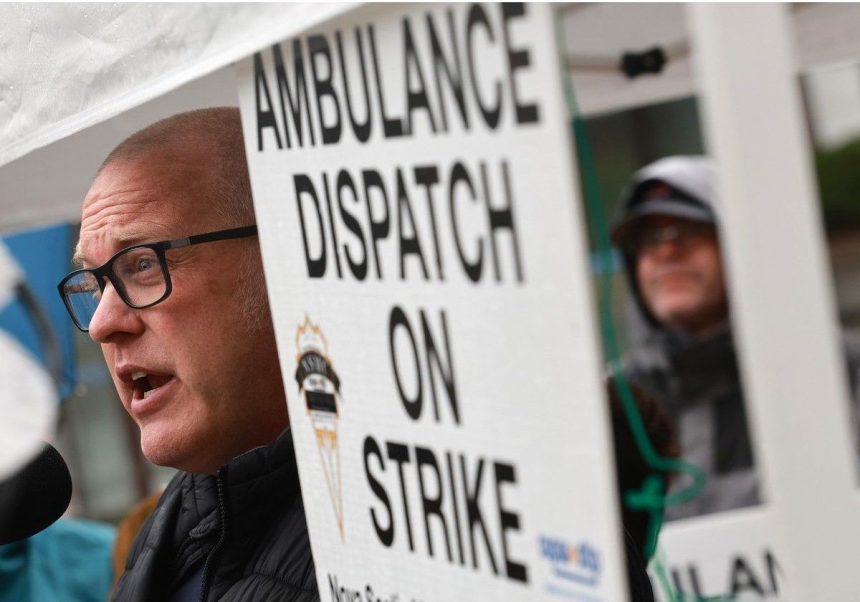
Article content Craig Power, regional union representative and lead negotiator for the striking ambulance dispatchers, speaks to reporters outside their offices and at the picket line on Brownlow Avenue in Dartmouth on Thursday. Photo by Tim Krochak /Chronicle HeraldArticle contentEMCI says it’s ‘committed’ to the collective bargaining processArticle contentThe last collective agreement expired on March 31, 2025, and the sides then went through numerous rounds of bargaining, as well as conciliation steps, before declaring a stalemate. Power said the employer’s last offer on annual wages was still about $10,000 short of what the union is seeking.Article content“Emergency Medical Care Inc. (EMCI) recognizes and deeply values the essential role communication officers and transfer administrators have in supporting the delivery of emergency health care to Nova Scotians,” read a statement from the employer.Article content“All EHS essential service delivery and operational requirements will be maintained throughout the labour disruption. Focus continues to be on delivering safe, high-quality care. If Nova Scotians find themselves in an emergency, we encourage them to call 911 immediately.Article content“We value all employees and are committed to the collective bargaining process, so a fair and comprehensive agreement can be reached. We look forward to a positive resolution to this matter and will not be commenting further as we work towards this.”Article contentArticle content Striking ambulance dispatchers and their supporters picket outside their offices on Brownlow Avenue in Dartmouth on Thursday. Photo by Tim Krochak /Chronicle HeraldArticle contentJob takes an ’emotional toll’ on employees, says striking dispatcherArticle contentAs much as wages are a leading point of discussion, the union said any solution has to include some kind of formal improvements to the day-to-day work conditions.Article content“I love my job,” MacVay said.Article content“I love that I get to help people every day, and I love the people that I get to work with every day. And I think it’s kind of cliché when people say that the people they work with are a family, but honestly, I feel like it’s true in this case.Article content“Everyone who works here, and that includes the supervisors who are on the other side of this strike, we’re all a family. We’re kind of a dysfunctional family at the moment, but we are a family nonetheless.”Article contentHe continued: “We all care about one another, and we look out for one another, and we have to because it’s a really hard job. We go through a lot of stress. It’s a job that takes an emotional toll. It takes a physical toll. And if you combine the stress inherent in this job with the fact that our wages have not kept up with the cost of living, then what you get is high turnover and low retention.Article contentArticle content“So we have people who leave us all the time. You could say that we are hemorrhaging people. People leave us because they want to get a job with better pay, or sometimes they go on stress leave and they simply never come back.”Article contentNegotiations stalledArticle contentThe sides haven’t had any meaningful dialogue in two weeks, but Power said there’s a chance for some new talks in the next day or two when the union hopes to revisit the staffing issues now that the reality has been laid bare during the strike.Article content“A big part of it is obviously going to be wages and benefits,” Power said.Article content“We’re actually thinking about making an offer to have some sort of a safe minimum staffing level because things have changed since last year.Article content“Right now, we have the staff information. We see how dangerous it was, so we’re actually going to come back likely with some sort of demand on minimum staffing.”Article content
Striking Nova Scotia ambulance dispatchers say work stoppage exposes chronic understaffing