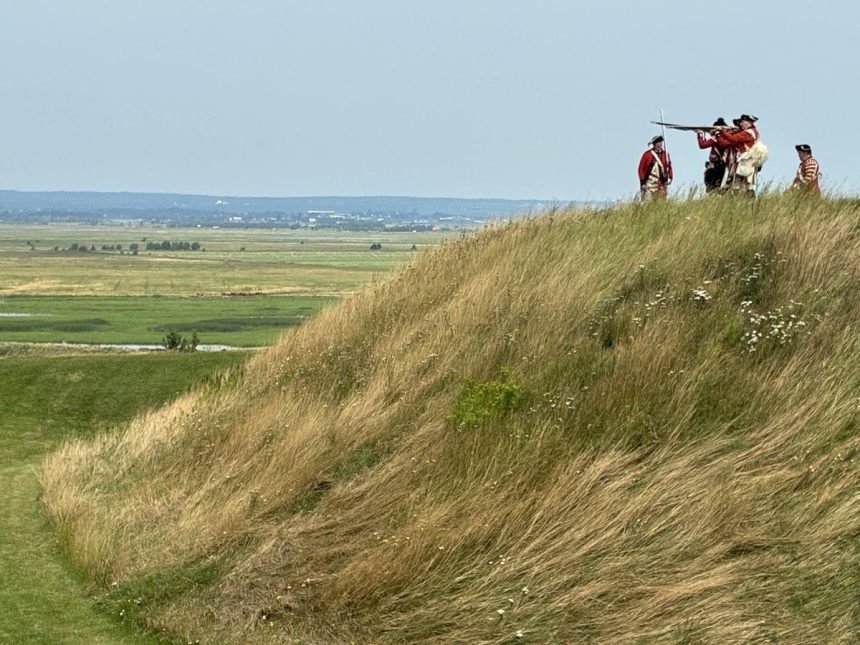
Published Aug 11, 2026Last updated 13 minutes ago8 minute readMembers of DeLancey’s Brigade performed historical re-enactments at Parks Canada events remembering the 250th anniversary of the Eddy Rebellion. Photo by Aaron Beswick /The Chronicle HeraldArticle contentMary Allan clutched her baby, George Washington Allan, to her chest as she and her five children huddled among the black spruce.THIS CONTENT IS RESERVED FOR SUBSCRIBERS ONLY.Subscribe now to access this story and more:Unlimited access to the website and appExclusive access to premium content, newsletters and podcastsFull access to the e-Edition app, an electronic replica of the print edition that you can share, download and comment onEnjoy insights and behind-the-scenes analysis from our award-winning journalistsSupport local journalists and the next generation of journalistsSUBSCRIBE TO UNLOCK MORE ARTICLES.Subscribe or sign in to your account to continue your reading experience.Unlimited access to the website and appExclusive access to premium content, newsletters and podcastsFull access to the e-Edition app, an electronic replica of the print edition that you can share, download and comment onEnjoy insights and behind-the-scenes analysis from our award-winning journalistsSupport local journalists and the next generation of journalistsRegister to unlock more articles.Create an account or sign in to continue your reading experience.Access additional stories every monthShare your thoughts and join the conversation in our commenting communityGet email updates from your favourite authorsSign In or Create an AccountorArticle contentIn the cold rain, they watched Loyalist soldiers burn their farm.Article contentArticle contentPillars of smoke rose along the length of the island on the Tantramar Marsh, between present-day New Brunswick and Nova Scotia, from the burning farms of over a dozen families accused of supporting the rebels.Article contentArticle contentIt was Nov. 29, 1776, and the fate of what nearly a century later would become Canada was being determined.Article content“If the siege (of Fort Cumberland) had not been lifted, we would probably be the 14th colony (of the United States),” said Ernest Clarke, author of Siege of Fort Cumberland, 1776: An Episode in the American Revolution.Article content“If Fort Cumberland fell, the plan was to move further and collect more support.”Article contentDescendants of rebels and Loyalists, often of both, crowded around Clarke’s table at Fort Beausejour – Fort Cumberland National Historic Site on Saturday, sharing thoughts on how different North America would look if their ancestors had chosen different allegiances.Article contentThe 250th-anniversary celebrations of the Eddy Rebellion saw Parks Canada hosting historical re-enactments by DeLancey’s Brigade, a theatrical tour of the times by Festival by the Marsh, and presentations by descendants, historians and authors.Article contentAs Canada’s sovereignty is threatened by American President Donald Trump, the Eddy Rebellion reminds us of the historical precarity of the world.Article contentArticle content“There was a lot of sympathy for the revolutionary cause here,” said Clarke.Article content“British control (of Nova Scotia) was a house of cards.”Article content Ernest Clarke, author of Siege of Fort Cumberland, 1776: An Episode in the American Revolution, speaks at Fort Beasejour for an event organized by Parks Canada. Photo by Aaron Beswick /The Chronicle HeraldArticle contentEven among settlers of English descent, there was rebellious support outside Halifax. The same policies of trade and governance emanating from London that infuriated the 13 colonies also frustrated residents of Nova Scotia (which also then included New Brunswick).Article contentEastern Canada shared tighter familial and trade ties with America’s eastern seaboard than it did with a capital across the Atlantic.Article contentAcadians who managed to avoid forcible deportation in the prior decades understandably had little love to spare for the English Crown.Article contentThe Mi’kmaq and Wolastoqey had fought their own wars, often side by side with the Acadians, against England.Article contentSouth of the border, George Washington and the young Congress of the rebellious states saw Nova Scotia as a natural piece of the country they aimed to build.Article content“Knowing the great Importance Canada will be of to us, in the present Interesting Contest, and the relief our Friends there stand in need of, I should be happy, were It in my Power, to detach a Battalion from this Camp, But It cannot be done,” wrote George Washington on Jan. 30, 1776 to his continental congress.Article contentThe letter bemoans the lack of funds or available soldiers to support sympathizers in Nova Scotia with the American colonies. He also didn’t have a navy to get them here.Article contentThe general advised that a militia should be raised in the New England states for “the Enterprize.”Article content“Whatever may be the determination of Congress upon the Subject, you will please to communicate to me immediately, for the Season most favorable for the Enterprize is advancing fast and we may expect in the Spring, that there will be more Troops there and the measure be more difficult to execute,” wrote Washington.Article contentThe AllansArticle contentAs Mary Allan and her children watched their farm burn in the cold November rain, her husband was sat by a fire at a pub in Massachusetts.Article content“Just like a man,” called out a woman listening to Clarke recollect what he’d pieced together from letters and other primary documents.Article contentJohn Allan was the representative for Cumberland in the Nova Scotia House of Assembly. After voicing support for American revolutionaries, he was charged with treason and fled to the colonies with a letter signed by sympathetic area families seeking Washington to send troops north.Article contentArticle contentHeading south, his vessel met a schooner carrying Col. Jonathan Eddy heading north in Passamaquoddy Bay.Article contentBorn in Massachusetts, Eddy served as an officer in the militia that captured Fort Beausejour from the French a decade earlier.Article contentHe’d settled in Cumberland County among other New England Planters taking over farmland the Acadians had been forced off. Like Allan, he was elected to represent Cumberland in the House of Assembly in Halifax and then chased out when he began agitating for Nova Scotia to join the American colonies.Article contentThe vessels stopped for one another and Allan tried to convince Eddy to hold off until a better-equipped attacking force could be arranged.Article contentAllan warned Eddy that despite their own concerns with the British, the Mi’kmaq would not join and, without their warriors and knowledge, his expedition was likely doomed.Article contentUnder orders from the British commander in Halifax, Col. Joseph Goreham raised 200 Loyalist soldiers under the banner of the Royal Fencible American Regiment of Foot and took over the derelict former Fort Beausejour (now Fort Cumberland) that occupied a promontory in the area rife with rebellious sympathies.Article contentArticle contentDespite being poorly provisioned themselves, under the leadership of Goreham, who pioneered guerilla warfare for the English during the French and Indian Wars, the Royal Fencibles had been repairing the fort.Article contentEddy had about 20 volunteers and no cannons. Goreham had six cannons and the high ground.Article contentEddy continued north, recruiting along the way. In the Saint John River Valley, he picked up 27 men but failed to convince Acadians or the head Wolastoqey chief to join him (though he convinced a lesser chief to come with 15 fighters).Article contentBy the time Eddy’s force sailed up the Bay of Fundy, he had 72 men. It was enough to take Goreham’s Shepody outpost on Oct. 25, 1776 in a surprise attack that captured a patrol of the Royal Fencibles.Article contentEddy began recruiting among the area’s farms, bringing his numbers to about 180.Article contentOn Nov. 6, Eddy’s men captured the sloop Polly when it arrived in nearby Aulac with the fort’s winter provisions, along with 13 of Goreham’s Royal Fencibles.Article contentUnaware that the Polly had been taken but concerned by reports of Eddy’s rebels, Goreham sent 30 soldiers down to the sloop with the intention that they sail for Windsor and raise the alarm among Loyalists.Article contentBut they were all captured.Article contentGoreham had lost over a quarter of his soldiers and his supplies for the long winter to come. Attempts to get a message out to English forces were all blocked.Article contentMeanwhile, a further 200 men had come from Cobequid and Pictou to swell Eddy’s ranks.Article contentGoreham’s soldiers, along with some 30 Loyalist farmers and their families, were locked in the star-shaped earthen fort that they’d managed to surround with a wooden palisade.Article contentOutside, Eddy’s men controlled the countryside, burning the farms.Article contentThe future of a country no one yet imagined hung by a thread.Article contentThomas DixsonArticle contentGet your hands on a map of Nova Scotia and look for Chignecto Bay.Article contentNow imagine getting in a small, open wooden boat in November and alternately sailing and rowing it out that bay against the world’s most powerful tides, then around the high cliffs of Cape Chignecto and through the many perils of the Minas Passage up to Windsor.Article contentArticle contentIt’s worth asking ourselves if we’d make that uncertain journey for Canada.Article contentOr if we think our local federal or provincial representative would?Article contentA veteran of the continent’s many wars, Thomas Dixson had settled to farm at Point de Bute, near Fort Cumberland.Article contentIn August 1776, Dixson won the byelection for the seat in the legislature that had been vacated by John Allan after his treason charge.Article contentWith the few Loyalist families held up with Goreham’s diminished forces inside a fort that didn’t have food for the winter, Dixson and three volunteers whose names are lost to time put their necks on the line in a desperate gamble. They snuck out of the fort and began the perilous journey by sea and land to get word to the British commander in Halifax.Article content Members of the DeLancey’s Brigade march into the Fort Beausejour National Historic Site for events remembering the 250th anniversary of the Eddy Rebellion. Photo by Aaron Beswick /The Chronicle HeraldArticle contentArticle contentArticle contentArticle contentThe siegeArticle contentHaving been asked to surrender by a rebel envoy, Goreham responded with an offer to accept Eddy’s sword.Article contentOn Nov. 12, Eddy launched his attack.Article contentA Wolastoqey warrior snuck over the fort’s walls and nearly succeeded in opening a door before being cut down.Article contentArticle contentEddy attempted a feint to draw the Loyalist forces away from a weak point in the fort’s defences.Article contentBut the old warrior Goreham saw through the strategy, rallied his Fencibles and drove off the rebels.Article contentOn Nov. 22 they were back.Article contentThey lit barns on fire outside the fort’s walls. High winds carried smoke and embers into the fort. With pails of water, Goreham’s soldiers put out fires that began on wooden-shingled structures within.Article contentThe Loyalists held on with their dwindling supplies, unaware of whether their message of distress had reached Halifax.Article contentThe vultureArticle contentOn Nov. 27, sails were spotted on the horizon.Article contentDixson had made it.Article contentHMS Vulture sailed up the bay with Royal Marines and volunteer Nova Scotia Fencibles.Article contentTwo days later, Major Thomas Batt led a combined force of 150 Royal Nova Scotia Fencibles and Marines in a counterattack.Article contentEddy and his forces were scattered.Article contentThose who escaped would spend months making their way back to New England over land.Article contentBatt’s forces burned over a dozen farms, including Mary Allan’s, believed to belong to rebel sympathizers.Article contentShe and her children, along with other families would arrive at Fort Cumberland seeking food and shelter from Goreham, who had precious little of either to spare.Article contentThe women and children were sent to Halifax, where they were questioned about the scheming of their husbands. While Batt wanted to prosecute the captured rebels and sympathizers, Goreham refused.Article contentInstead, he issued pardons for all those who would give up their arms, an offer taken by some 100 local rebels.Article contentBatt would seek to have Goreham prosecuted for neglect of duty. That would fail and Goreham was exonerated.Article contentOne of those pardoned was Richard John Uniacke, who would later be Nova Scotia’s attorney general.Article contentHistory’s lessonArticle contentMary Allan would ultimately be reunited with John, and together they would have four more children. What thoughts she may have shared with him about being left alone with their first five amid a civil war have been lost to history.Article contentIn the years that followed, Loyalists escaping the rebellious states would come north to settle in Nova Scotia, entrenching British support here.Article contentArticle contentRaids by American privateers on coastal settlements further diminished sympathies to their cause.Article contentHung on a wall in a gazebo at the Fort Beausejour National Historic Site on the weekend were banners with the names of those who fought on either side. Surnames like Allan, Doiron, Boudreau, Smith, Sutherland, Lawrence, Crow, Newell, West and Mills are familiar in the area.Article content“It was a time of upheaval between nations,” said Scott Hoyt, whose great-great-great-great-great-grandfather, Robert Wilson, joined the rebels.Article content“But it wasn’t that long afterward that they were able to go back to being friends and neighbours. We could learn from them.”Article content
That time we almost all became Americans: The Eddy Rebellion and the lessons of history