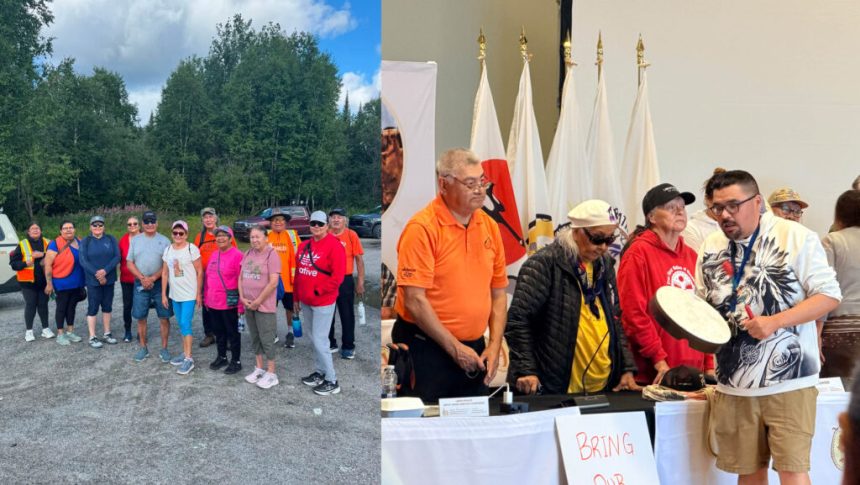
A four-day walk to raise awareness about diabetes culminated with a grand entrance at the Cree Nation Government’s Annual General Assembly in Waswanipi August 12. The group began their journey at the Chibougamau hospital, where many Waswanipi community members travel every second day for hemodialysis treatments. The initiative was conceived as a relay walk, with the small group generally walking 10 km each day to cover the 144 km from Chibougamau to Waswanipi. Recently elected Waswanipi Chief Matthew Happyjack joined the procession on the first and final days. “At the end, we’ll bring in the dialysis patients through the doors of the general assembly to present their testimonies,” explained Happyjack. “We have a lot of people in Montreal too being treated for dialysis we’ll try to include by phone to present our resolution of support to have hemodialysis equipment in Waswanipi.” The rate of diabetes in Eeyou Istchee is growing at a rate far higher than that of the general population. The Cree Board of Health and Social Services of James Bay (CBHSSJB) revealed this year that 43% of Chisasibi’s adults live with either pre-diabetes or Type 2 diabetes. Diagnoses there have increased fourfold over the past 30 years. “These are big issues we are experiencing in the Cree Nation that are shaped by little decisions,” said the CBHSSJB’s Paul Linton at the CONNECT leadership conference in March. “How we eat, the 30 minutes of activity a day to make health a priority. We can make an impact as individuals, and we can make a difference in how we come together to be more active.” The opening of Waskaganish’s new Community Miyupimâtisîun Centre (CMC) in January added five hemodialysis treatment rooms to the region, joining those available in Chisasibi and Mistissini. In 2023, Waskaganish launched the Home Dialysis Training Centre and Respiratory Clinic to bring quicker solutions for diabetes patients. That followed a pilot project launched in 2019 enabling Waswanipi residents to operate hemodialysis machines from their own homes. Waswanipi was selected for its stable and safe water supply, which is essential for dialysis, and because the round trip to Chibougamau is three hours by car. “It’s tiring with all the travel you do, especially in the wintertime,” said Shirley Matoush, who participated in this pilot project after six months of training in Montreal. “Even a storm cannot stop you – you have to do your treatment.” A tragic patient vehicle crash claimed the lives of four Waswanipi community members in 2024, including one travelling for dialysis. Then-CBHSSJB chairperson Bertie Wapachee described the route as “probably one of the worst highways in the province … a risky place to be on dialysis.” Diagnosed with kidney failure unrelated to diabetes in 2013, Matoush had dialysis treatments in Ottawa and Montreal for eight months before landing a spot in Chibougamau. Since receiving a kidney transplant in 2022, Matoush has been able to resume normal activities, such as taking a vacation or participating in this community walk. “Before I couldn’t go anywhere,” Matoush said. “I just stayed home. I know what is it to be away from family a long time – being in the city is a cultural shock. I am going to the final walk to the AGA. I’m walking for everyone on dialysis. I want to help my people come home.” Chief Happyjack hopes to expedite the CBHSSJB’s plans for a dialysis unit at the Waswanipi clinic. Currently managing his Type 2 diabetes with pills, Happyjack said a fundraising campaign for local hemodialysis machines will follow the walk. “If I have community support, hopefully people will listen,” said Happyjack. “I’ll have a platform where I can talk with government. Based on the public heath stats, people in Waswanipi are aware [of treatment needs] so it’s a matter of getting the Nation aware of it too.” Happyjack said plans for this walk began three months ago with Sol Awashish, whose 2002 diabetes awareness walk visited most Cree communities. Since then, Awashish has organized walks almost every summer, often arriving to the AGA to emphasize Miyupimaatisiiun – the Cree way of life, health and well-being. “I think we have enough rights already and if we’re not healthy, we cannot practice those rights,” Awashish said. “The physical part of walking isn’t the hardest for me. It’s the mental, emotional and spiritual part. When I walk, I think about all the people who are suffering out there.” Awashish’s son Kenneth died five years ago from complications due to diabetes. As high blood sugar levels associated with the chronic disease thickens the blood so it doesn’t flow regularly, patients have higher risk of heart attacks and strokes. Damaging blood vessels and nerves over time, diabetes may result in blindness or the amputation of feet or hands. As a retired public health employee, Awashish recalled the CBHSSJB being warned years ago to expand regional hemodialysis access because of diminishing availability in Montreal. His vision is for every Cree community to have their own hemodialysis machines. In addition to the long commutes faced by Waswanipi members, each hemodialysis treatment takes about four hours. Awashish highlighted that some Elders rely on transportation services between the communities, sometimes waiting hours when their ride doesn’t come on time. “I go to the hospital and I see the Elders sleeping in their wheelchairs and I don’t think that’s right,” Awashish asserted. “Every time we have a general assembly, people say we take care of our Elders. But leaving them in a hallway to wait at a hospital for two or three hours, that’s not respect.” Choosing walking as a communication platform was partly inspired by the “moccasin telegram” tradition of sharing news by sending a walker to the next camp. There’s a legend of a man named Philip Petawabano walking from Mistissini to Fort George to deliver a message between Hudson Bay posts. “I figured if walking was the way they used to do things, I’d continue the tradition,” said Awashish. “As I walk, I cry for everybody I lost to diabetes and pray for solutions. I hope my walking is not in vain.”
The Moccasin Telegram Walking to Waswanipi for hemodialysis awareness