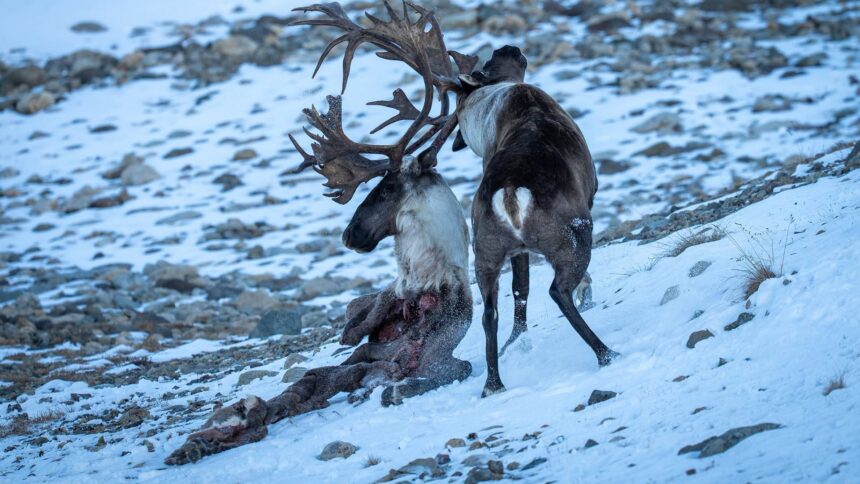
It’s an incredible act of nature. Two caribou. Their antlers locked in battle. One dead. The survivor, nearly immobilized by the weight of his opponent, preyed upon by a bear as foxes and birds scavenge the dead bull’s remains. Yukon photographer Peter Mather captured the remarkable images earlier this month while filming the Southern Lakes caribou’s rut, when up to a few hundred animals gather and males spar for females. “I have never seen anything like that before,” Mather said. “Their horns are locked together, and one of them is dead. And the bear is like sitting 10 feet away, just watching, trying to figure out what to do. It was the strangest situation.” Mather came across the rare sighting about 20 kilometres south of Whitehorse while filming content for the Kwanlin Dün First Nation as part of a project for the Southern Lakes Caribou Steering Committee. Kwanlin Dün is one of six First Nations governments represented on the committee. With fewer than 1,000 animals in the early 1990s, the Southern Lakes caribou, which is composed of four woodland herds, has increased to about 4,000 today, thanks in part to voluntary harvest moratoriums by First Nations. Yukon photographer Peter Mather. Photo: Jordan Haslbeck/APTN. A rare encounter Mather said he first became aware of the caribou after he and a friend helping him gather footage encountered an aggressive grizzly, something he said is not common around Whitehorse. He said days later they saw another bear in the same spot, along with several ravens and eagles. Assuming a dead animal was nearby, he flew a drone to investigate. He said he was shocked to see the two bulls locked together. “Then you’d see the bear go in to try to get this big caribou, and the caribou would stand up, and the bear would go away scared, which is surprising because you would think a bear isn’t afraid of a bull caribou. But those bull caribou are so big they can take on a bear,” he said. Mather figures the surviving caribou spent about a week weighed down in one spot while fending off bears and other predators. After leaving the caribou some lichen, Mather said he appeared to gain back some strength. He said scavengers and what he believes was a pack of wolves further helped free the animal by removing most of the dead caribou’s carcass, leaving just the head attached. Mather said he and his friend resolved to remove what was left of the dead caribou with a hacksaw, but by that point the caribou was able to get up and leave. “Last we saw, he was heading off in the mountains with two heads,” he said. ‘These herds are really special’ Lars Jessop, the steering committee’s project manager, said males are exhausted during the rut, leaving them vulnerable to predation. He said while it can be a dangerous time for bulls, it’s rare for them to be unable to separate. He said he’s only seen bulls locked together once before while both were alive, and that a colleague had previously found the skeletons of two locked bulls. He said that makes the situation all the more remarkable as one bull died and the other survived. “He would have been extremely vulnerable because he couldn’t move and somehow avoided predation until he managed to get away,” he said. Lars Jessop, the project manager for the Southern Lakes Caribou Steering Committee. Photo: Jordan Haslbeck/APTN. Despite the burden of an extra head, Jessop said the caribou has a good shot at survival. That’s because adult males typically shed their antlers after the rut. “If he can make it another month or so, those antlers will drop. He’ll drop his antlers, and then he will have a good chance,” he said. He noted that Mather’s images of the entangled caribou, as well as the herds themselves, have helped share the beauty of the southern lakes caribou while also educating the public. “These herds are really special,” he said. For Mather, the surviving caribou is a reminder of what can happen when nature is allowed to thrive. “I think he’s kind of the symbol of that recovery because that resilience that he’s got is indicative of what the herd has and how they’re growing again. They still need more work, but they’re coming back.” Sara ConnorsReporter | WhitehorseSara Connors is originally from Nova Scotia and has a journalism degree from the University of King’s College in Halifax. After graduation she worked in South Korea for two years as an English language teacher and freelance journalist. After she returned home in 2019 she worked behind the scenes at CTV Atlantic in Halifax before joining APTN’s Yukon bureau in July 2020. Tags: antlers, Caribou, caribou rut, Lars Jeesop, males sparring, National, Peter Mather, rut, southern lakes caribou, Southern Lakes Caribou Steering Committee, Survival, Wildlife, Yukon Continue Reading
Yukon photographer captures caribous extraordinary fight for survival


Leave a Comment