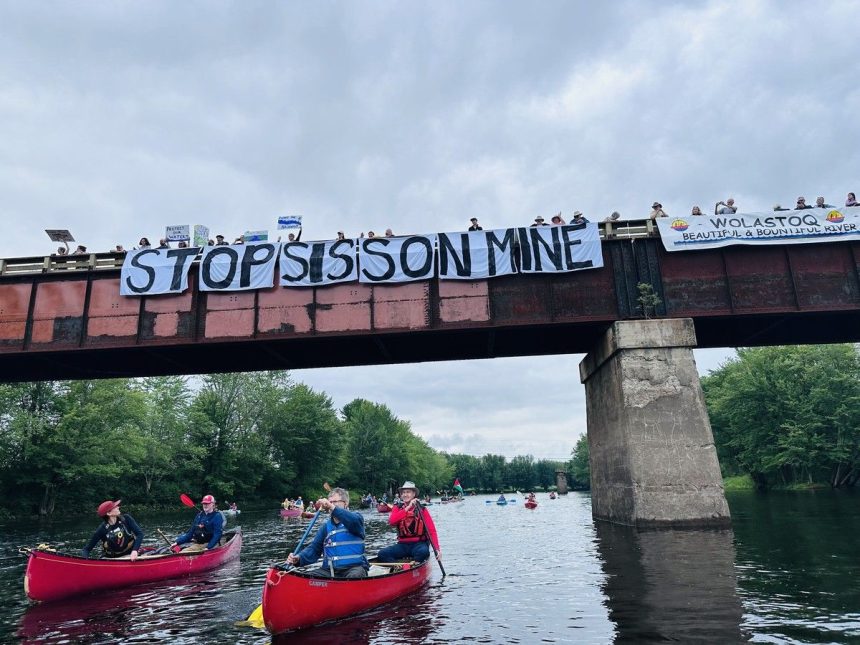
Dozens of canoes and kayaks hit the Nashwaak River over the weekend to protest the Sisson mine, despite the promise of jobs and moneyPublished Jun 29, 2026 • Last updated Jun 30, 2026 • 6 minute readAbout 130 people opposed to the Sisson mine took part in the Great Paddle on Saturday, crossing underneath the Nashwaak Trail Bridge just before the tributary drains into the St. John River in the heart of Fredericton. Photo by Jackie McVicar/for Brunswick NewsMore than 100 people canoed and kayaked together on the Nashwaak and St. John rivers on Saturday, a protest paddle against a mining project that has the enthusiastic support of the premier and prime minister.THIS CONTENT IS RESERVED FOR SUBSCRIBERSSubscribe now to read the latest news in your city and across Canada.Unlimited online access to articles from across Canada with one account.Get exclusive access to the e-Edition, an electronic replica of the print edition that you can share, download and comment on.Enjoy insights and behind-the-scenes analysis from our award-winning journalists.Support local journalism and the next generation of journalists.SUBSCRIBE TO UNLOCK MORE ARTICLESSubscribe now to read the latest news in your city and across Canada.Unlimited online access to articles from across Canada with one account.Get exclusive access to the e-Edition, an electronic replica of the print edition that you can share, download and comment on.Enjoy insights and behind-the-scenes analysis from our award-winning journalists.Support local journalism and the next generation of journalists.REGISTER / SIGN IN TO UNLOCK MORE ARTICLESCreate an account or sign in to keep reading.Access articles from across Canada with one account.Enjoy additional articles per month.Get email updates from your favourite journalists.THIS ARTICLE IS FREE TO READ REGISTER TO UNLOCK.Create an account or sign in to continue with your reading experience.Access articles from across Canada with one accountShare your thoughts and join the conversation in the commentsEnjoy additional articles per monthGet email updates from your favourite authorsArticle contentOne of the leaders of the flotilla was Ron Tremblay, who for the last 10 years has served as the traditional Wolastoqey Grand Chief.He told Brunswick News the people who paddled leisurely for more than two hours from the Marysville Heritage Centre on the Nashwaak to the St. John River near the Princess Margaret Bridge were deeply concerned about the proposed Sisson mine.The mine’s location near the headwaters of the Nashwaak about 113 kilometres north of Fredericton has raised fears that a large berm and tailings pond planned for the site could pollute the wider watershed if it breaches.Saturday’s fine weather event, dubbed the Great Paddle, was organized by Stop Sisson Mine Coalition, the Nashwaak Watershed Association and Wolastoq Grand Council.“We wanted to educate more people who aren’t aware of the proposed mine,” the chief said on Monday. “As well, we wanted to bring people together, just to show how important and sacred our river systems are, and that we need to protect them from any further pollution.”Article contentNorthcliff Resources, based out Vancouver, wants to develop the open-pit tungsten and molybdenum mine near headwaters and the old village of Stanley. The two heavy metals are coveted by manufacturers for a wide variety of products.After being stalled for decades, the project received a huge boost last year from the U.S. Department of War and the Government of Canada when they announced $29 million in funding to accelerate its pre-construction and feasibility phases.Prime Minister Mark Carney later endorsed Sisson as a nation-building project. Premier Susan Holt says the mine promises to create hundreds of jobs over a lifetime and fill government coffers with tens of millions of royalties that can be used to fund hospitals and schools.The CEO of the company, Andrew Ing, told Brunswick News last year his company was working on an updated feasibility study for the project that he hoped to have completed by the second quarter of this year, which ends June 30. He anticipated the project would begin digging the valuable metals out of the ground by 2030.By signing up you consent to receive the above newsletter from Postmedia Network Inc.Article contentArticle contentOver the last couple of weeks, repeated calls and emails to the company by Brunswick News have gone unanswered. Andrew Ing is the CEO of Northcliff Resources, the firm that wants to build the Sisson Mine in central New Brunswick. SubmittedMinister of Natural Resources John Herron declined an interview request.However, in a prepared statement on Tuesday, he told Brunswick News that his Liberal government’s new critical minerals strategy recognized the growing global demand for precious commodities while placing strong emphasis on environmental stewardship, Indigenous and community engagement, scientific oversight, and transparent regulatory processes.“We believe New Brunswick has an opportunity to play a significant role in supplying the world with minerals needed for clean energy technologies and economic growth,” the provincial minister said. “However, any project moving forward in this province must meet rigorous environmental standards and demonstrate that it can operate safely and responsibly.“Our government will continue to work closely with communities, Indigenous partners, environmental experts, and industry stakeholders to ensure that decisions are guided by sound science, accountability, and the long-term interests of New Brunswickers.”Article contentDavid Sweeney, the mayor of Nashwaak Rural Community, isn’t convinced. He took part in the paddle protest.“I participated because I felt it was important to show support for the community members who have been raising concerns,” he told Brunswick News in an email Monday. “My role requires me to stay connected to the people I serve, and being present there was part of that responsibility.”Last February, his council raised similar concerns with Sisson.“Council supports development that is done responsibly and with full transparency,” Sweeney said at the time in a prepared statement. “However, the protection of the Nashwaak and Tay watersheds is not negotiable. These waters are fundamental not only to our community, but to the downstream communities and ecosystems that rely on them.”The statement warned that his community would suffer disproportionally if there were a tailings breach. It also said the council remained concerned that the company hadn’t met key environmental requirements yet nor meaningfully engaged with the local politicians up to that point.Article contentNothing has changed since then, Sweeney said.“There has not been any meaningful interaction with council,” he wrote Monday. “We have not received commitments for a meeting, nor has there been substantive follow‑up from them.”The elected chiefs and councils of the six Wolastoqey communities in the St. John River valley, whose traditional territory includes the Nashwaak watershed, have already given tacit approval of the mine by accepting a multimillion-dollar accommodation agreement with the provincial government in 2017 that will give them a cut of future royalties from the project.Tremblay does not feel bound by that agreement. He became leader of the Wolastoqey Grand Council after being selected by several elders from the Indigenous communities.He said from an economic standpoint, he didn’t think locals would benefit from the hundreds of construction and mining jobs that would be created, pointing out that much of the work would be carried about by unionized crews from other places.Article contentBut he is chiefly against the mine for environmental reasons. Last November and early December, he travelled half way around the world to New Zealand, where he said he met two representatives of the Todd Group, major investors in Northcliff. The Grand Council also participated in an online meeting with Northcliff executives earlier this year. He described both meetings as polite and cordial. Ron Tremblay, chief of the Wolastoq Grand Council, says the proposed Sisson mine is a threat to animals, birds, insects and other creatures. Brunswick News archive“They reassured us that the mine was years away from being developed,” he said. “I told them to look at the footage of what happened with fracking near Rexton. I said, ‘we are not a violent people, we are very peaceful,’ but that we wanted to make sure that, you know, our people were safe, and I said the majority of our people who have spoken do not want that mine here.”In October 2013, RCMP tried to remove a blockade near Rexton in eastern New Brunswick led by people from the Mi’kmaq community of Elsipogtog and their supporters, who had been trying to stop the company Southwestern Energy Resources (SWN) from doing exploratory testing for shale gas.Article contentA massive fight ensued, with dozens arrested and several RCMP vehicles torched. SWN workers eventually left the province and never returned.Asked if he’d be willing to compromise if Northcliff put in stronger environmental safeguards for the mine, Tremblay said no.The chief referred to the 2014 catastrophe at Mount Polley, B.C., when the unexpected collapse of a tailings pond dam released about 24 billion litres of toxic mining wastewater and sediment into Polley Lake, Hazeltine Creek, and pristine Quesnel Lake.The contamination is still being felt today, both in studies done on fish and plant life and for Indigenous communities who draw their drinking water from those water bodies.“For the Indigenous people, the First Nations people, who relied on that area for water, drinking water, recreation, and fishing and food, it was all poisoned, and even still today, they haven’t recovered from that,” the chief said.Tremblay is not persuaded by arguments that hundreds of other Canadians mines have been running since then without major incidents.“The animals, birds and insects will be poisoned when they drink the water in the toxic tailings pond. We can’t allow that to happen.”Article content
Paddlers try to put a damper on ‘nation-building’ mine project