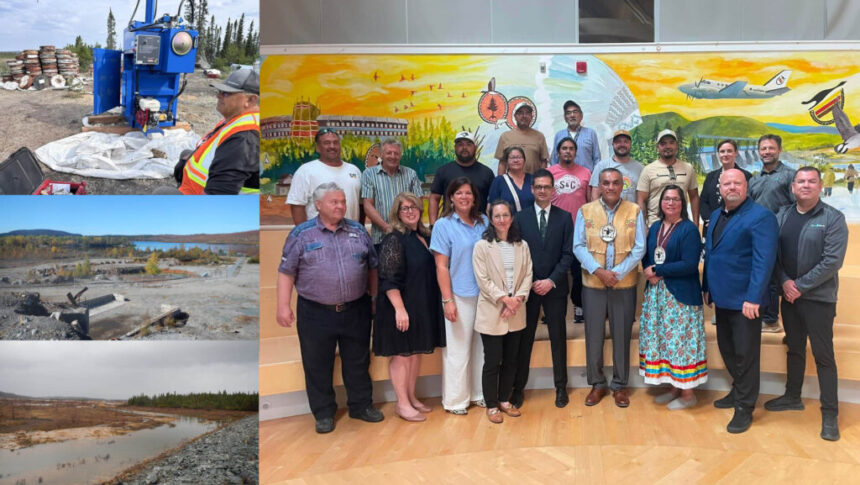
Contamination removal at the Principale Mine site is set to begin this fall, following an agreement between the provincial government and Construction Econord in July. Cleanup efforts at one of the worst abandoned mining sites in Quebec, with a budget estimated at $30.4 million, will generate significant benefits for Chibougamau and Ouje-Bougoumou. “Today marks the culmination of nearly 30 years of perseverance by the Cree Nation of Oujé-Bougoumou,” said Chief Gaston Cooper at the announcement. “For decades, our Nation has worked tirelessly to draw attention to the toxic contamination left by the Principale Mine on its traditional territory and to ensure that this situation is addressed with respect for the concerns of the Cree who use the territory and all those who depend on these waters.” Operating for over 50 years southeast of Chibougamau on Lac aux Dorés, the copper and gold processing site left three tailing ponds covering nearly 170 hectares. They contain approximately 19 million tonnes of mining waste, including arsenic, copper, nickel and zinc. After closing the mine in 2004, the company went bankrupt in 2009, forcing Quebec to initiate a rehabilitation plan in 2011. The restoration project is divided into five phases, beginning this fall with the excavation of an oil spill, the treatment of excavated contaminated materials and the opening of a quarry that reinforces the site for future stages. As work progresses to the site’s renaturalization, the project will create jobs and require local machinery and supplies. The agreement also supports the acquisition of expertise among Cree and James Bay businesses. With arsenic poisoning of wildlife a central concern, work over the past decade included securing former facilities, installing water-testing sensors and collecting groundwater samples. It was the first time Cree have been involved in a mine-rehabilitation plan. “We did visit the actual site a couple of years ago and the soil was so contaminated that we had to be monitored exactly where we were walking,” recalled former Ouje-Bougoumou councillor Susan Mark. “Even the bus taking us there needed a certain road.” Mark remembered her late father-in-law drawing attention to the mine’s danger at a community assembly in Chibougamau in the mid-1980s after catching fish with red burns on their gills. She speculated that a higher rate of cancer in the community could be related to the site. Work to restore Eeyou Istchee’s nearly 500 abandoned mining exploration sites began after an $11 million agreement signed in 2018 between the Quebec and Cree governments, Eeyou-Istchee James Bay regional government and the mine industry group Fonds Restor-Action Cri. “It’s fantastically rewarding to see sites that people have complained about their whole lives and seeing results,” said CNG environment manager Cameron McLean. “In a lot of cases, they’re working alongside us. It’s been a slow process just because it’s complex.” Adario Masty, the CNG coordinator of abandoned mining site cleanup, occasionally posts TikTok videos of helicopters carrying away bulky waste. Extensive planning is required to transport personnel and equipment to remote locations. Helicopters are sometimes reserved for firefighting or other industries, while overgrown areas require a crew to clear landing pads. “You have to see the site, make assessments and analyses of what’s there and then come up with a plan,” McLean explained. “How many trips? Are you bringing in drum crushers? Do you have to bring in crews of specialists? Is there anything about that site to make it tricky?” Costs for each step in the process have risen significantly since the funding agreement, so trips are limited by assessing potential contamination and other issues while the materials are removed. Experts later take soil and water samples to determine whether further analysis is necessary. “Quebec has the responsibility for contaminated soil but we have to demonstrate it,” said McLean. “Contaminated soil stays there. I’ve worked on 70-year sites. Our soil is very cold and keeps everything preserved.” John Rupert’s trapline 60 km north of Whapmagoostui has been polluted since 2006, when a large prospecting camp moved in without his approval. After leaving two years later, they left about 300 leaking fuel barrels and other waste. Black bears and wolves have been seen breaking plastic containers and eating unknown substances. While Rupert was pleased that a massive cleanup was undertaken in 2024 and 2025, he said contamination remains. “Things are changing in that area, especially the fish,” Rupert told the Nation. “They’re thinner than they were. If you stay there in the summer, you’ll still smell the diesel from the waste. I don’t trust hunting there anymore.” The 73-year-old has always lived off the land in the traditional ways he learned from his father. Rupert still spends winters in an insulated cabin near the abandoned site, beside a lake with abundant fish and the area’s best ptarmigan and caribou hunting. “That’s my whole life there,” shared Rupert. “They didn’t tell me they were going to set up the camp in that place. That lake is right at the centre of my trapline. My trapline is small. I can travel it less than two hours by ski-doo.” Rupert still wants answers about the extent of contamination of his land and when it will be safe to hunt. Or when a bulldozer the prospectors left behind will be removed. While protocols are in place to ensure such a situation never happens again, Rupert just wants this land back. “It’s important for mining companies to inform the tallymen before starting the work,” said Rupert. “My grandchildren are starting to hunt but I warned them not to hunt or fish in that area. I hope in the future it will come back the way it was but I won’t be around anymore.”
Cleaning up Contamination Long-awaited restoration of Principale Mine set to begin