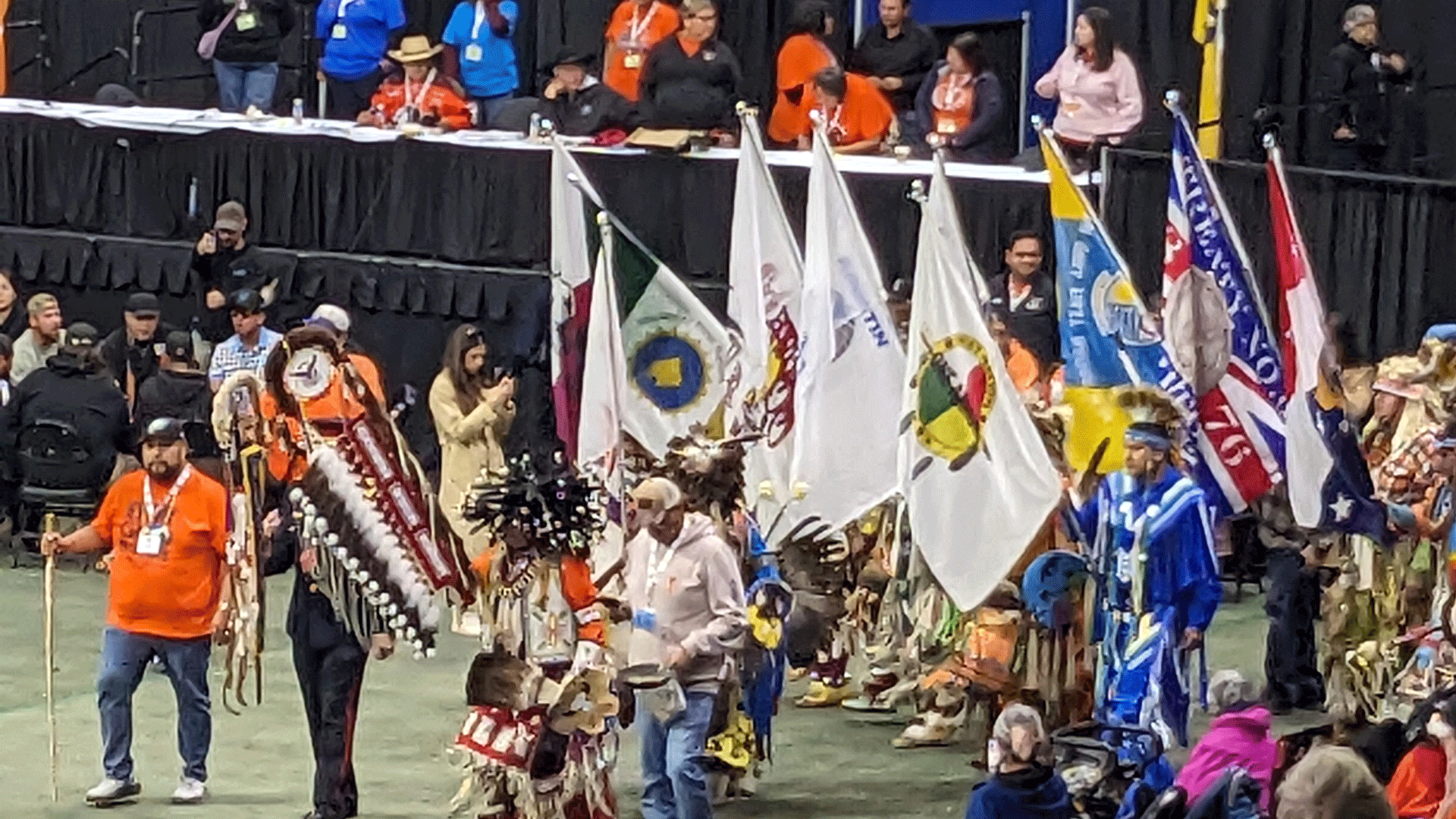
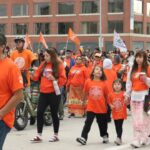
The steady thump of drums could be heard in the background as drum groups and dancers readied themselves for the procession leading to the Saskatoon Tribal Council’s Every Child Matters powwow in Saskatoon. The powwow is held each year to honour residential school survivors and remember the children who never made it home. About 700 dancers in all manner of regalia registered for the powwow, which organizers say is to help people understand what the orange shirt means to residential school survivors, and to provide a safe atmosphere to celebrate culture that was lost to the school system. One elderly survivor, Irene Nippi of Kinistin Saulteaux First Nation, said she went to residential school “for a long time.” “There were a lot of things that happened, like sexual abuse, physical abuse, emotional abuse, and spiritual abuse. And most of the women I went to school with, the children, either committed suicide or died of alcoholism because of what happened to us at residential school,” Nippi said. “And that’s why for me, it matters because it’s intergenerational. I myself, went to residential school and I thought I was doing a good thing sending my children to residential school only to find out they went through the same thing.” Nippi said she participates in the powwow because it’s important for people to understand why “so many of our people out on the streets, homeless, doing drugs.” “Some people are always telling us that-‘get over it.’ But how can you get over it when it’s happened and it seeps into our children. And that’s where I’m trying to bring awareness to my own family and of all of them that all went to school. [They] are slowly getting their lives back, but are still not ready to talk about what they experienced at the residential school,” Nippi said. “Somewhere along the line,” Nippi said she realized she had to “wake up and try and stop that cycle.” Arcand said the tribal council holds a powwow each year for a very good reason. “When they were in those schools, it was their language, their culture, their identity taken away. Now here, we’re implementing it. We’re having their culture, their songs, their dance, their ceremony back to who they were. So that’s something that we’re proud of, and we want to keep making sure that this is alive and vibrant in our First Nations people,” Arcand said. A former corrections worker who’s now a social work student brought her infant daughter to experience the powwow for the first time. “I’ve come across a lot of people who are disconnected with their culture,” said Leanna Fiddler of Pelican Lake First Nation. “So, it makes it more important for me to show my own children how important it is and being able to be here. I worked with corrections, and that’s what drove me to go into social work. And the representation to have indigenous people in that setting.” A young traditional dancer in full regalia said he started out as a grass horse dancer 10 years ago when he was seven. “I gradually changed into a traditional because the storytelling and what it shows in me, and it shows resilience. I just like dancing with my people too because a lot of my people are in pain right now, so I just hate seeing them like that. And I get a lot of compliments on all my dancing, so it just keeps me going,” Francis Junior Cardinal of Onion Lake Cree Nation told APTN News. “I dance for every survivor there on this day. Orange is very important because my dad’s a survivor too. And I want to dance for him for all the pain he’s been through all his life,” Cardinal said, noting he thinks things are getting better for people on his First Nation. “I see some of my friends graduating, getting their driver’s licenses, which is good seeing how the community is doing and how far we’re progressing as people.” Denialism as a crime Arcand said recent displays of denialism show more work needs to be done to educate Canadians about the truth of what went on in the schools. He added that he fully supports denialism being classified as a hate crime and noted the federal government has “an obligation to keep people safe.” On June 3, the Senate voted down an amendment to the federal anti-hate legislation (Bill C-9, or the Combating Hate Act) that would have classified public denial, downplaying, or justification of residential school harms as a criminal offense. Senators who opposed the inclusion cited a lack of formal consultation and potential unintended legal consequences rather than defending the denialist ideology itself. Since then, the Assembly of First Nations passed emergency resolutions urging the federal government to enact standalone legislation or revisit the Criminal Code, mirroring protections used against Holocaust denialism. Meanwhile, figures like NDP MP Leah Gazan continue to press for dedicated legislative bans following public demonstrations questioning residential school findings. “And if they classify this as a as a hate crime or people that are doing things in a negative way that’s intentional like happened in Kamloops…they have to be held accountable,” Arcand said. Arcand said there’s an opportunity to “bring people back to a circle of finding their culture.” Continue Reading
Residential school survivor calls for understanding at annual Every Child Matters Powwow

Leave a Comment