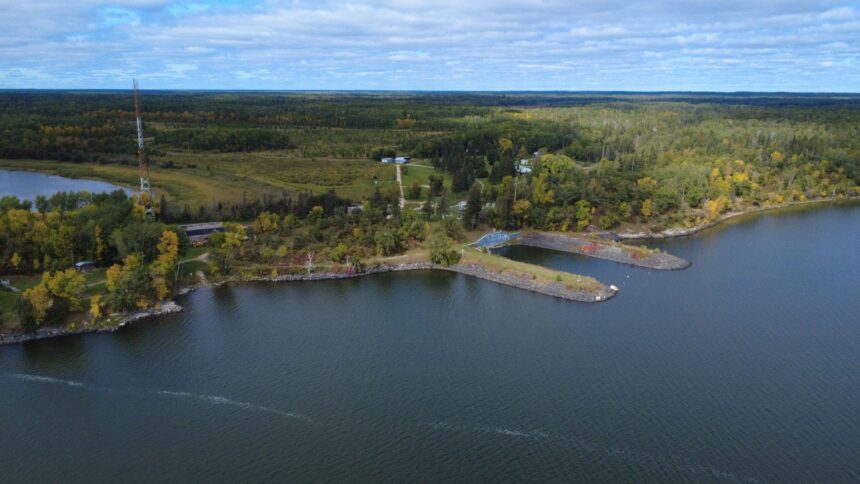
A century-old exchange of letters between senior government officials is at the heart of a $2 billion lawsuit alleging Indigenous water rights were sacrificed to ensure Winnipeg could draw its drinking water from Shoal Lake. In 1914, Ontario deputy minister of lands, forests and mines Aubrey White warned federal Indian Affairs deputy superintendent general Duncan Campbell Scott that honouring existing legislative commitments to First Nations could “cripple” Winnipeg’s proposed aqueduct project. The letters were uncovered by a historian hired by lawyer Julian Falconer’s firm. “Completely out of sight of the First Nations, completely in secret, the deputy minister in a letter that we now have, says, if we follow through on this it would cripple, and that’s the word he used, cripple the Winnipeg water project,” says Falconer. Falconer’s firm is representing Iskatewizaagegan (Shoal Lake) No. 39 Independent First Nation in litigation heading to trial against the City of Winnipeg and Ontario. A statement of claim filed in the Ontario Superior Court of Justice in 2024, alleges ecological, cultural and financial impacts resulting from Winnipeg’s aqueduct intake in Shoal Lake and seeks $2 billion in damages. In a letter responding to White’s warning, Scott agrees that White has raised “important” points, but recommends that “we should say nothing about water or fisheries, but leave those questions to be decided as the cases arise.” The following year, Ontario passed legislation that in effect eliminated the issue White had raised concerns about. The legislation governed reserve lands in Treaty 3 territory, and removed a provision from an 1894 agreement between Ontario and Canada that had recognized certain waters and lakebeds between projecting headlands as part of First Nations reserves. Lawyer Julian Falconer at a presentation for Shoal Lake No.39 citizens. Photo: Christopher Read/APTN. In its statement of defence, the city of Winnipeg denies Ontario altered the law for Winnipeg’s benefit, arguing the changes arose from a separate dispute. The lawsuit also points to a provision in a 1913 Ontario Order in Council approving Winnipeg’s Shoal Lake aqueduct that requires compensation be made to “all private parties whose lands or properties may be taken, injuriously affected or in any way interfered with.” In 2019, before filing Shoal Lake 39’s lawsuit, Falconer asked the court for a ruling on whether the provision applied to the First Nation. “We applied to a court to ask a simple question: Does Iskatewizaagegan number 39 constitute a private party for the purposes of this compensation provision? The court answered yes,” says Falconer. The ruling did not determine whether Winnipeg is liable for the damages the First Nation alleges. Winnipeg acknowledges the compensation provision exists but denies causing the damage alleged. In its statement of defence, the city says other dams and overfishing are responsible for many of the environmental changes Shoal Lake 39 has identified. Not so, says Shoal Lake 39 Chief Gerald Lewis. According to Lewis, the aqueduct intake doesn’t just take in water. “It also includes fish, and the fish eggs,” says Lewis. Iskatewizaagegan litigation committee chair Rachel Green at the edge of Shoal Lake. Photo: Christopher Read/APTN. For Iskatewizaagegan citizen Rachel Green, the lawsuit is also an opportunity to reclaim a history she believes has been largely told by others. She’s the chair of her community’s litigation committee and a graduate student writing a master’s thesis at the University of Winnipeg. Her research is closely tied to Falconer’s team’s investigation into how Winnipeg’s aqueduct project came to be. “My whole motivation for doing this research is because the Iskatewizaagegan water issue, our story, has only been told from the perspective of the government, a colonial perspective, and has never, ever been told from our perspective,” says Green. Her concern about the issue is also rooted in deeply held beliefs about the water of Shoal Lake. “When it comes to the water coming to Winnipeg from Shoal Lake, it’s used as a commodity, as a source to make revenue from,” says Green, “whereas us that are from Shoal Lake, having that spiritual bond and connection to the water, water is a relative.” She is alluding to Winnipeg’s practice of diverting dividends generated by its water utility to subsidize the city’s general revenue. Through this practice, called cross-subsidization, the water utility has contributed tens of millions of dollars annually to Winnipeg’s revenue coffers, according to records obtained by APTN Investigates from the city. But while Winnipeg acknowledges earning revenue from its water utility, it denies improperly profiting from Shoal Lake. Shoal Lake No.39 Chief Gerald Lewis on the shore of Shoal Lake. Photo: Christopher Read/APTN. Chief Gerald Lewis has a different perspective. As he sees it, while Winnipeg has flourished, his community has languished. “Our housing is not good. We have a lot of homes that are on the verge of collapsing, but there’s so much mould, a lot of them are condemned, and we have really limited resources,” says Lewis. “Funding-wise, we get very minimal funding and you’ve seen how the city is, how the city is expanding every day, how they’re growing.” Falconer believes the litigation has Winnipeg and Ontario worried, and he thinks that’s why they have brought in the federal government as a third party. “They’re dragging in Canada because they know that reparations are coming,” says Falconer. He also believes the defendants are hoping Shoal Lake 39 runs out of money, as he tells Iskatewizaagegan citizens in Troubled Waters. “Think about this for a minute,” says Falconer. “As we take each step, we are expending resources, money, that should be spent on your children, that should be spent on allowing your community to prosper. But instead, they’re spent on this legal battle. And that’s what’s really going on. Winnipeg is basically fighting a war of attrition.” Christopher ReadInvestigative ReporterChristopher is proud of his deep roots in the place we now call Winnipeg, which connect him to the early days of the Red River Settlement. A graduate of Ryerson University’s journalism program, Chris also has a degree in English from the University of Manitoba. In 2014 he produced the documentary Alice and Kevin – which screened at imagineNative. He started at APTN Investigates in June of 2018. Continue Reading
Letters from 1914 reveal worry that Shoal Lake water rights would cripple Winnipeg aqueduct


Leave a Comment