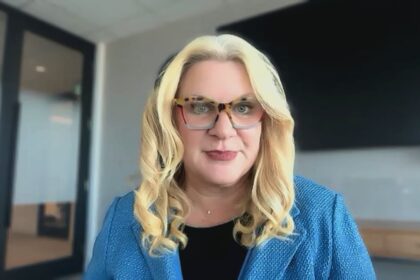
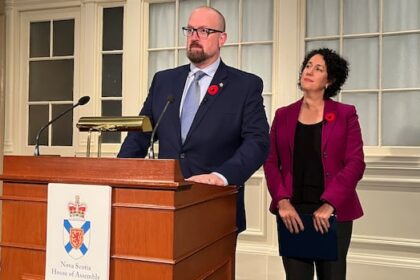
For the last two years, Dana Fergusson has been asking Aurora College the same questions. As chair of Thebacha Leadership Council, she wants to know what academic programs will be offered at the college’s Fort Smith and Inuvik campuses as the institution works toward becoming a polytechnic university. She also wants to know how decisions about program locations are being made, what progress the college has made toward its transformation and how much the process has cost. “Where are the measurable outcomes on where they are with getting closer to this polytech?” Fergusson said in an interview with APTN News. “And then tell me where the money went.” The Thebacha Leadership Council is governed by local leadership from Salt River First Nation, Tthebatthie Denesuline Nation, Fort Smith Métis Council and Town of Fort Smith. On Nov. 18, the council sent a second open letter to Aurora College’s board of governors, the minister of Education, Culture and Employment and all members of the legislative assembly. The letter asks the college to make clear commitments on regional program delivery, including transparent criteria for deciding where programs are offered, an assessment of campus infrastructure and utilization, and in-person engagement with communities. It also calls for a public plan to maintain and renew student residences. The letter follows a presentation the council made to the board on Oct. 2. “We just received their response letter from that, and it really felt like a nothing letter,” she said. “It had nothing of substance in it.” The letters signed by Fergusson on behalf of the Town of Fort Smith, along with the Fort Smith Métis Council, Salt River First Nation and Thebacha Denesųłiné Nation. Fort Smith questions the future of its campus The concern has a longer history. A 2018 foundational review found the school needed to evolve to better meet the need of northerners and it proposed moving the college’s headquarters to Yellowknife as part of its transformation into a polytechnic university. The Thebacha Campus has classrooms, laboratories, a library, computer labs and student housing. Fergusson said much of that infrastructure is being underutilized. “We have this huge regional campus here, big classrooms, library, labs, computer labs, all of these resources sitting here empty, vacant,” she said. Fergusson has started making videos to show residents what is available at the campus, including its student housing. “Why are we talking about centralizing something in another region, another community to build all this infrastructure when you have it already sitting here in Fort Smith?” she said. Fergusson said Fort Smith has gradually lost access to programs that once brought students to the community, including teacher education, social work and early childhood education. She said some of those programs have been absent for about eight years. The impact, she argued, reaches beyond the classroom. Fewer students living in Fort Smith also means fewer customers for local businesses. The uncertainty is particularly difficult for young people trying to plan their education. Fergusson said high school students have asked how they are supposed to prepare for post-secondary studies when they do not know where a program will be delivered. “You don’t know where it’s going to be, so you can’t plan for the community,” she said. “How do you plan for where you’re going to live?” Students may need to arrange housing, employment and financial assistance well before a program begins. Without knowing where a course of study will be offered, Fergusson says, those decisions become harder to make. Inuvik wants more in-person diploma programs The concerns are not limited to Fort Smith. In Inuvik, Mayor Peter Clarkson said the town wants more in-person programming at the Aurora College campus. Clarkson said there’s a notable decline in student enrolment. He puts the numbers at about 165 students at one point, compared with roughly 25 more recently, and just half of that number graduating last year. Clarkson says office and business administration courses have been offered in Inuvik for decades, alongside some upgrading and online learning. But he wants the college to introduce more diploma programs that respond to employment needs across the Beaufort Delta and the wider territory. His suggestions include information technology, recreation leadership, northern natural resource technology and advanced finance. Clarkson said employers across the territory need people with those skills, but students often have to leave the region to pursue the training. “If you’ve been offering office administration and business admin for the last 30 years, maybe we should be offering something else that people might be interested in,” he told APTN. Clarkson said since becoming mayor two years ago, he has met with Aurora College’s interim president once to discuss the future of the campus. He said the college has indicated it is looking at more in-person diploma programs, but has not given any specifics on new programs. Aurora College says it is not centralizing The college has confirmed it is working with the Inuvialuit Regional Corporation on potential program development to support employment across the Beaufort Delta. Kenny Ruptash, who serves as the chair for Aurora College’s board of governors, said that while the board is responsible for governance and oversight, decisions about where individual programs are delivered are operational decisions made by college staff. “I would strongly oppose the notion that the college is working towards centralization,” he said. Nora Houlihan, Interim President of Aurora College, said there are several factors that must be considered when deciding where to offer programs, including student outcomes, partnerships, practicum requirements, and whether programs can be delivered efficiently. She said the college’s goal is to maintain strong campuses in Fort Smith, Inuvik and Yellowknife, with full programs available at each. But the college’s current plan also raises questions about where some of its new degree programs will be delivered. Aurora College said it intends to offer a Bachelor of Social Work at its North Slave campus in Yellowknife and a Bachelor of Education at its South Slave campus in Fort Smith. Both programs remain subject to regulatory and governance approvals. Houlihan said the college cannot publicly promote programs before agreements with partner institutions and other approvals are finalized, but said more announcements will be made regarding programming in early 2027. “We do have some restrictions around the regulatory and the governance agreements until they are signed,” she said. The college’s 2026-27 corporate plan provides more detail about the intended degree pathways. The plan describes general studies as the main entry point for the new Bachelor of Social Work and Bachelor of Education programs. Students with transferable university credits are expected to be able to enter the third year of those degrees. The college said the programs are slated to begin accepting students for the 2027-28 academic year. That leaves an important question for regional students: what parts of those degree pathways will be available in their communities, and what will they need to do to complete their studies? What the public record shows about the transformation The college’s transformation is not new. It has been years in the making, with a formal timeline and a series of public commitments. The 2025-2028 Aurora College Mandate Agreement between the college and the Northwest Territories identifies the transformation into a polytechnic university as its overarching priority. That agreement set a 2027 target for the launch of the transformed institution. The transformation also involves a new governance structure known as tricameral governance. It consists of the Board of Governors, an Academic Council and an Indigenous Knowledge Holders Council. Aurora College’s commitment to provide students with access to high quality post-secondary education close to home sits at the centre of the debate over regional campuses: what does access close to home mean in practice, and how will the college measure whether it is delivering? A student worries about the future of social work in Fort Smith For students in Fort Smith, questions about program location are not just about institutional planning. Austin Blanchard, a General Studies student at Thebacha Campus and president of the college’s Student Association for 2026-27, wrote to Fergusson and MLA Jay MacDonald about concerns over the planned Bachelor of Social Work program. In that letter shared with APTN, Blanchard says he has been working toward pursuing social work and has built connections in the community through his studies. Blachard argues that offering the program in Yellowknife rather than Fort Smith could create barriers for students who cannot afford to move or who have established family, employment and housing responsibilities. He describes the potential relocation as creating “significant financial, personal, and educational barriers for students who cannot afford to move or who have established families, employment, lack of housing, and other responsibilities within their communities.” His concerns reflect a larger question facing the college as it develops its degree programs: whether students can begin and complete their education close to home, or whether they will have to relocate to access the credentials they want. Regional leaders want a clearer commitment Thebacha Leadership Council is asking for an in-person meeting with the Board of Governors and college leadership to discuss the future of degree-level education outside Yellowknife. Fergusson says the council has invited the board chair to visit Fort Smith and offered to cover the cost of travel. She says the visit has not happened during the council’s two years of advocacy. The college says it is continuing work toward polytechnic designation, including legislative changes, quality assurance and the development of new programs. For now, the college’s plans for new regional programming remain a mix of proposed programs, work in progress and offerings that are still subject to approval. Ruptash says the college appreciates that communities are advocating for their own interests, but says decisions must be based on what will help students succeed. “Every community is advocating for their community,” he said. “We appreciate that, but all our decisions at the college are founded in student outcomes, student successes, and how do we help students graduate to become contributing members to the North.” Charlotte Morritt-JacobsVideo Journalist | YellowknifeCharlotte joined APTN in January 2017 as a video journalist in Yellowknife, N.W.T.. Before coming to APTN she interned at CTV Lethbridge, earned her BA in feminist research from Western University and obtained her post-graduate in journalism at Humber College. Continue Reading
Regional leaders say future of Aurora College campuses remains unclear


Leave a Comment