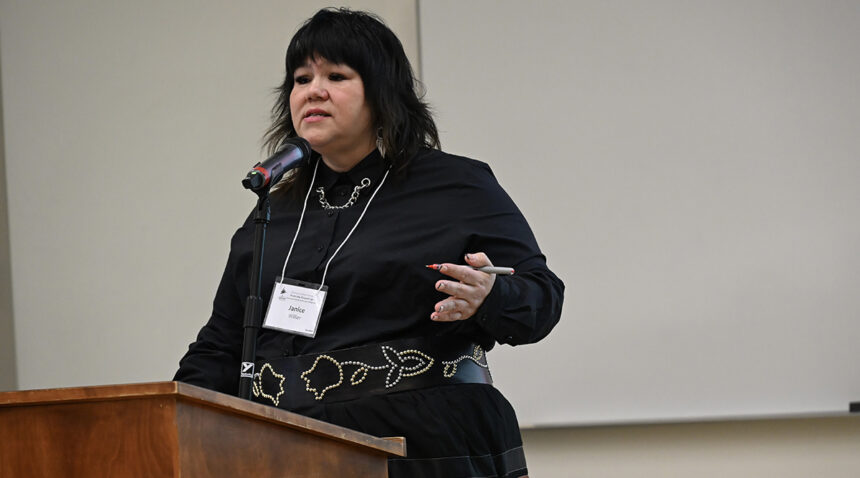
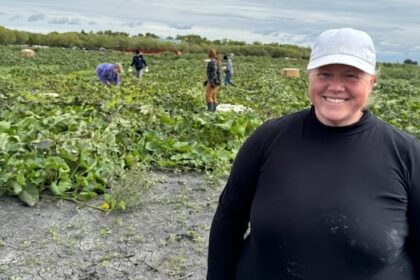
Janice Willier is the Lubicon Lake First Nation’s health projects co-ordinator. Photo by Paula Kirman. By Jeremy Appel, Local Journalism Initiative Reporter (ANNews) – Attendees of the annual Parkland Institute conference on Nov. 22 heard about Lubicon Lake Band’s work building climate-resilient sovereignty on Treaty 8 territory. In 2018, the Lubicon Lake Band reached a historic land claims settlement with the federal and Alberta governments. The Cree First Nation was awarded 246 square kilometres of Crown land northeast of Peace River to establish a reserve, in addition to $113 million in compensation. The settlement provided the Lubicon Lake band leadership with the necessary resources to provide essential services for its members. “Lubicon is essentially building a First Nation from the ground up,” Janice Willier explained to the audience at the University of Alberta. Willier is the First Nation’s health projects co-ordinator. Lubicon became the first First Nation to partner with the Canadian Urban Institute to ensure that all its infrastructure is climate resilient, which Willier emphasized will “support the occupants’ health and safety in increasingly unpredictable conditions.” This meant developing strategies for mitigating the impacts of increased wildfire smoke. Willier said these include building homes that are “air tight,” ventilation systems that can effectively filter outside air, constructing fire breaks near roads and infrastructure, and creating retention ponds “fed by rain, runoff and snowmelt.” Band members were heavily involved in the design process to “integrate traditional knowledge with modern climate resilient technologies,” she added, “fostering a holistic approach to building and living in harmony with the changing climate.” The project managers held repeated community meetings both large and small that opened with a prayer, providing child care, transportation, meals and door prizes to incentivize community engagement. “Once we heard the information, we followed up afterwards with individuals to ensure their ideas and viewpoints were collected correctly, and then presented the project once again to review and input,” said Willier. “It’s a longer process, but it builds trust and solidifies the relationship. Respecting and listening to the community you are serving is essential to a successful project.” Willier’s team developed a social and economic responsibility framework for projects on reserve, which uses criteria such as economic impact, employment and workforce development, community benefits, social value and social outcomes to inform contractors of what’s expected. Each contractor and subcontractor must also sign onto a “construction site code of conduct” and reconciliation policy that is based on the United Nation Declaration on the Rights of Indigenous Peoples, the Truth and Reconciliation Commission’s Calls to Actions, and the National Inquiry into Missing and Murdered Indigenous Women and Girls’ Calls to Justice. “This framework will ensure that visitors to our community respect the Lubicon culture, land, community, and people, and increase their knowledge of the community that they are guests in,” said Willier. She said her team also has a “Lubicon-specific Indigenous awareness training package” in the works, which “explores the nation’s history, rights, and modern challenges grounded in our traditions and culture.” “Creating a community-specific training package helps the contractors and others understand and respect the population. It gives them a safe space to ask questions and helps minimize bias, racism, and stereotypes,” said Willier.
Parkland conference spotlights Lubicon Lakes sovereignty building