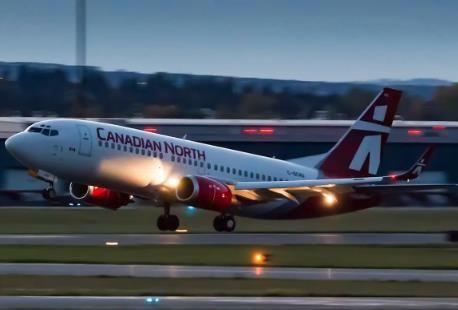
Published 11:27 am Tuesday, November 24, 2026 By William Koblensky Varela Local Journalism Initiative Northern News Service The Canadian Union of Public Employees (CUPE) and Canadian North are meeting all week to hammer out a contract deal for flight attendants to avoid a strike by Dec. 19, as nine months of negotiations run into the busy holiday season. Canadian North flight attendants aren’t paid full hourly wages for work they do before planes take off, something Air Canada and WestJet flight attendants went on strike for and won enhanced compensation for over the past year. On Nov. 6, the Canadian Industrial Relations Board issued a survey to Northerners asking them if a stoppage in Canadian North service would cause “immediate and serious danger to the safety or health of the public.” If Canadian North services such as medical travel and cargo shipment are deemed essential, then a strike preventing that essential service would be deemed illegal. However, Air Canada flight attendants disregarded an illegal strike notice in August 2025 over the same pay issue and won higher on-the-ground wages. Labour leaders argue service levels are the responsibility of the airline, and that flight attendants aren’t being paid like they’re essential workers. Canadian North has been mandated by the federal government to operate flights to all of its Northern destinations at least once per week since 2023, pointed out Hugh Pouliot, senior communications officer for the CUPE. That puts the onus on Canadian North to avoid a work stoppage, CUPE contended. Flight attendants are necessary for passenger service to carry on, Pouliot said. “Ultimately, the power to maintain air services to Northern communities and prevent a work stoppage lies with Canadian North,” he said. “If Canadian North wants to keep planes flying, they should negotiate a fair deal for flight attendants that pays them for every hour they work maintaining passenger safety.” Cargo shipments would not be interrupted by a flight attendant strike, Pouliot noted. The airline ships 12 million tons of cargo per year, according to Canadian North president and CEO Shelly De Caria. “In most of the communities we serve, there is no road access. We are the only airline offering scheduled passenger service, which residents rely on to attend doctors’ appointments, access urgent care, travel to surgeries, and receive prenatal care not available to them locally,” De Caria said. She’s working with the union to avoid a strike, she added. Inuit Tapiriit Kanatami President Natan Obed and Nunavut MP Lori Idlout said in a Nov. 18 press conference that they want Canadian North declared an essential service, which would prohibit flight attendants’ right to strike. “We are not against unions. We’re not against the ability to negotiate the best possible deal with corporations. But we are between all of that,” Obed said. Across Inuit Nunagat, 49 communities are only accessible by plane, and most do not have hospitals, Obed pointed out. Idlout said there shouldn’t even be a debate about whether Canadian North is an essential service because it operates the vast majority of passenger air travel in Nunavut. “Nunavut’s communities are all fly-in communities. All the communities that I represent all need the airline. Any potential disruption can truly be life-threatening,” Idlout said. Obed characterized the essential services debate as a “southern-based focus on labour negotiations.” “We have been lobbying the federal government for decades about defining air travel within our homeland as an essential service that has not come to pass,” he said. “But we will continue to push for that, and we will continue to tell anyone who will listen that even one day of disruption in service within our homeland causes massive risks to our population.” Nunavut Employees Union President Jason Rochon, who is not involved in the negotiations, said Canadian North does provide an essential service, but not all the employees are required to carry out that service.
Potential Canadian North flight attendants strike revives essential service debate