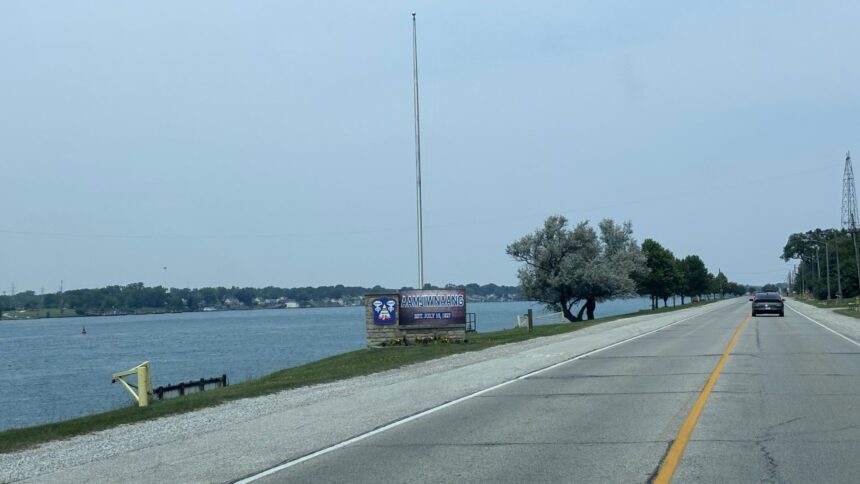
Aamjiwnaang First Nation has had it’s share of environmental struggles. For decades the community has lived with toxic surroundings from chemical valley, where roughly forty percent of Canada’s petrochemical industry lies. Land defender, advocate, activist. These are just a few ways to describe Vanessa Gray. She’s a member of Aamjiwnaang and the co-director of the Environmental Data Justice Lab at the University of Toronto and offers “Toxic Tours.” Her community has seen many environmental impacts including a benzene crisis in 2026 and just recently a pipeline leak. Now a new challenge is coming. Two weeks ago, Alberta Premier Danielle Smith and Ontario Premier Doug Ford proposed an oil pipeline from Alberta to Ontario. The primary route would be 33,300-kilometres from Hardisty, Alberta, to Aamjiwnaang’s doorstep in Sarnia, Ontario. Gray grew up in the community until she was ten years old. Hearing alarm warnings is normal, in fact, every Monday at 12:30 a test alarm can be heard throughout the community. She said it’s an experience that not a lot of people know. “If you hear an alarm, you have to go inside and shut all the windows and turn on the radio and that’s just kind of something I’ve always just known, but that can be pretty shocking to somebody who’s not used to it.” Gray recently offered a short sample of her “Toxic Tours” to APTN News. Generally, the tours are up to two hours, to educate the public and show the reality of the pollution caused by refineries. The tours start from her community of Aamjiwnaang and head to nearby Sarnia. “When community members of Aamjiwnaang need to go to school, the hospital, basically like a grocery store or like anything, you have to drive through what is known as chemical Valley.” Aamjiwnaang needs to be consulted Chief Janelle Nahmabin said her community as a whole needs to be consulted and engaged in the conversation because they already deal with complex situations regularly. “Right now, we’re dealing with aftermaths of a pipeline leak. Also, you know the history of even abandoned pipelines that are protruding from the earth and there’s not enough knowledge from the government of how they got there. Response time and knowledge with the issues we’re already experiencing here in regards to pipelines. So, it doesn’t give me much hope that looking in the long-term of a pipeline how is that going to be properly maintained because Aamjiwnaang First Nation has already seen that many lines aren’t properly maintained”, she said. In the meantime, Gray continues to advocate and educate about the impacts of living with industrial pollution. She’s hopeful more Canadians will join in a new movement. “When the air is so toxic that you can’t even see, none of us are going to be able to breathe and…none of us are actually happy with Doug Ford, we’re probably not very happy with Mark Carney either but when I see the air quality code at a yellow and then an orange, we basically are getting cornered into a place where we don’t have a choice, but it can’t be just Indigenous voices.” According to Chief Nahmabin she’s advocating for future developments in the area with zero emissions. She’s also asking for meaningful consultations for the proposed Alberta to Ontario pipeline. Continue Reading
Aamjiwnaang First Nation already worried about proposed Alberta to Ontario oil pipeline


Leave a Comment