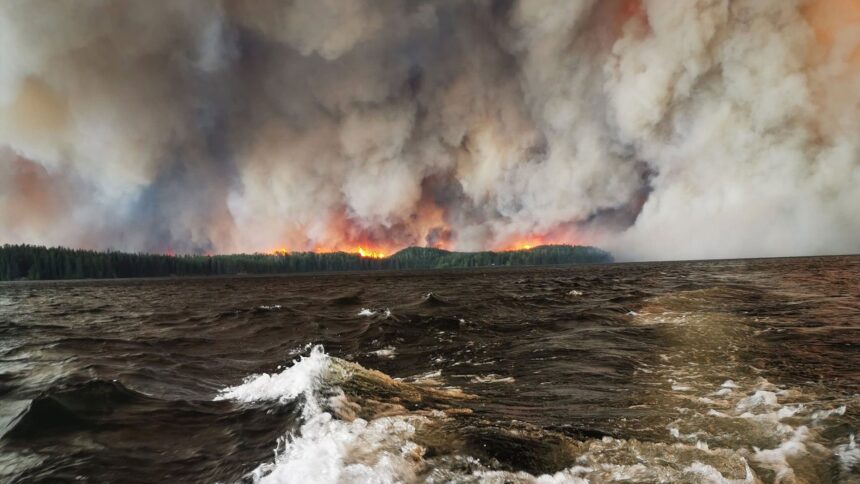
First Nations Leaders in Northwestern Ontario are calling for an immediate public inquiry and independent investigation into the province’s emergency response and handling of the wildfires that have destroyed Collins First Nation (also known as Namaygoosisagagun) and Whitewater First Nation over the course of a week. “The province’s Public Inquiries Act is meant to investigate matters of public interest,” said Wilfred King, Chief of Gull Bay First Nation. “The lack of communication and evacuation support should horrify all Canadians, and our community was on its own. “The federal government has responsibility here too,” King continued. “We won’t accept any jurisdictional disputes. In the year 2026, how could this happen, and more importantly, how do we make sure it never happens again?” Chief Michele Solomon of Fort William First Nation, who was present in support, agreed that “the best thing going forward” would be to examine the current situation so that it doesn’t repeat in the same way. “We know wildfires aren’t going anywhere,” she said. [But] the complete devastation of a community should never happen. “I stand with these chiefs in calling on the government to implement a public inquiry and investigative review into how this all happened and to move forward to not have something like this happen again,” she said. The call was made at a Tuesday press conference in Thunder Bay, which was organized by Nishnawbe Aski Nation. Leadership from Gull Bay, Whitewater, and Fort William First Nations, as well as Anishinabek Nation, Nokiiwin Tribal Council, and Nishnawbe Aski were on hand for the conference. According to King, the event was in direct response to Ontario Premier Doug Ford’s conference Monday where he fielded a question from the media to talk instead about meeting with fellow premiers to discuss a national fire strategy. The question was later addressed by Ontario’s Minister of Natural Resources Mike Harris, who said that “there is year-round co-ordination with First Nation communities across, obviously Northern Ontario, but around Ontario when it comes to emergency management. “It’s something we take very seriously,” Harris said. “We really encourage all communities, especially in the North, to have emergency plans and work with us.” During the premier’s news conference, Ford also discussed the provincial emergency alert system and the transportation of evacuees to 13 hub cities. King said he listened to the conference, and “not once in his speech did [Ford] mention First Nations people. “He praised himself and his government about what a wonderful job they were doing in fighting these fires, and I reached out to my fellow Chiefs, our leaders, and I said, we have to counter what Mr. Ford is saying,” he said. Multiple members of the panel who were representing communities that were and are being evacuated due to the fires, said that self-evacuation had already started before they received formal notification from the province. Chief Lawrence Wanakamik of Whitesand First Nation said that although leadership was preparing for evacuation by 4 p.m. on July 13, they didn’t receive a recommendation from Ontario at 9:30 p.m. By that point, several community members had already left and accommodations had been made in hotels. Despite the warning, Wanakamik referred to it as “self-evacuation” due to the delay. Chief Solomon Atlookan of Eabametoong First Nation (also known as Fort Hope) said Ontario was “negligent,” and that he supports the push for an inquiry. He said when a fire started near his community, it was directly across the lake (approximately seven kilometres away), and that members did not receive support before the wind shifted two days later. “Hot spots were coming all over the place, and still they did not move,” Atlookan said. He received a call at midnight and the federal government evacuated the community the following day. “I appreciate what the federal government did,” he said, but noted that there were no water bombers or support from the province when it came to preventing the fire. In an attempt to control the blaze, firefighters from the community were deployed to fight hot spots before things got out of control. “We’re not just sitting around, yelling at the government,” he said. “We had our own people drive around the lake, looking for smoke, so our own firefighters could put it out. “Our community didn’t know it was going to be a wildfire, it was extremely hot,” Atlookan continued. “And it was dry, dry, and that one day that thunderstorm came by, and a few days later, that’s when all the fires started.” He said the mentality of leadership must change, and that they “must fight together.” “Regardless of who you are, we are a nation. And there are many people on our side, regardless of the colour of their face,” he said. Push to recognize Collins First Nation following devastation During the press conference, Chief Helen Paavola of Collins First Nation also confirmed that “nothing remained but just ashes” after the community self-evacuated on July 13. “The videos and pictures that are out there right now don’t do it justice, it’s horrible, it’s awful … Those words aren’t enough to explain what we saw,” she said. While members have status, the community is unrecognized by Canada, she said, and did not receive support from the province. “My members barely escaped with the clothes on their backs,” Paavola said. “My community was left to evacuate without notice and support.” Paavola said she appreciated Ottawa’s willingness to extend services and that it is “treating us like any other First Nation in Canada,” but called on Prime Minister Mark Carney to approve the claim to be recognized as a First Nation in the eyes of the government. “We need your commitment and help today,” she said Chris Plain, Deputy Grand Council Chief of the Anishinabek Nation, also pushed for the federal government to officially recognize Collins. “This community is in profound hardship,” he said. “And is in urgent need of support … While all recognized First Nations across the country benefit from federal recognition, granting access to programs, funding and resources, Namaygoosisagagun remains excluded. This lack of official recognition has significant ramifications, particularly in these moments of crisis.” Plain said because of the community’s unrecognised status, members are “barred” from vital housing and funding programs through Indigenous Services Canada (ISC) and other government-funded organizations. “Recognition enables communities to access funding for housing, infrastructure, economic growth, [and]social services. Without it, communities like Namaygoosisagagun remain vulnerable, marginalized, and incapable of pursuing sustainable futures,” Plain continued. Although, he said, even when communities are recognized, many miss out on opportunities due to “bureaucratic delays and political indecision.” “Such principles undermine the principles of fairness and justice that are fundamental to reconciliation,” Plain said. Continue Reading
Chiefs in Ontario call for public inquiry into provinces wildfire response

Leave a Comment