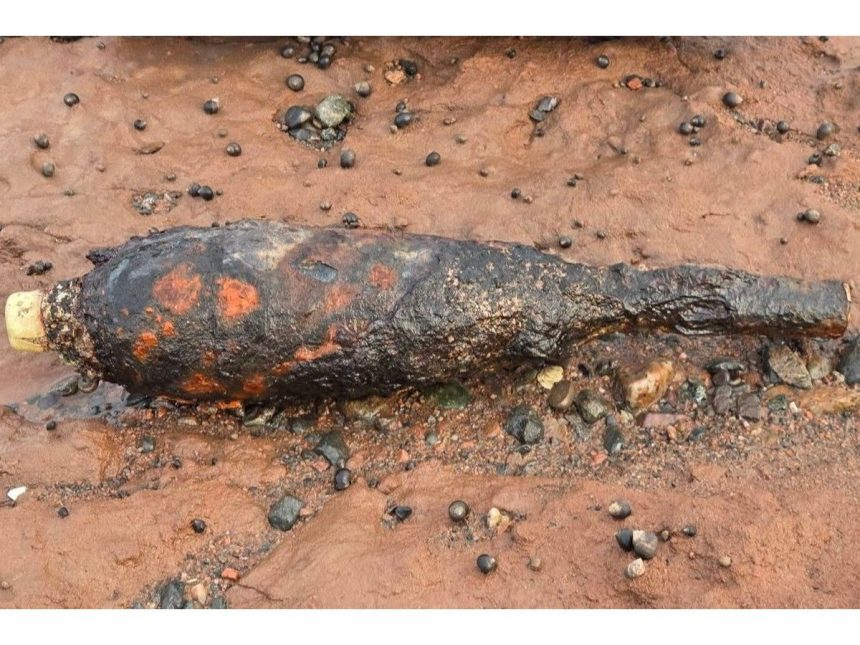
A specialized Canadian Armed Forces unit and Colchester County District RCMP recently removed this two-inch mortar that washed ashore in Portapique. Photo by ContributedArticle contentPORTAPIQUE – A specialized Canadian Armed Forces unit, alongside Colchester County District RCMP, recently removed an old explosive device that washed ashore in Portapique by conducting a controlled explosion.THIS CONTENT IS RESERVED FOR SUBSCRIBERS ONLY.Subscribe now to access this story and more:Unlimited access to the website and appExclusive access to premium content, newsletters and podcastsFull access to the e-Edition app, an electronic replica of the print edition that you can share, download and comment onEnjoy insights and behind-the-scenes analysis from our award-winning journalistsSupport local journalists and the next generation of journalistsSUBSCRIBE TO UNLOCK MORE ARTICLES.Subscribe or sign in to your account to continue your reading experience.Unlimited access to the website and appExclusive access to premium content, newsletters and podcastsFull access to the e-Edition app, an electronic replica of the print edition that you can share, download and comment onEnjoy insights and behind-the-scenes analysis from our award-winning journalistsSupport local journalists and the next generation of journalistsRegister to unlock more articles.Create an account or sign in to continue your reading experience.Access additional stories every monthShare your thoughts and join the conversation in our commenting communityGet email updates from your favourite authorsSign In or Create an AccountorArticle contentThe ordnance, removed on July 15, was identified as a two-inch mortar.Article contentArticle contentLt. Navy Andrew MacLeod, executive officer of Fleet Diving Unit (Atlantic), an operational unit of Maritime Forces Atlantic, explained that a mortar is something that’s shot out of a tube. It becomes active at that time.Article contentArticle content“It fires for a particular distance, usually point detonating so that it’ll explode on impact,” he said, adding that 20 to 30 per cent of ordnance doesn’t actually explode.Article content“That’s the standard percentage. So, it’s not uncommon for us to find historical or even new ordnance that … hasn’t properly functioned.”Article contentThe unit is comprised of about 120 divers and trained support staff. One of its responsibilities is explosive ordnance disposal, which includes items from the First and Second World Wars.Article contentFOUND BY RESIDENTArticle contentA resident originally informed police of the ordnance in Portapique. Police then reported it to the Regional Joint Operations Centre, which informed the diving unit.Article contentMacleod said his team uses various methods to identify what the ordnance might be and assess how to approach the call. This includes looking at pictures, as well as identifying certain features and measurements.Article contentArticle content“There’s a lot of factors that are involved with the decision of whether we can move it and transport it to some place safe to dispose of,” he explained, “or if we feel it’s too dangerous to touch, then we’ll do a demolition on site.”Article contentArticle contentMacleod estimates the controlled explosion in Portapique took less than 40 minutes.Article contentWHERE IT CAME FROMArticle contentIt’s hard to determine where exactly the two-inch mortar came from, said MacLeod, but he indicated it belongs to the Second World War period.Article contentAsked why the ordinance might have washed up on the shore in the first place, MacLeod said there were a number of military sites in Atlantic Canada during the First and Second World Wars.Article content“There’s lots of legacy sites out there around the Atlantic provinces; old runways, ammo depots, training grounds, because a lot of individuals trained before they headed overseas,” he said, “so it’s not uncommon to find these things on the beach or you know, when you’re digging up.”Article contentSome sites are unmarked, he added. If an ordnance gets washed into the water, it can travel quite a distance.Article contentCONTACT POLICEArticle contentShould residents find something that looks like a piece of ordnance, they should contact their local police force, said MacLeod.Article content“Don’t touch it, don’t bring it home. A lot of these explosives are chemicals, basically, and over time, chemicals degrade and can make them unstable,” said MacLeod.Article content“Even though it’s been, obviously, in the ground or in the ocean, picking it up, even drying it out … it can become further sensitive.”Article content
Explosive device washed ashore in Portapique identified as a two-inch mortar