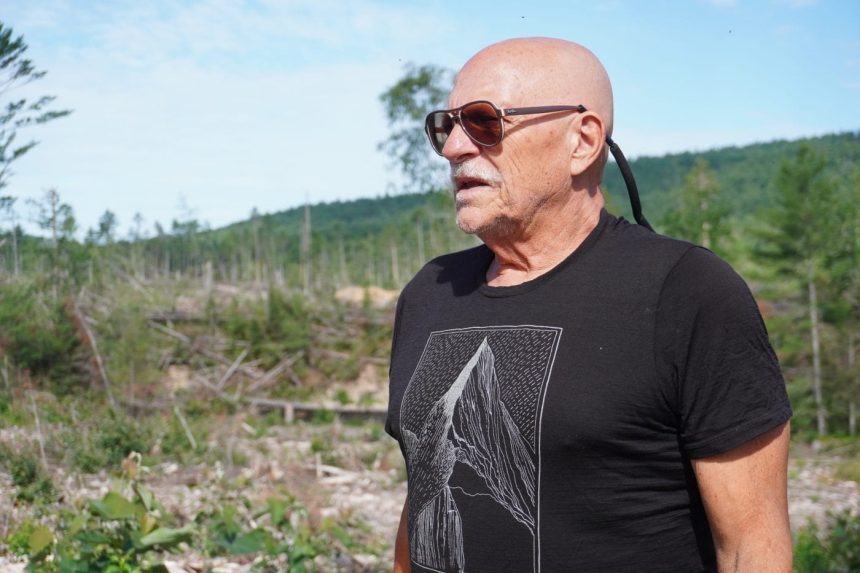
Summary In 2025, a powerful storm crashed down on Samuel de Champlain Provincial Park outside North Bay, Ont., dropping trees on tents, trailers and an environmental education centre. Since then, park staff and Forests Canada have been working to replant some of the trees that were lost and clean up the park to allow visitors in again this season. Extreme weather is becoming more common and severe as the climate warms. At the same time, global warming means the type of trees that will thrive in northern environments like Samuel de Champlain is also changing, and the restoration work has to account for that. Nearly four decades ago, Bill Steer — or Back Roads Bill, as he’s known locally — rode his mountain bike through the trails of Samuel de Champlain Provincial Park, about 50 kilometres east of North Bay, Ont. As he took in the landscape of towering pines and blue lakes, he recalls thinking, “This would be a great place to teach environmental science.” It was here that Steer founded a “classroom without walls” where he and others taught students about environmental stewardship, leadership, ecology and wilderness survival. For years, the set-up worked — until a thunderstorm rattled the camp and the group woke to a big white pine tree fallen near one of their tents. So Steer built walls. Starting with a few cabins, he established what is now the Canadian Ecology Centre in the park. Then, nearly 30 years later, on the summer solstice in 2025, another, much more violent storm changed the game. It devastated the centre’s buildings and the park around it, right as Steer and colleagues headed into the height of their season. Ontario Parks called it “one of the most destructive weather events,” in the park’s history, complete with intense lightning, torrential rain and powerful winds. Some of the most beloved spots in the 2,550-hectare park, the size of more than 4,700 football fields combined, were affected. The hardest-hit areas were the Jingwakoki campground, looking out over Moore Lake, and the area of the Canadian Ecology Centre next to it. Along with rising temperatures and changing rain patterns, northern Ontario is experiencing more frequent and severe storms, floods and wildfires. And research suggests downbursts in particular — like the one that hit Samuel de Champlain in 2025 — are expected to increase in frequency and intensity due to climate change. Photo: Leah Borts-Kuperman / The Narwhal “Everyone thought it was a tornado. … The tree came through the roof,” Steer, now the centre’s general manager, said. The storm turned out to be a downburst, a series of powerful winds that crash down from a thunderstorm and spread outwards. In the park, wind speeds surpassed 100 kilometres per hour. Steer said he expects the park to face more storms and wildfires in the future: “What happened that night was a devastating natural event, based on a changing climate.” Along with rising temperatures and changing rain patterns, northern Ontario is experiencing more frequent and severe weather events like storms, floods and wildfires. And research from the University of Technology Sydney suggests downbursts in particular — like the one that hit Samuel de Champlain — are expected to increase in frequency and intensity due to climate change because of increased amounts of water vapour in the lower atmosphere that feed clouds. During 2025’s summer storm, more than 300 people, trapped in campers and tents, were evacuated in the night. Trees fell on family trailers and sent people to the hospital. But in the morning, a fuller picture of the park’s damage was clear: roads were blocked and flooded, power lines downed and tens of thousands of trees across the park were toppled and snapped, including old-growth pines. A year later, with the centre and parts of the park reopened as of May 2026, park managers are still repairing the damage, and deciding what kind of forest they should help to rebuild. Alongside immediate efforts to restore buildings and roads, thousands of trees are being planted using climate projections to meet a moment where global warming is expected to alter the distribution of tree species in Canada, “adding a level of uncertainty to forest management and planning,” according to the federal government. But from the first moment visitors enter the park, the current scars on the landscape are clear; they see downed trees left on the ground, others cut and piled into logs and areas that were previously lush forest are now razed. “It looks like a clearcut in some areas,” Steer said, explaining that over the last year, some fallen and damaged trees had been removed and chipped in an effort to clean up after the storm. “Everything is back to normal operation-wise, except the landscape has changed.” For decades to come, areas that were dense pine forest will be a meadow, “providing habitat for different species and fostering biodiversity,” according to an Ontario Parks blog post written by Heather Stern, a senior park clerk who has worked at Samuel de Champlain for seven years. Many fallen and damaged trees were removed and chipped in an effort to clean up after the storm. In light of the damage, an Ontario Parks superintendent said that forests “take generations to regrow, and even then, it will be impossible to replicate what we had before.” Photo: Leah Borts-Kuperman / The Narwhal And, though the Ontario government is investing $4.75 million to rebuild and upgrade the provincial park, Stern wrote: “No matter how much time, effort or money is spent, Samuel de Champlain Provincial Park will be forever changed.” Rebuilding a park after disaster strikes Ontario Parks superintendent Warren Verina told The Narwhal in an email that forests “take generations to regrow, and even then, it will be impossible to replicate what we had before.” But, he added, that can be a good thing. “Honestly, I don’t think we want to replicate what was,” Verina said, explaining that the forest hit with the downburst was predominantly red pine. “While this was stunning to walk through, it wasn’t very diverse … This is an opportunity to make the campground better.” Ontario Parks has taken “lessons learned from the downburst,” Verina said, to be better equipped. During the rebuild, for example, hydro lines within the park were buried as part of the repairs, rather than restrung on poles, so the park hopefully experiences fewer power outages from falling trees. As they resurfaced roads in 2026, the new designs included an eco-passage, turtle fencing, artificial nesting sites and escape ramps to protect animal species. Steer is also optimistic. “We’re in a new regreening phase. The park is going to look different in 10, 20, 50 years. I won’t be here, but it will grow back in the way it wants to grow back,” Steer said. At the Canadian Ecology Centre, students learn about environmental stewardship, leadership, ecology and wilderness survival in the forests of Samuel de Champlain. This year, scars on the landscape are clear as soon as they enter the park. Photo: Leah Borts-Kuperman / The Narwhal To encourage this natural regreening, Forests Canada planted 8,000 trees in fall 2025 and spring 2026 through the Ontario government’s species conservation program. Of these, 500 were more established trees including white pine, red maple, red oak, black cherry and bur oak that were grown in nursery pots for up to a few years prior to planting. An additional 7,500 were white and black spruce seedlings. “Those are smaller trees, so you are expected to lose a few, for sure,” Verina told CBC in spring 2026 about the seedlings. But, so far, the weather conditions have co-operated. “The trees are doing pretty well. We were fortunate enough to have a pretty good spring with a lot of moisture, and so that helped with a lot of the growing conditions,” Jessica Kaknevicius, CEO of Forests Canada, said. “You can see the physical impact that it’s having on restoring these areas.” Kaknevicius told The Narwhal the goal of replanting is to help the forest recover faster than it would naturally. How effective it will be isn’t certain. Ze’ev Gedalof, an associate professor at the University of Guelph who studies forest ecosystem dynamics and climate variability, said replanting can be a great method to revitalize a park environment. But that comes with a caveat: biodiversity is difficult to achieve when trying to restore a forest quickly, instead of allowing nature to run its course. “Replanting, you tend to get fairly even-aged and evenly spaced and often pretty homogenous stands that come out of it,” he said. And in most cases, replanting skips the stage where smaller trees, shrubs and plants grow up beneath that bigger tree canopy, called the understory. “You might lose some of that understory as part of your goal to restore the forest overstory.” But another aim of replanting the park is to help prepare today’s forest for the conditions of the future as the climate changes. Replanting a forest with climate change in mind To decide which trees to plant, Kaknevicius said Forests Canada selected species already found in the park, and also tried to predict what species could live in the area in the future. Samuel de Champlain is located in the transitional zone between the Great Lakes-St. Lawrence forest, which has a mix of deciduous and coniferous trees, and the primarily coniferous boreal forest of northern Ontario. But the forest is changing as the climate warms. Forests Canada used computer modelling tools to predict future conditions and from that information, selected seedlings from down south that are used to warmer temperatures. “When you see something grow … and you see forests coming back, I think it gives a sense of hope for people. We hope that we were able to contribute that to Samuel de Champlain,” Kaknevicius said. The dead trees left on the ground in areas not frequented by visitors are “really important habitat structures for all kinds of organisms” living in and under them, said Ze’ev Gedalof, an associate professor at the University of Guelph who studies forest ecosystem dynamics and climate variability. Photo: Leah Borts-Kuperman / The Narwhal But Gedalof said this science of prediction, while promising, is still being perfected. “That kind of climate modelling works,” Gedalof said, but added that it’s a fairly recent science. “We’re talking about trees that can easily live for 100 years, and we try and predict what the climate is going to be like in 100 years. Those data aren’t really there yet. We’re just doing our best guesses.” He said it’s some of the same trees downed in the storm that will actually be some of the most important generators of biodiversity in the years to come. The dead trees left on the ground in areas not frequented by visitors are “really important habitat structures for all kinds of organisms” living in and under them. “They’re also reservoirs of nutrients, and as they’re rotting, they become reservoirs of water that can help lifeboat some of that regenerating plant and animal material,” Gedalof said. It will be a long recovery, but campers experiencing a radically different Samuel de Champlain than they have on trips in years past will see parts of the forest grow back, even if slowly. “Some of those big red pine trees will take 70 or 100 years to get to that kind of magnitude again,” Gedalof said. “But it’ll be a walkable forest within a few decades.”
Rebuilding a northern Ontario forest with climate change in mind