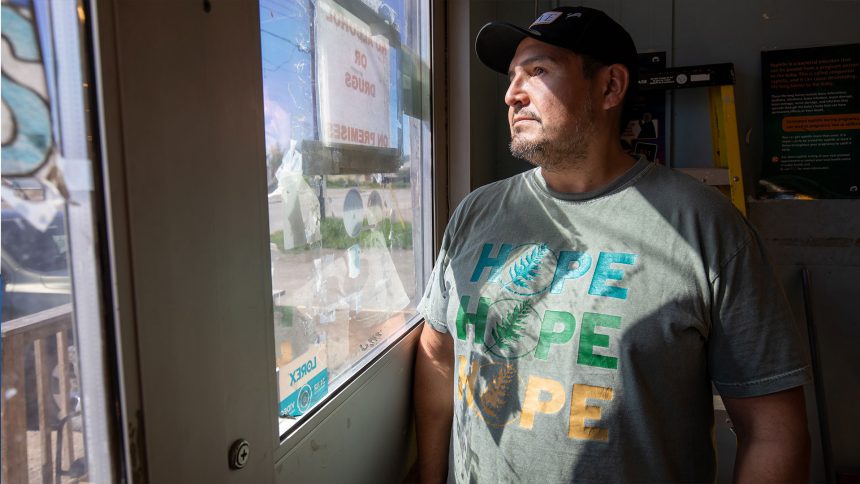
For Jake Laliberte, working at the Fort Simpson warming and homeless shelter is a second chance. He is more than 100 days sober and, for the first time in years, says his life feels stable after battling addiction. Now, he is trying to offer that same support to others. “Every day you wake up and you’re hungover, and you need to drink just not to seize up or feel bad. It’s a vicious, vicious cycle,” he said. The shelter, operated by the Dehcho Society for Wellness and Sustainable Development, is open 24 hours a day and can accommodate up to 12 clients. Staff provide meals and help with everything from replacing government-issued identification to filing taxes, connecting people with addiction supports and checking in on their well-being. “Here is each of their cubbies, and they have sheets over them so they have privacy,” Laliberte said while walking through the shelter. “We always have the regulars, usually about eight or so.” Laliberte was once a client himself. He hopes his recovery can show others that change is possible. “It’s hard seeing our people like that, just withering away, because I grew up with all these guys,” he said. Why the shelter opened The shelter opened nearly four years ago after a group of volunteers recognized a growing need in the Dehcho. Chuck Blyth, president of the Dehcho Society for Wellness and Sustainable Development, said the goal was to stop people from having to leave the community altogether. “If you’ve been to Yellowknife, which you have, of course, you notice there’s lots of homeless people there, and many of them start out here in the Dehcho,” Blyth said. “We thought, this is kind of the first step. If we could get people without homes a place to stay here, they wouldn’t end up in Yellowknife and never come back.” Staff say the work extends well beyond providing a bed for the night. Building trust often comes first, followed by helping people access treatment, replace identification, file taxes or reconnect with family when they are ready. Blyth said homelessness rarely has a single cause. “Every person, when you talk to people, it’s always, ‘Oh, it’s because of this, that, the next thing,’” he said. “But actually, it turns out every single person has a completely different story as to why they’re homeless. I went to a conference this year and found out that a lot of it starts with losing someone in your family. That’s like the trigger that gets this whole thing started, losing a family member.” “You can direct somebody someplace or make them take a program of treatment or X, Y or Z, but if they don’t want to do it, you’re wasting your time,” Blyth said. “A lot of it is getting to know the person and convincing them that this is the best thing for their life.” Jake Laliberte is grateful to give back to Fort Simpson’s warming and homeless shelter, a space he relied on as a client. Photo: Charlotte Morritt-Jacobs/APTN. Recovery rooted in community Laliberte’s recovery began through an on-the-land program run by the Łı́ı́dlı̨ı̨ Kų́ę́ First Nation. “I got out of town, and there was no booze around, so I just shook. It was a little bit at first, but you do active stuff, sweat it out, and you feel a lot better,” he said. Now he hopes others can find the same opportunity. Laliberte said many of the needs are practical. One of the biggest is having somewhere safe to store belongings. “It’s, like, a big thing,” he said. “Especially when they’re coming, like, getting kicked out from wherever they were staying before and they have all this work here that they just don’t know where to put, right?” He said many of the men staying at the shelter have years of experience working on the land. “All of them are bushmen,” he said. “They worked firefighting before and they know a lot of stuff.” The society has begun offering land-based activities, including morel mushroom foraging, and hopes to expand its addictions programming. With most of the clients being from the dehcho region of the N.W.T. Laliberte told APTN most feel more like brothers than clients. Photo: Charlotte Morritt-Jacobs/APTN. A building that no longer meets the need The shelter operates out of a former retail space that was never designed for the work taking place inside. The building has warped, sloping floors and water damage has left visible mould in a back room. New cabinets and a sink remain boxed up waiting to be installed, while one bathroom sink is unusable. Blyth said homelessness in Fort Simpson cannot be solved simply by building more houses. “Our population is actually declining in Fort Simpson,” he said. “We’re building new houses every year. So somewhere there, two things have to intersect. We should have lots of houses. But it still means people are homeless, because it really isn’t about the house. If we built 10 brand new houses and said, ‘Here you go, guys,’ that wouldn’t happen. There’s reasons why people are not in a home, addictions and other things, until that’s dealt with.” Architectural plans for a new facility have already been completed. Inspired by a shelter in Dawson City, Yukon, Blyth said the proposed building would include 10 emergency shelter beds on the main floor and 10 transitional housing units above, allowing people to move toward permanent housing without leaving behind the supports they have built. “That’s why the next stage is transitional housing, and there’s a lack of that in town. ” Blyth said. “Blueprints are done and it’s ready to go, now we just need to find somebody to fund it.” Blyth said the organization has secured multi-year operational funding from the Government of the Northwest Territories, giving staff greater stability. Blyth said returning from treatment to the same environment remains one of the biggest barriers to recovery. “You need to come back into a new situation,” he said. “Otherwise, the things that triggered and that helped facilitate or enable the issue you had are still there. So you need to find a way to save your life on a different course when you get back. It’s where you live, who your friends are, all that kind of stuff.” Chuck Blyth, president of the Dehcho Society for Wellness and Sustainable Development, is working on securing funding to build a multipurpose shelter and transitional housing space to replace the current shelter. Photo: Charlotte Morritt Jacobs/APTN. A challenge shared across the North Fort Simpson is a town of 1,300 located about 630 kilometres west of Yellowknife. Research has found many of the same challenges identified in Fort Simpson exist in Indigenous communities across the North. A 2024 study published in Housing Policy Debate found Indigenous people are disproportionately represented among those experiencing homelessness in Canada, with the crisis particularly severe in the Northwest Territories. Researchers Sandeep K. Agrawal and Celine Zoe concluded territorial housing policies have not kept pace with the realities of remote Indigenous communities. They identified the lasting impacts of colonialism, housing shortages, geographic isolation and inadequate policy responses as key contributing factors. A separate 2026 study commissioned by the Tłı̨chǫ Government proposed new approaches to temporary shelter in remote Indigenous communities based on interviews with government officials and frontline service providers. The studies point to broad policy challenges, while Fort Simpson’s shelter represents one community’s effort to respond to those realities. For Laliberte, the work comes back to making sure people have somewhere to turn. He understands why some people judge those staying at the shelter, but wishes they could see beyond addiction. “People don’t think much of them just because they drink,” he said. “And that’s not a bad thing. We all go through it.” Then he pauses. “We’re not horrible people,” he said. “Not at all.” Continue Reading
Former shelter client now helps others rebuild their lives in Fort Simpson, N.W.T.


Leave a Comment