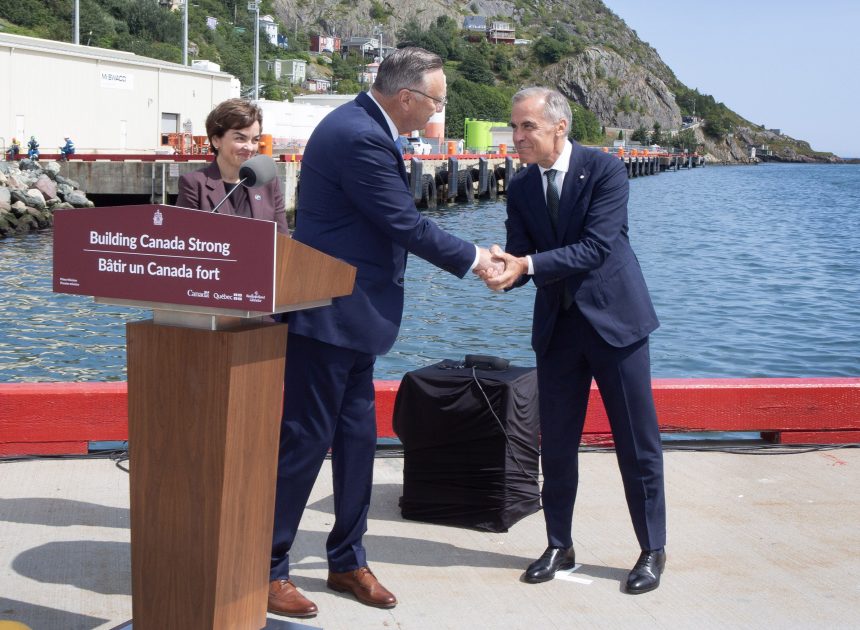
Innu Nations in Quebec say they’re opposed to a non-binding agreement between Quebec, Newfoundland and Labrador and the federal government to expand the Churchill Falls hydro electric project. In a statement, the leaders argued the project affects their ancestral territories, regardless of contemporary borders, and could not go ahead without their participation and consent. On Monday, Prime Minister Mark Carney joined Quebec Premier Christine Fréchette and Newfoundland and Labrador Premier Tony Wakeham in St. John’s to announce an agreement-in-principal over the controversial Churchill Falls project. But the band councils of Uashat mak Mani-Utenam, located adjacent the community of Sept-Îles on the north shore of the St-Lawrence, and Matimekush–Lac John, located near Schefferville in northern Quebec by the border of Labrador, released a joint statement in response to the announcement of the framework deal. “The Churchill Falls Megaproject was built and is being operated illegally in Nitassinan, the traditional territory of the Innu of Matimekush–Lac John and Uashat mak Mani-utenam,” the press release argues. With $10-billion in federal funding to update and expand existing Churchill Falls power generation infrastructure on the Churchill River in Labrador, the project is now slated to have $70-billion in combined funding, making it what the prime minister said was the largest clean-energy investment in North America. The framework deal will be in place until 2027, and will depend upon the results of Quebec’s coming Oct. 5 election. Speaking at the announcement, Carney said the developments to the Churchill Falls project would allow it to produce 14,000 MW of power, which he said was “more than the entire generating capacity of BC hydro, [and] more than double the output of Bruce Power, the largest nuclear plant on this continent. It is the equivalent of 18 Hoover Dams.” The completed project will transmit as much as 985 MW to U.S. markets through Quebec. Hydro-Québec promised Churchill Falls would make electricity available to Quebec at six cents per kilowatt hour, a price Hydro-Québec said was “one third of other alternatives.” The Churchill Falls project has long been controversial. A 1969 deal determined that Newfoundland and Labrador would sell electricity from the project to Quebec at a low price, which Quebec was able to sell for an increasing profit over the years. That deal was locked in for 40 years, and gradually raised the ire of many in Newfoundland and Labrador, who felt Quebec was profiting from their own resources. The project has been equally controversial among Innu, who lost 6,500 square kilometres of ancestral land to flooding when the Upper Churchill River was dammed in the early 1970s. In October 2025, too few Innu Nation members chose to vote for or against the “Tsheuatishiun Agreement,” which was also called the “Reconciliation and Collaboration Agreement.” Under that deal, Hydro-Québec would have paid out $87-million, plus three per cent of dividends, to the Innu Nation. Fewer than 50 per cent of eligible voters cast a ballot, however. An attempt to revive the Tsheuatishiun Agreement in June 2026 was postponed due to a community tragedy. “Any agreement regarding projects on our territory, the Nitassinan, requires our participation and consent,” said Chief Pako Vachon of Matimekush–Lac John. “The mistakes of the past must not be repeated. It is high time that our ancestral rights and our title to this territory be recognized and respected.” Chief Jonathan Shetush of Uashat mak Mani-Utenam added, “The Innu continue to fight in court to ensure that any development in Nitassinan is carried out with respect for our rights, which includes any additions to the Churchill Falls project or any renewal of the power purchase agreement for electricity from Churchill Falls.” In its announcement of the agreement, Hydro-Québec said it was “committed to continuing the dialogue initiated in 2024 with Indigenous and local communities in Québec and Labrador in order to support their active participation in the planning and implementation of the projects.” Read more: Fast-tracking to a reconciliation breakdown: Ottawa’s resource rush is straining First Nations relations Hydro Quebec’s Churchill Falls subject of $4B lawsuit filed by Innu of Labrador The government of Newfoundland and Labrador said it would give priority to Labrador Innu in hiring for the project. Its press release noted, “in keeping with the principles of reconciliation and the recommendations of the [TRC], the Government of Newfoundland and Labrador has begun conversations with representatives of the Innu Nation about opportunities for the Innu to engage as full partners in developments related to the agreement.” The federal government did not mention Indigenous people in its announcement about Churchill Falls, but added that the “Labrador Trough is a world-class mining-region […] with significant access to high-purity ore” and announced Ottawa was referring the Labrador Trough Clean Power, Critical Minerals and Infrastructure Corridor to the Major Projects Office, which it said would “work with Indigenous Peoples to forge meaningful partnerships.” The leaderships of Matimekush–Lac John and Uashat mak Mani-utenam reiterated they are suing both Hydro-Québec and Churchill Falls Corporation Limited regarding the Churchill Falls project. “In November 2025,” the press release says, “they secured a significant ruling recognizing that they may continue their legal action in Quebec to seek redress regarding a project on their Nitassinan, the inseparable components of which are located on either side of a colonial border. This ruling is currently under appeal.” APTN News contacted Labrador Innu leadership, but did not hear back. Continue Reading
Innu in Quebec reject Churchill Falls deal between Quebec, Newfoundland and Labrador



Leave a Comment